0/3 points details my notes scalcet9 11.11.022. consider the following function. f(x) = sinh(2x), a = 0, n =…
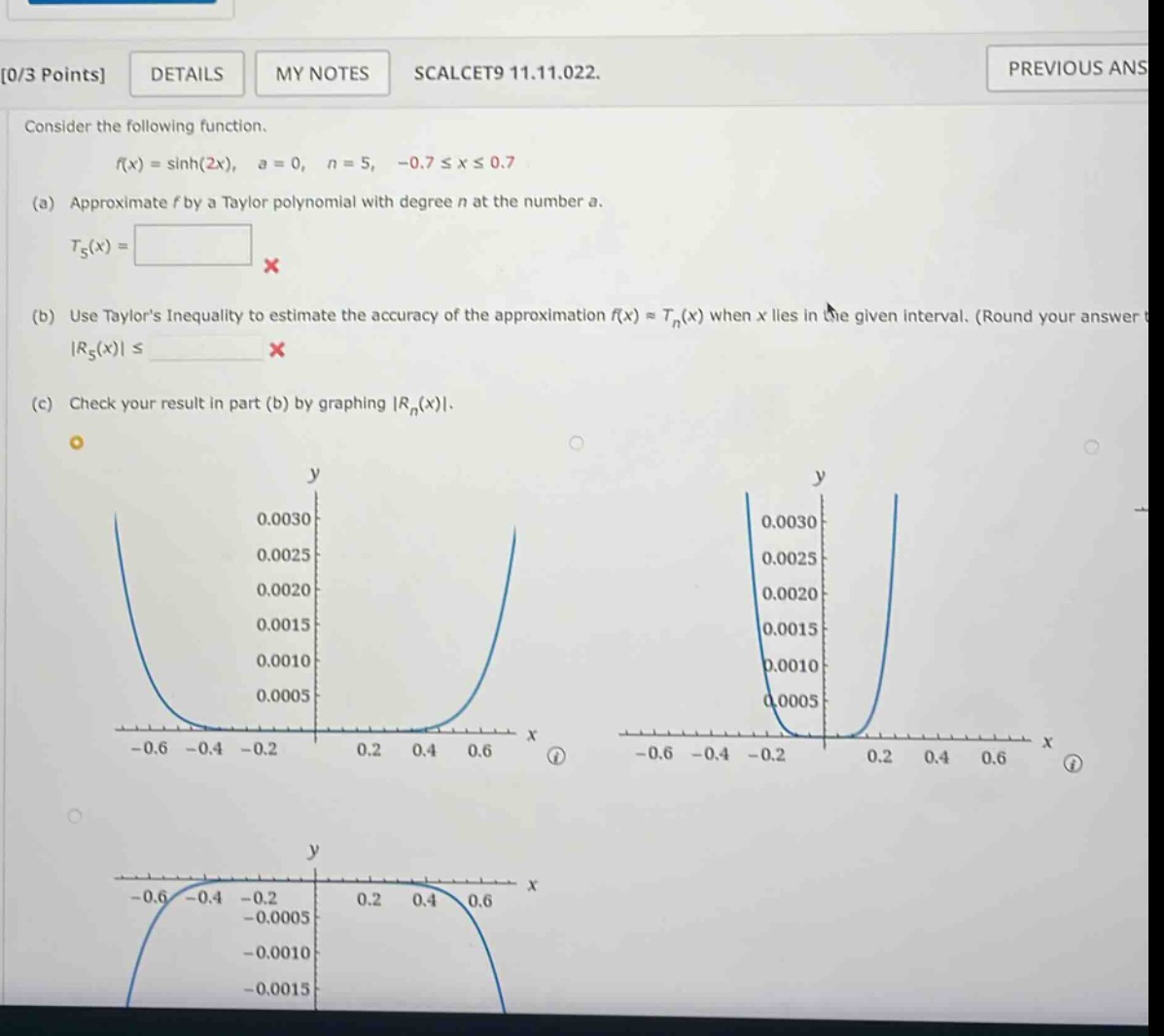
0/3 points details my notes scalcet9 11.11.022. consider the following function. f(x) = sinh(2x), a = 0, n = 5, -0.7 ≤ x ≤ 0.7 (a) approximate f by a taylor polynomial with degree n at the number a. t5(x) = x (b) use taylors inequality to estimate the accuracy of the approximation f(x) ≈ tn(x) when x lies in the given interval. (round your answer to |r5(x)| ≤ x (c) check your result in part (b) by graphing |rn(x)|.
Answer
Explanation:
Step1: Recall Taylor - series formula
The Taylor series of a function (f(x)) about (x = a) is given by (T_n(x)=\sum_{k = 0}^{n}\frac{f^{(k)}(a)}{k!}(x - a)^k), where (f^{(k)}(x)) is the (k) - th derivative of (f(x)). First, find the derivatives of (y = f(x)=\sinh(2x)). The derivative of (\sinh(u)) with respect to (u) is (\cosh(u)), and by the chain - rule, (f^{\prime}(x)=2\cosh(2x)), (f^{\prime\prime}(x)=4\sinh(2x)), (f^{(3)}(x)=8\cosh(2x)), (f^{(4)}(x)=16\sinh(2x)), (f^{(5)}(x)=32\cosh(2x)). Evaluate at (a = 0): (f(0)=\sinh(0)=0), (f^{\prime}(0)=2\cosh(0)=2), (f^{\prime\prime}(0)=4\sinh(0)=0), (f^{(3)}(0)=8\cosh(0)=8), (f^{(4)}(0)=16\sinh(0)=0), (f^{(5)}(0)=32\cosh(0)=32).
Step2: Calculate (T_5(x))
[ \begin{align*} T_5(x)&=\frac{f(0)}{0!}(x - 0)^0+\frac{f^{\prime}(0)}{1!}(x - 0)^1+\frac{f^{\prime\prime}(0)}{2!}(x - 0)^2+\frac{f^{(3)}(0)}{3!}(x - 0)^3+\frac{f^{(4)}(0)}{4!}(x - 0)^4+\frac{f^{(5)}(0)}{5!}(x - 0)^5\ &=0 + 2x+0+\frac{8}{6}x^3+0+\frac{32}{120}x^5\ &=2x+\frac{4}{3}x^3+\frac{4}{15}x^5 \end{align*} ]
Step3: Recall Taylor's Inequality
Taylor's Inequality states that (|R_n(x)|\leq\frac{M}{(n + 1)!}|x - a|^{n+1}), where (M) is an upper - bound for (|f^{(n + 1)}(t)|) on the interval between (a) and (x). For (n = 5), (f^{(6)}(x)=64\sinh(2x)). On the interval (-0.7\leq x\leq0.7), the maximum value of (|f^{(6)}(x)|) occurs at (x=\pm0.7). (|f^{(6)}(x)| = |64\sinh(2x)|), and (\sinh(2x)=\frac{e^{2x}-e^{-2x}}{2}). When (x = 0.7), (\sinh(1.4)=\frac{e^{1.4}-e^{-1.4}}{2}\approx\frac{4.0552 - 0.2466}{2}\approx1.9043). So (M = 64\times\sinh(1.4)\approx64\times1.9043 = 121.8752).
Step4: Calculate the error bound
[ \begin{align*} |R_5(x)|&\leq\frac{M}{(5 + 1)!}|x - 0|^{6}\ &\leq\frac{121.8752}{720}|x|^{6} \end{align*} ] On the interval (-0.7\leq x\leq0.7), when (|x| = 0.7), (|R_5(x)|\leq\frac{121.8752}{720}\times(0.7)^6\approx\frac{121.8752}{720}\times0.117649\approx0.0198 ]
Answer:
(a) (T_5(x)=2x+\frac{4}{3}x^3+\frac{4}{15}x^5) (b) (|R_5(x)|\leq0.0198) (c) The graph of (|R_5(x)|) should show values less than or equal to the estimated error bound of (0.0198) on the interval (-0.7\leq x\leq0.7). The first graph (with (y) - values ranging from (0) to (0.0030)) is likely the correct graph of (|R_5(x)|) as it is consistent with the error - bound calculation.