5. -/1 points details my notes tanapcalc10 4.2.042.ep. consider the following function. g(x) = x / (2 + x^2)…
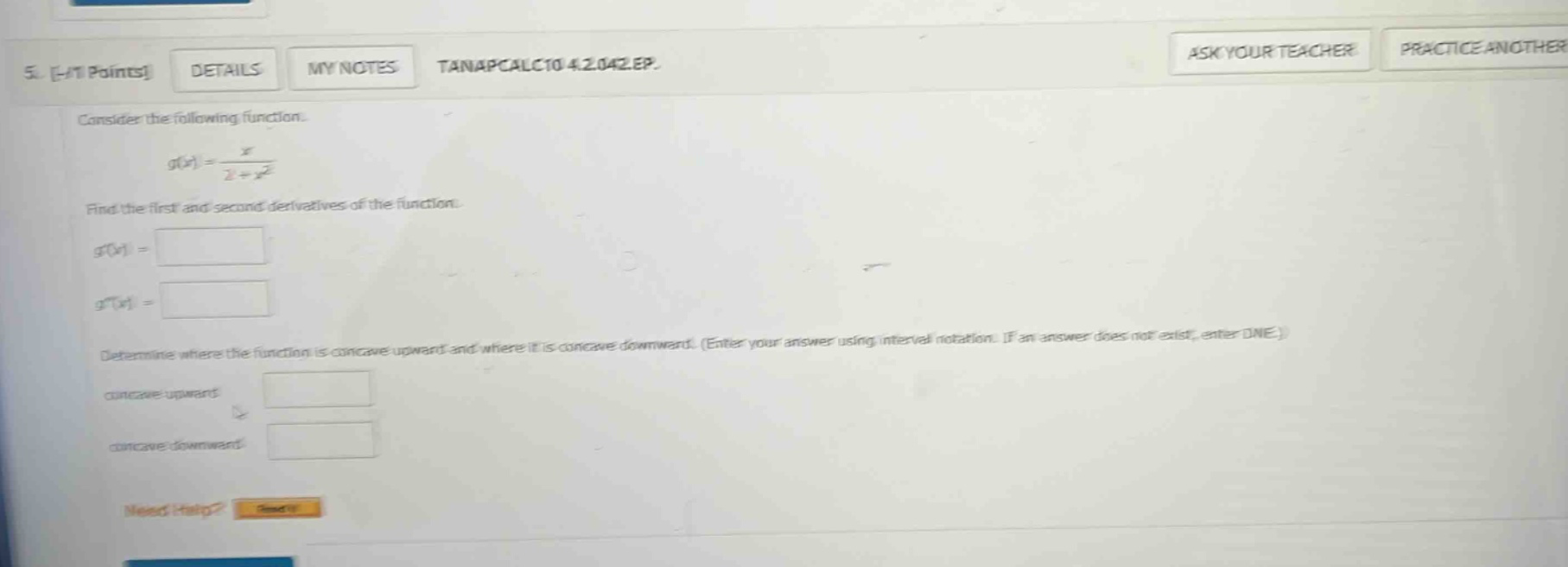
5. -/1 points details my notes tanapcalc10 4.2.042.ep. consider the following function. g(x) = x / (2 + x^2) find the first and second derivatives of the function. g(x) = g(x) = determine where the function is concave upward and where it is concave downward. (enter your answer using interval notation. if an answer does not exist, enter dne.) concave upward concave downward
Answer
Explanation:
Step1: Find the first - derivative using quotient rule
The quotient rule states that if $y=\frac{u}{v}$, then $y^\prime=\frac{u^\prime v - uv^\prime}{v^{2}}$. For $g(x)=\frac{x}{2 + x^{2}}$, where $u = x$, $u^\prime=1$, $v = 2 + x^{2}$, and $v^\prime = 2x$. Then $g^\prime(x)=\frac{1\cdot(2 + x^{2})-x\cdot(2x)}{(2 + x^{2})^{2}}=\frac{2 + x^{2}-2x^{2}}{(2 + x^{2})^{2}}=\frac{2 - x^{2}}{(2 + x^{2})^{2}}$.
Step2: Find the second - derivative using quotient rule
Let $u = 2 - x^{2}$, $u^\prime=-2x$, $v=(2 + x^{2})^{2}$, and $v^\prime = 2(2 + x^{2})\cdot2x=4x(2 + x^{2})$. Then $g^{\prime\prime}(x)=\frac{-2x\cdot(2 + x^{2})^{2}-(2 - x^{2})\cdot4x(2 + x^{2})}{(2 + x^{2})^{4}}=\frac{-2x(2 + x^{2})[(2 + x^{2})+2(2 - x^{2})]}{(2 + x^{2})^{4}}=\frac{-2x(2 + x^{2})(2 + x^{2}+4 - 2x^{2})}{(2 + x^{2})^{4}}=\frac{-2x(6 - x^{2})}{(2 + x^{2})^{3}}$.
Step3: Find intervals of concavity
Set $g^{\prime\prime}(x)=0$. Then $-2x(6 - x^{2})=0$, which gives $x = 0$, $x=\sqrt{6}$, and $x =-\sqrt{6}$. Test the intervals: For $x<-\sqrt{6}$, let $x=-3$. Then $g^{\prime\prime}(-3)=\frac{-2(-3)(6 - 9)}{(2 + 9)^{3}}=\frac{6\times(-3)}{11^{3}}<0$. For $-\sqrt{6}<x<0$, let $x=-1$. Then $g^{\prime\prime}(-1)=\frac{-2(-1)(6 - 1)}{(2 + 1)^{3}}=\frac{2\times5}{27}>0$. For $0<x<\sqrt{6}$, let $x = 1$. Then $g^{\prime\prime}(1)=\frac{-2\times1\times(6 - 1)}{(2 + 1)^{3}}=\frac{-10}{27}<0$. For $x>\sqrt{6}$, let $x = 3$. Then $g^{\prime\prime}(3)=\frac{-2\times3\times(6 - 9)}{(2+9)^{3}}=\frac{-6\times(-3)}{11^{3}}>0$.
Answer:
$g^\prime(x)=\frac{2 - x^{2}}{(2 + x^{2})^{2}}$ $g^{\prime\prime}(x)=\frac{-2x(6 - x^{2})}{(2 + x^{2})^{3}}$ concave upward: $(-\sqrt{6},0)\cup(\sqrt{6},\infty)$ concave downward: $(-\infty,-\sqrt{6})\cup(0,\sqrt{6})$