1. (a) (4 points) determine whether the series ∑k = 1∞ k / (k² + 2) converges or diverges. (b) (5 points)…
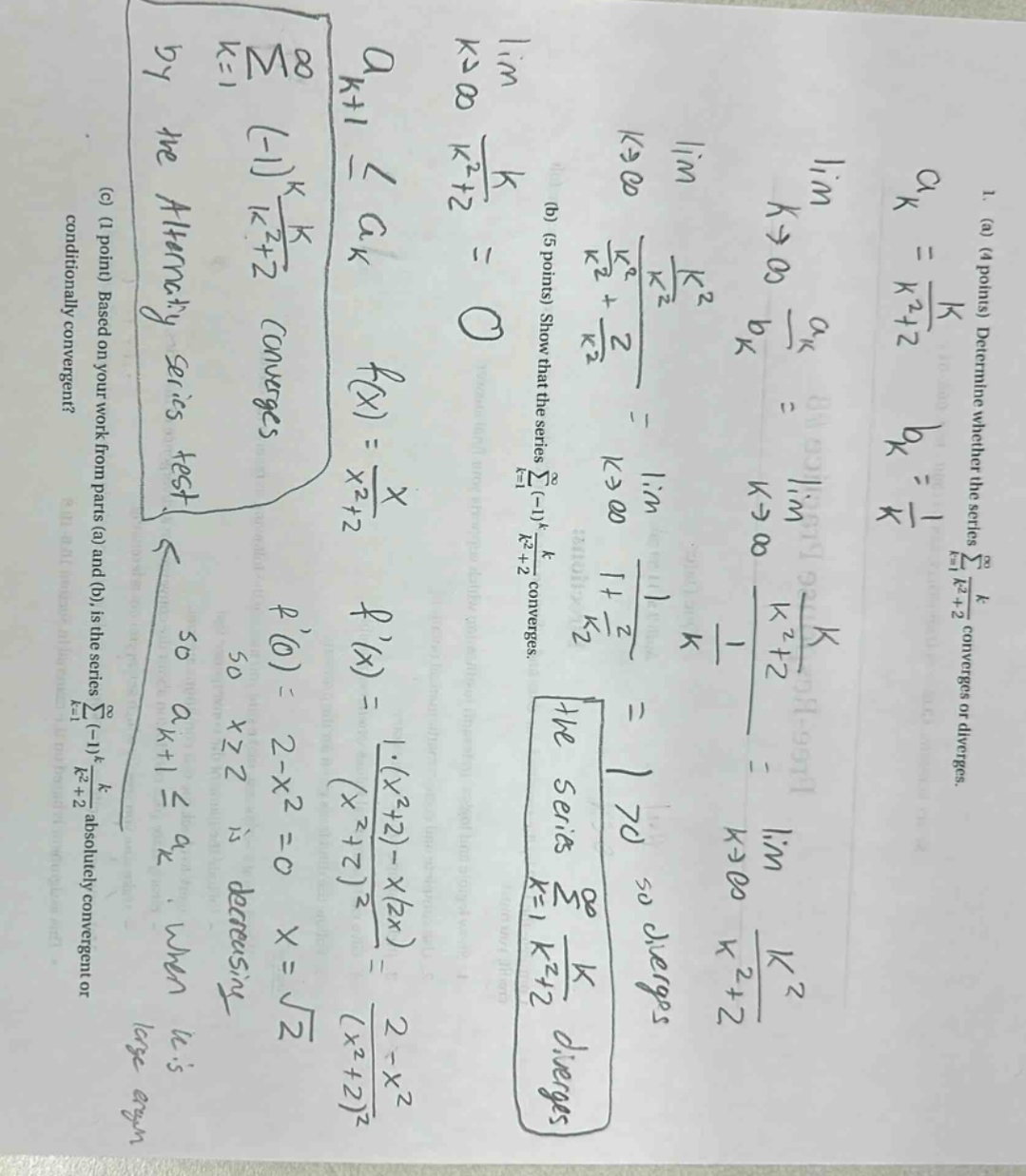
1. (a) (4 points) determine whether the series ∑k = 1∞ k / (k² + 2) converges or diverges. (b) (5 points) show that the series ∑k = 1∞ (-1)ᵏ k / (k² + 2) converges. (c) (1 point) based on your work from parts (a) and (b), is the series ∑k = 1∞ (-1)ᵏ k / (k² + 2) absolutely convergent or conditionally convergent? lim k→∞ k / (k² + 2) = 0 f(x) = x / (x² + 2) f(x) = (1·(x² + 2) - x(2x)) / (x² + 2)² = (2 - x²) / (x² + 2)² f(0) = 2 - x² = 0 x = √2 x² + 2 is decreasing so aₖ₊₁ ≤ aₖ when it is large the series ∑k = 1∞ k / (k² + 2) diverges lim k→∞ aₖ / bₖ = lim k→∞ (k / (k² + 2)) / (1 / k) = lim k→∞ k² / (k² + 2) = 1 lim k→∞ 1 + 2 / k² = 1
Answer
Explanation:
Step1: Check for absolute - convergence
We first consider the series of absolute values $\sum_{k = 1}^{\infty}\left|\frac{(- 1)^{k}k}{k^{2}+2}\right|=\sum_{k = 1}^{\infty}\frac{k}{k^{2}+2}$. Use the limit - comparison test. Compare with the series $\sum_{k = 1}^{\infty}\frac{1}{k}$. Calculate $\lim_{k\rightarrow\infty}\frac{\frac{k}{k^{2}+2}}{\frac{1}{k}}=\lim_{k\rightarrow\infty}\frac{k^{2}}{k^{2}+2}$. [ \begin{align*} \lim_{k\rightarrow\infty}\frac{k^{2}}{k^{2}+2}&=\lim_{k\rightarrow\infty}\frac{1}{1 + \frac{2}{k^{2}}}\ &=1 \end{align*} ] Since $\sum_{k = 1}^{\infty}\frac{1}{k}$ is a harmonic series (divergent) and the limit is a positive finite number, $\sum_{k = 1}^{\infty}\frac{k}{k^{2}+2}$ diverges. So the series is not absolutely convergent.
Step2: Check for conditional - convergence using the Alternating Series Test
Let $a_{k}=\frac{k}{k^{2}+2}$. First, find $\lim_{k\rightarrow\infty}a_{k}$. [ \begin{align*} \lim_{k\rightarrow\infty}a_{k}&=\lim_{k\rightarrow\infty}\frac{k}{k^{2}+2}\ &=\lim_{k\rightarrow\infty}\frac{\frac{k}{k^{2}}}{\frac{k^{2}}{k^{2}}+\frac{2}{k^{2}}}\ &=\lim_{k\rightarrow\infty}\frac{\frac{1}{k}}{1+\frac{2}{k^{2}}}\ & = 0 \end{align*} ] Next, find the derivative of the function $f(x)=\frac{x}{x^{2}+2}$ using the quotient rule. If $f(x)=\frac{u}{v}$ where $u = x$ and $v=x^{2}+2$, then $f^\prime(x)=\frac{u^\prime v - uv^\prime}{v^{2}}=\frac{(x^{2}+2)-x(2x)}{(x^{2}+2)^{2}}=\frac{2 - x^{2}}{(x^{2}+2)^{2}}$. For $x\geq\sqrt{2}$, $f^\prime(x)\leq0$, so the sequence $a_{k}$ is decreasing for $k\geq2$. By the Alternating Series Test, $\sum_{k = 1}^{\infty}\frac{(-1)^{k}k}{k^{2}+2}$ converges.
Answer:
The series $\sum_{k = 1}^{\infty}\frac{(-1)^{k}k}{k^{2}+2}$ is conditionally convergent.