4. (4 points) graph $f(x)=\\sqrt3{x - 2}+3$.
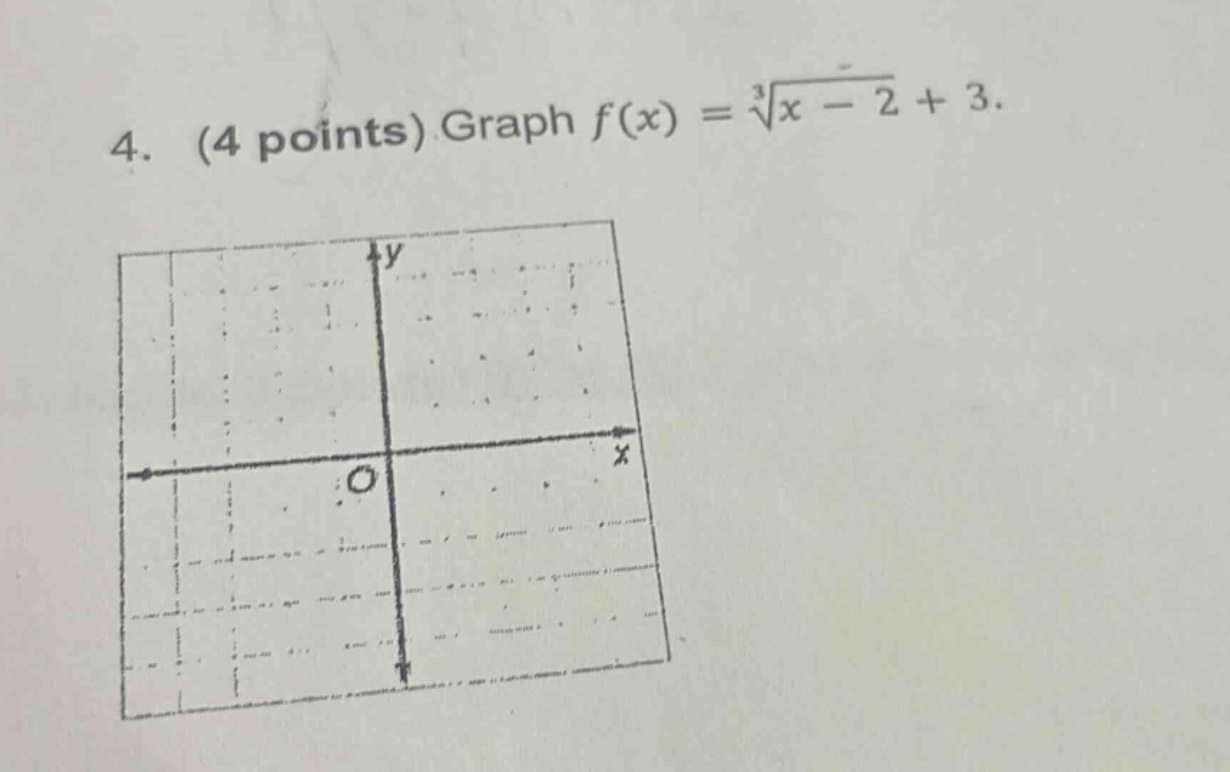
4. (4 points) graph $f(x)=\\sqrt3{x - 2}+3$.
Answer
Explanation:
Step1: Identify the parent function
The parent function of (y = \sqrt[3]{x-2}+3) is (y=\sqrt[3]{x}). The graph of (y = \sqrt[3]{x}) has the following key points: when (x = 0), (y=0); when (x = 1), (y = 1); when (x=-1), (y=-1).
Step2: Apply the horizontal translation
For the function (y=\sqrt[3]{x - h}+k), a horizontal translation is given by the rule. For (y=\sqrt[3]{x-2}+3), compared to (y=\sqrt[3]{x}), we have (h = 2). The horizontal translation rule is (x\to x - h). So the graph of (y=\sqrt[3]{x}) is shifted 2 units to the right. The key - point ((x,y)) of (y=\sqrt[3]{x}) is transformed to ((x + 2,y)) for (y=\sqrt[3]{x-2}). For example, the point ((0,0)) of (y=\sqrt[3]{x}) is transformed to ((2,0)) for (y=\sqrt[3]{x - 2}).
Step3: Apply the vertical translation
We have (k = 3) in (y=\sqrt[3]{x-2}+3). The vertical translation rule is (y\to y + k). So the graph of (y=\sqrt[3]{x-2}) is shifted 3 units up. The key - point ((x,y)) of (y=\sqrt[3]{x-2}) is transformed to ((x,y + 3)) for (y=\sqrt[3]{x-2}+3). The point ((2,0)) of (y=\sqrt[3]{x-2}) is transformed to ((2,3)) for (y=\sqrt[3]{x-2}+3). Another example: for (y=\sqrt[3]{x}), when (x=1,y = 1). For (y=\sqrt[3]{x-2}+3), when (x=3,y=\sqrt[3]{3 - 2}+3=1 + 3=4); when (x=-1,y=\sqrt[3]{-1-2}+3=\sqrt[3]{-3}+3\approx - 1.44+3 = 1.56)
To graph (y=\sqrt[3]{x-2}+3):
- Plot the key point ((2,3)) (obtained from transforming ((0,0)) of (y = \sqrt[3]{x})).
- Use the shape of the cube - root function (it has a similar S - like shape, symmetric about the point of inflection). The domain of (y=\sqrt[3]{x-2}+3) is ((-\infty,\infty)) and the range is ((-\infty,\infty)) since the cube - root function (y=\sqrt[3]{u}) has domain and range ((-\infty,\infty)) and translations do not change the domain and range of the cube - root function.
Answer:
Graph the function (y = \sqrt[3]{x-2}+3) by shifting the graph of (y=\sqrt[3]{x}) 2 units to the right and 3 units up, with key point ((2,3)) and using the characteristic S - shaped curve of the cube - root function.