the polar function r = f(θ), where f(θ) = 1 - 2 cos(-θ), is graphed in the polar coordinate system. as θ…
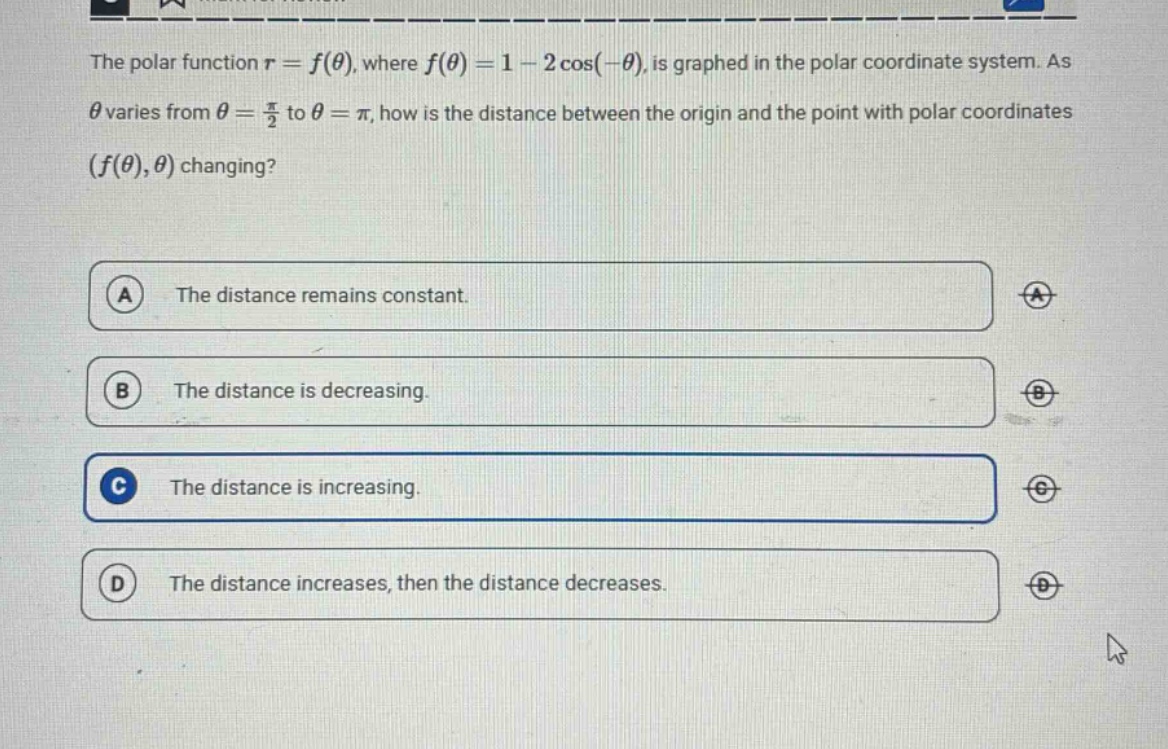
the polar function r = f(θ), where f(θ) = 1 - 2 cos(-θ), is graphed in the polar coordinate system. as θ varies from θ = π/2 to θ = π, how is the distance between the origin and the point with polar coordinates (f(θ),θ) changing? a the distance remains constant. b the distance is decreasing. c the distance is increasing. d the distance increases, then the distance decreases.
Answer
Explanation:
Step1: Recall the property of cosine function
We know that $\cos(-\theta)=\cos\theta$, so $f(\theta)=1 - 2\cos\theta$.
Step2: Analyze the behavior of $\cos\theta$ in the given interval
When $\theta\in[\frac{\pi}{2},\pi]$, the function $y = \cos\theta$ is decreasing. As $\theta$ increases from $\frac{\pi}{2}$ to $\pi$, $\cos\theta$ decreases from $0$ to $- 1$.
Step3: Analyze the behavior of $f(\theta)$
Let $y = f(\theta)=1 - 2\cos\theta$. When $\cos\theta$ decreases, $-2\cos\theta$ increases. Then $1-2\cos\theta$ also increases. Since in polar - coordinates, the distance from the origin to the point $(r,\theta)$ is $r = f(\theta)$, as $\theta$ varies from $\frac{\pi}{2}$ to $\pi$, the distance $r=f(\theta)$ is increasing.
Answer:
C. The distance is increasing.