a polar function is given by r = f(θ) = 3 sin(5πθ) - 6. as θ increases on the interval 0 < θ < 1/10, which…
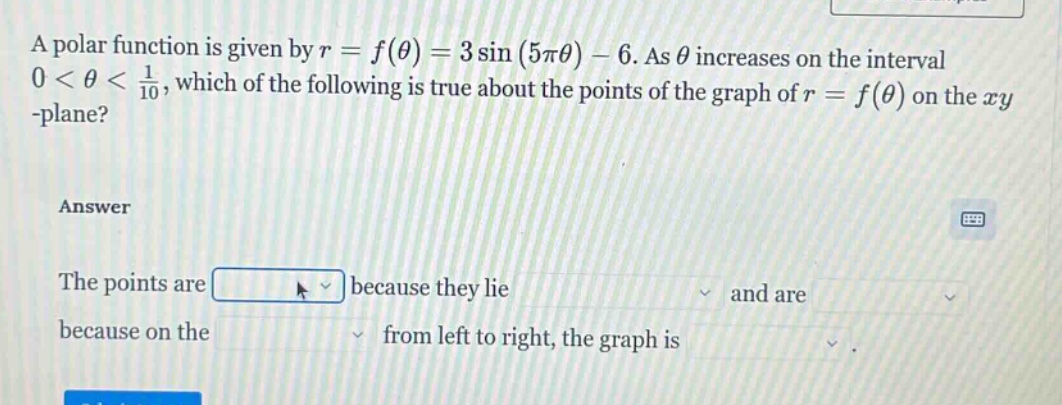
a polar function is given by r = f(θ) = 3 sin(5πθ) - 6. as θ increases on the interval 0 < θ < 1/10, which of the following is true about the points of the graph of r = f(θ) on the xy -plane? answer the points are because they lie and are because on the from left to right, the graph is
Answer
Explanation:
Step1: Analyze the range of $\theta$
Given $0 < \theta<\frac{1}{10}$. Then for the argument of the sine - function $u = 5\pi\theta$, when $\theta = 0$, $u = 0$; when $\theta=\frac{1}{10}$, $u=\frac{\pi}{2}$.
Step2: Analyze the range of $r$
We know that $r = 3\sin(5\pi\theta)-6$. Since the range of $\sin(5\pi\theta)$ for $0 < \theta<\frac{1}{10}$ is $0<\sin(5\pi\theta)<1$. Then $r=3\sin(5\pi\theta)-6$. Multiply the inequality for $\sin(5\pi\theta)$ by 3: $0 < 3\sin(5\pi\theta)<3$. Subtract 6 from all parts of the inequality: $- 6<3\sin(5\pi\theta)-6<-3$, so $r<0$.
Step3: Understand the meaning of $r < 0$ in polar - coordinates
In polar coordinates, when $r < 0$, the point $(r,\theta)$ is equivalent to the point $(-r,\theta+\pi)$. Geometrically, when $r < 0$, the points are in the opposite direction of the terminal side of the angle $\theta$.
Answer:
The points are in the opposite direction of the terminal - side of the angle $\theta$ because they lie in the region where $r<0$ and are moving in a certain way (not fully specified in the problem - setup) because on the interval $0 < \theta<\frac{1}{10}$, from left to right, the graph is changing according to the behavior of the sine - function (increasing as $\sin(5\pi\theta)$ increases from 0 to 1 in this interval while $r$ is still negative). In a more general sense, we can say: The points are in the opposite direction of the terminal side of the angle $\theta$ because they lie in the region where $r < 0$ and are moving as the value of $r$ is increasing (since $\sin(5\pi\theta)$ is increasing on $0 < \theta<\frac{1}{10}$) from left to right, the graph is rising (in the sense of the value of $r$ getting less negative).