a polar function is given by r = f(θ) = 3 sin(2θ) - 5. as θ increases on the interval -3π/2 < θ < -5π/4…
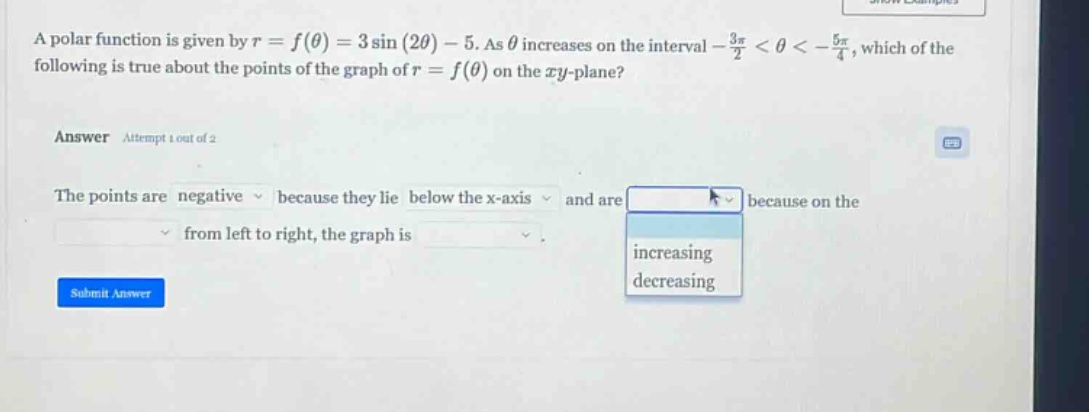
a polar function is given by r = f(θ) = 3 sin(2θ) - 5. as θ increases on the interval -3π/2 < θ < -5π/4, which of the following is true about the points of the graph of r = f(θ) on the xy - plane? answer attempt 1 out of 2 the points are negative because they lie below the x - axis and are increasing decreasing because on the from left to right, the graph is submit answer
Answer
Explanation:
Step1: Analyze the sign of (r)
We know that in polar - coordinates, the sign of (r) is related to the position of the point. If (r\lt0), the point ((r,\theta)) in polar - coordinates is equivalent to ((-r,\theta + \pi)) in polar - coordinates. For the function (r = 3\sin(2\theta)-5), we know that the range of (y = \sin(2\theta)) is ([- 1,1]). So the range of (r = 3\sin(2\theta)-5) is (3\times(-1)-5\leq r\leq3\times1 - 5), i.e., (-8\leq r\leq - 2). So (r\lt0) for all (\theta). In the (xy) - plane, when (r\lt0), the points ((r,\theta)) in polar coordinates are reflected across the origin compared to the case when (r\gt0). Geometrically, when (r\lt0), the points lie on the opposite side of the origin from the direction indicated by (\theta). In the given interval (-\frac{3\pi}{2}\lt\theta\lt-\frac{5\pi}{4}), we can also think of it in terms of the conversion to Cartesian coordinates (x = r\cos\theta) and (y = r\sin\theta). Since (r\lt0), the points are "negative" in the sense that they are on the "opposite" side of the origin. And in the (xy) - plane, when (r\lt0), they lie below the (x) - axis for the given range of (\theta).
Step2: Analyze the monotonicity of (r)
First, find the derivative of (r) with respect to (\theta). Using the chain - rule, if (r = 3\sin(2\theta)-5), then (r'=6\cos(2\theta)). Let's find the critical points of (r) by setting (r' = 0), so (6\cos(2\theta)=0), which gives (2\theta=(2n + 1)\frac{\pi}{2}), or (\theta=(2n + 1)\frac{\pi}{4}), (n\in\mathbb{Z}). For the interval (-\frac{3\pi}{2}\lt\theta\lt-\frac{5\pi}{4}), we can take a test point. Let (\theta=-\frac{11\pi}{8}) (which is in the interval (-\frac{3\pi}{2}\lt\theta\lt-\frac{5\pi}{4})). Then (r'=6\cos(2\times(-\frac{11\pi}{8}))=6\cos(-\frac{11\pi}{4})=6\cos(\frac{11\pi}{4})=6\cos(2\pi+\frac{3\pi}{4})=6\cos(\frac{3\pi}{4})=- 3\sqrt{2}\lt0). Since (r'\lt0) in the interval (-\frac{3\pi}{2}\lt\theta\lt-\frac{5\pi}{4}), the function (r = f(\theta)) is decreasing on this interval.
Answer:
The points are negative because they lie below the x - axis and are decreasing because on the interval (-\frac{3\pi}{2}\lt\theta\lt-\frac{5\pi}{4}), from left to right, the graph is decreasing.