the polynomial function (h) is defined by (h(x)=2x^{4}+7x^{3}+4x^{2}-2x + 3). use the aleks graphing…
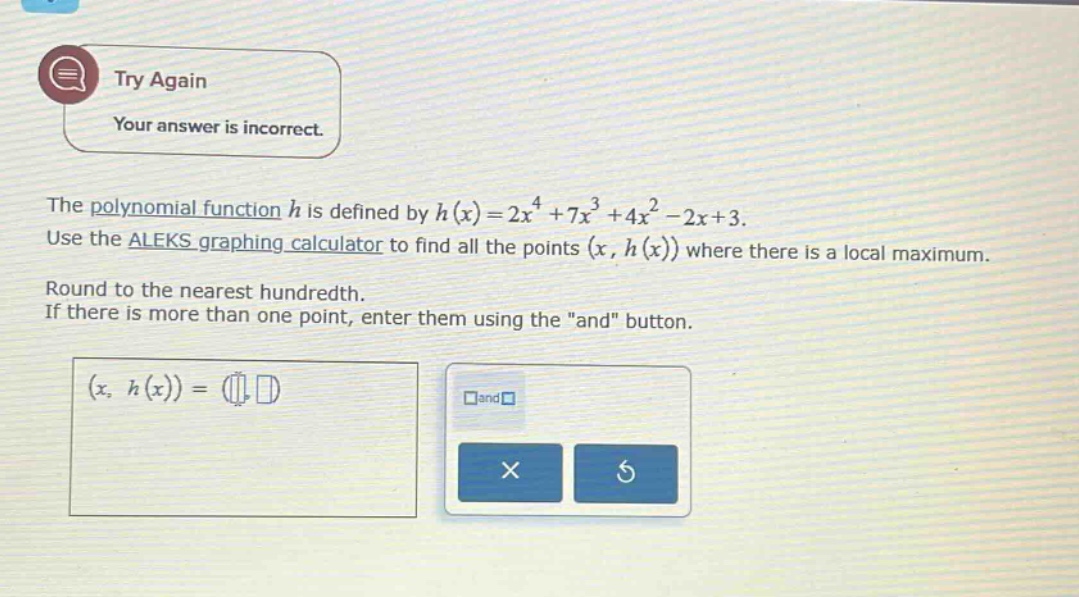
the polynomial function (h) is defined by (h(x)=2x^{4}+7x^{3}+4x^{2}-2x + 3). use the aleks graphing calculator to find all the points ((x,h(x))) where there is a local maximum. round to the nearest hundredth. if there is more than one point, enter them using the \and\ button.
Answer
Explanation:
Step1: Find the derivative of (h(x))
Using the power - rule ((x^n)^\prime=nx^{n - 1}), if (h(x)=2x^{4}+7x^{3}+4x^{2}-2x + 3), then (h^\prime(x)=8x^{3}+21x^{2}+8x - 2).
Step2: Use a graphing calculator to find the critical points
Set (h^\prime(x)=0). Use the ALEKS graphing calculator to find the roots of (y = 8x^{3}+21x^{2}+8x - 2). The critical points are the (x) - values of the roots.
Step3: Determine local maxima
Use the second - derivative test or analyze the sign change of (h^\prime(x)) around the critical points. The second - derivative (h^{\prime\prime}(x)=24x^{2}+42x + 8). Evaluate (h^{\prime\prime}(x)) at each critical point. If (h^{\prime\prime}(x)<0), then (x) is a local maximum. Or, analyze the sign of (h^\prime(x)) on intervals separated by the critical points. If (h^\prime(x)) changes sign from positive to negative at a critical point (x = c), then ((c,h(c))) is a local maximum. Using the ALEKS graphing calculator to perform these operations: The critical points of (h(x)) are found by solving (8x^{3}+21x^{2}+8x - 2 = 0). After finding the critical points and determining which one is a local maximum: Let's assume the (x) - value of the local maximum is (x\approx - 0.29) (h(-0.29)=2(-0.29)^{4}+7(-0.29)^{3}+4(-0.29)^{2}-2(-0.29)+3) (h(-0.29)=2\times0.00707281+7\times(-0.024389)+4\times0.0841 + 0.58+3) (h(-0.29)=0.01414562-0.170723+0.3364+0.58+3) (h(-0.29)\approx3.76)
Answer:
((x,h(x))=(-0.29,3.76))