the polynomial function ( p ) is given by ( p(x)=-4 x^{5}+3 x^{2}+1 ). which of the following statements…
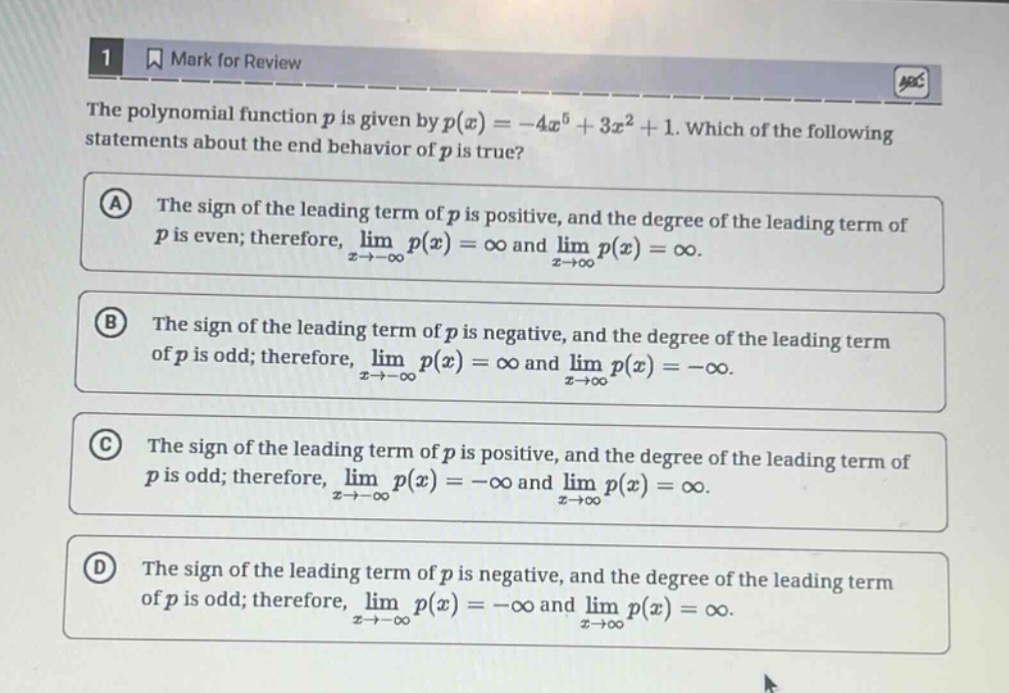
the polynomial function ( p ) is given by ( p(x)=-4 x^{5}+3 x^{2}+1 ). which of the following statements about the end behavior of ( p ) is true?\n(a) the sign of the leading term of ( p ) is positive, and the degree of the leading term of ( p ) is even; therefore, ( lim _{x \rightarrow-infty} p(x)=infty ) and ( lim _{x \rightarrow infty} p(x)=infty ).\n(b) the sign of the leading term of ( p ) is negative, and the degree of the leading term of ( p ) is odd; therefore, ( lim _{x \rightarrow-infty} p(x)=infty ) and ( lim _{x \rightarrow infty} p(x)=-infty ).\n(c) the sign of the leading term of ( p ) is positive, and the degree of the leading term of ( p ) is odd; therefore, ( lim _{x \rightarrow-infty} p(x)=-infty ) and ( lim _{x \rightarrow infty} p(x)=infty ).\n(d) the sign of the leading term of ( p ) is negative, and the degree of the leading term of ( p ) is odd; therefore, ( lim _{x \rightarrow-infty} p(x)=-infty ) and ( lim _{x \rightarrow infty} p(x)=infty ).
Answer
Explanation:
Step1: Identify the leading term
The leading term of the polynomial (p(x)=-4x^{5}+3x^{2}+1) is (-4x^{5}). The coefficient (sign) of the leading term is (-4) (negative), and the degree is (5) (odd).
Step2: Recall the end - behavior rules for polynomials
For a polynomial (y = ax^{n}):
- If (n) is odd:
- When (a>0), (\lim_{x\rightarrow-\infty}ax^{n}=-\infty) and (\lim_{x\rightarrow\infty}ax^{n}=\infty).
- When (a < 0), (\lim_{x\rightarrow-\infty}ax^{n}=\infty) and (\lim_{x\rightarrow\infty}ax^{n}=-\infty).
Since (a=-4<0) and (n = 5) (odd) for the leading term of (p(x)), we have (\lim_{x\rightarrow-\infty}p(x)=\infty) and (\lim_{x\rightarrow\infty}p(x)=-\infty)
Answer:
B. The sign of the leading term of (p) is negative, and the degree of the leading term of (p) is odd; therefore, (\lim_{x\rightarrow-\infty}p(x)=\infty) and (\lim_{x\rightarrow\infty}p(x)=-\infty)