for a polynomial function (f), (lim_{x\rightarrow-infty}f(x)=infty) and (lim_{x\rightarrowinfty}f(x)=-infty)…
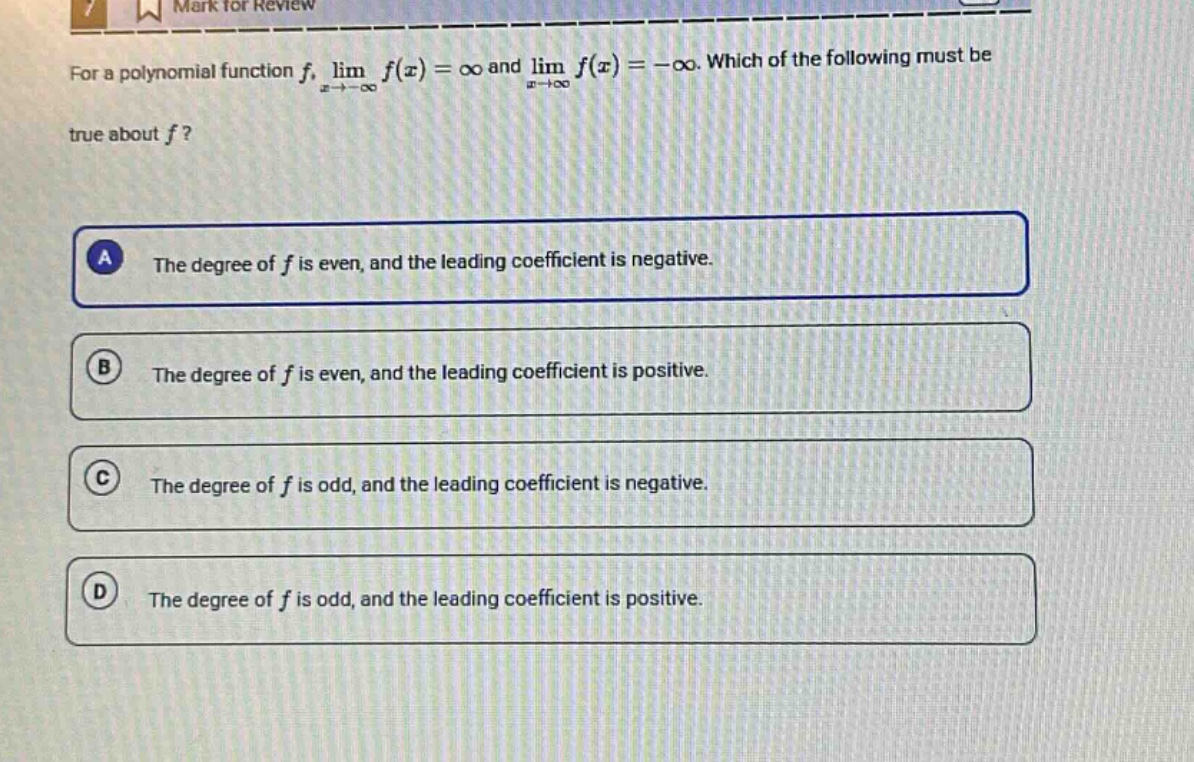
for a polynomial function (f), (lim_{x\rightarrow-infty}f(x)=infty) and (lim_{x\rightarrowinfty}f(x)=-infty). which of the following must be true about (f)?\na the degree of (f) is even, and the leading coefficient is negative.\nb the degree of (f) is even, and the leading coefficient is positive.\nc the degree of (f) is odd, and the leading coefficient is negative.\nd the degree of (f) is odd, and the leading coefficient is positive.
Answer
Explanation:
Step1: Recall end - behavior rules
For a polynomial function (f(x)=a_nx^n + a_{n - 1}x^{n-1}+\cdots+a_0), the end - behavior is determined by the degree (n) and the leading coefficient (a_n).
Step2: Analyze cases for even - degree polynomials
If (n) is even, (\lim_{x\rightarrow-\infty}f(x)=\lim_{x\rightarrow\infty}f(x)) when (a_n>0) (both are (\infty)) and (\lim_{x\rightarrow-\infty}f(x)=\lim_{x\rightarrow\infty}f(x)) when (a_n < 0) (both are (-\infty)). Since (\lim_{x\rightarrow-\infty}f(x)=\infty) and (\lim_{x\rightarrow\infty}f(x)=-\infty), the degree cannot be even.
Step3: Analyze cases for odd - degree polynomials
If (n) is odd, when (a_n>0), (\lim_{x\rightarrow-\infty}f(x)=-\infty) and (\lim_{x\rightarrow\infty}f(x)=\infty). When (a_n < 0), (\lim_{x\rightarrow-\infty}f(x)=\infty) and (\lim_{x\rightarrow\infty}f(x)=-\infty).
Answer:
C. The degree of (f) is odd, and the leading coefficient is negative.