the population p(t) of mice in a meadow after t years satisfies the logistic differential equation dp/dt =…
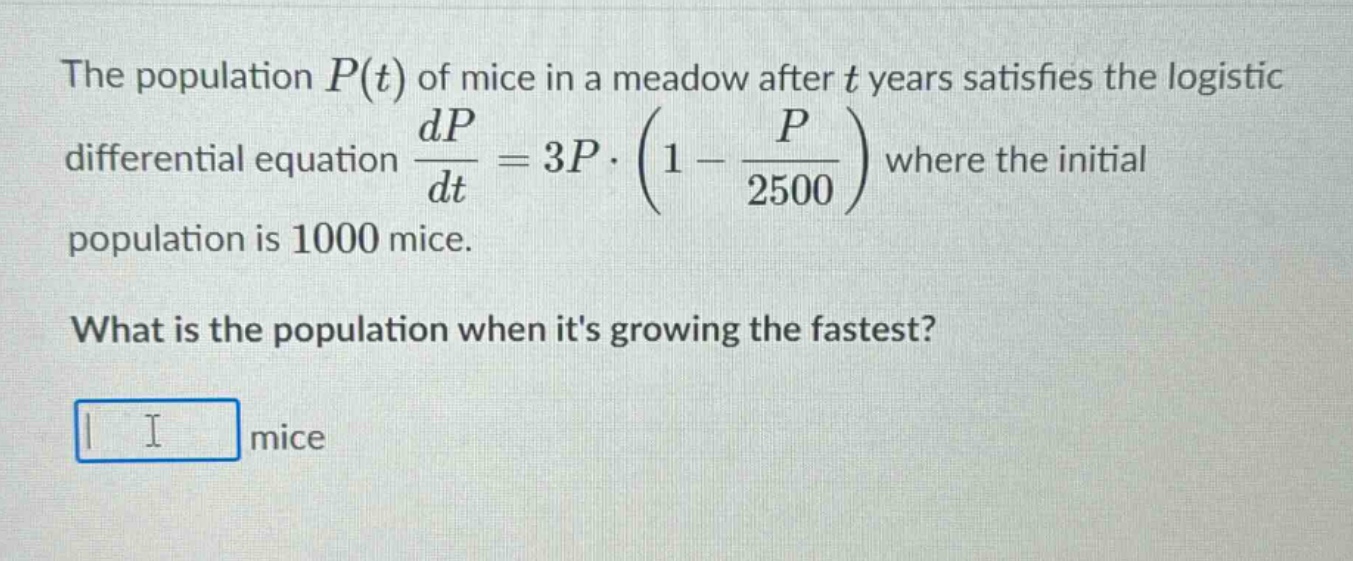
the population p(t) of mice in a meadow after t years satisfies the logistic differential equation dp/dt = 3p·(1 - p/2500) where the initial population is 1000 mice. what is the population when its growing the fastest? mice
Answer
Explanation:
Step1: Recall logistic - growth property
The logistic differential equation is $\frac{dP}{dt}=kP(1 - \frac{P}{L})$, and the function $y = \frac{dP}{dt}$ reaches its maximum when $P=\frac{L}{2}$.
Step2: Identify the carrying capacity $L$
In the given logistic differential equation $\frac{dP}{dt}=3P(1 - \frac{P}{2500})$, the carrying capacity $L = 2500$.
Step3: Calculate the population at maximum - growth rate
Using the property that the population is growing the fastest when $P=\frac{L}{2}$, substituting $L = 2500$ into the formula, we get $P=\frac{2500}{2}=1250$.
Answer:
1250