if c is a positive real number and a_k = k ln c, for what values of c, if any, does the infinite series ∑_{k…
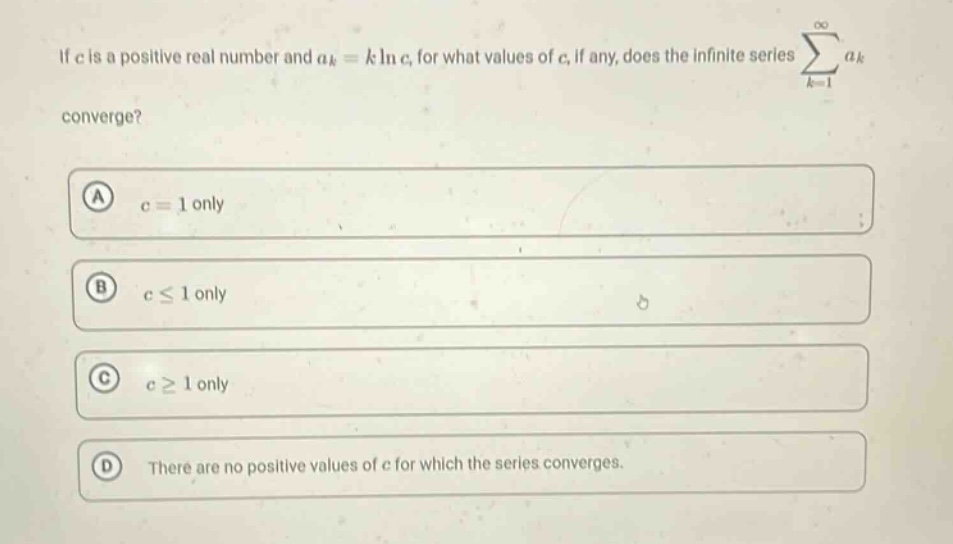
if c is a positive real number and a_k = k ln c, for what values of c, if any, does the infinite series ∑_{k = 1}^∞ a_k converge? a c = 1 only b c ≤ 1 only c c ≥ 1 only d there are no positive values of c for which the series converges.
Answer
Explanation:
Step1: Recall divergence - test for series
The divergence - test states that if $\lim_{k\rightarrow\infty}a_{k}\neq0$, then the series $\sum_{k = 1}^{\infty}a_{k}$ diverges.
Step2: Calculate $\lim_{k\rightarrow\infty}a_{k}$
We have $a_{k}=k\ln c$. Case 1: If $c > 1$, then $\ln c>0$. So, $\lim_{k\rightarrow\infty}a_{k}=\lim_{k\rightarrow\infty}k\ln c=\infty$ (since $\ln c$ is a positive constant and $k\rightarrow\infty$). Case 2: If $c = 1$, then $\ln c = 0$, and $a_{k}=k\times0 = 0$ for all $k$. But the series $\sum_{k = 1}^{\infty}a_{k}=\sum_{k = 1}^{\infty}0=0$ (a trivial case). Case 3: If $0 < c<1$, then $\ln c<0$. Let $m=-\ln c>0$. So, $a_{k}=-km$. And $\lim_{k\rightarrow\infty}a_{k}=-\infty$. In all non - trivial cases ($c\neq1$), $\lim_{k\rightarrow\infty}a_{k}\neq0$.
Answer:
A. $c = 1$ only