is it possible for a function to satisfy f(x)>0, f(x)>0, and f(x)<0 on an interval? explain. choose the…
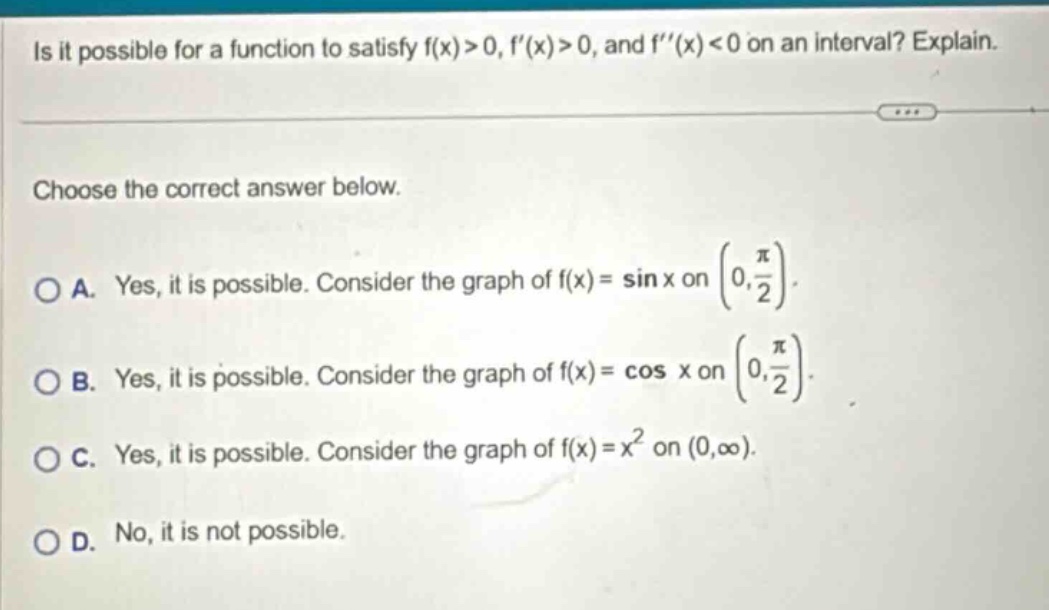
is it possible for a function to satisfy f(x)>0, f(x)>0, and f(x)<0 on an interval? explain. choose the correct answer below. o a. yes, it is possible. consider the graph of f(x)=sin x on (0,π/2). o b. yes, it is possible. consider the graph of f(x)=cos x on (0,π/2). o c. yes, it is possible. consider the graph of f(x)=x² on (0,∞). o d. no, it is not possible.
Answer
Explanation:
Step1: Recall derivative - function relationship
$f(x)>0$ means the function is above the $x$ - axis. $f^{\prime}(x)>0$ means the function is increasing, and $f^{\prime\prime}(x)<0$ means the function is concave - down.
Step2: Analyze option A
For $y = \sin x$, on the interval $\left(0,\frac{\pi}{2}\right)$:
- $f(x)=\sin x>0$ since $\sin x$ is positive in the first - quadrant.
- $f^{\prime}(x)=\cos x>0$ on $\left(0,\frac{\pi}{2}\right)$ as $\cos x$ is positive in the first - quadrant.
- $f^{\prime\prime}(x)=-\sin x<0$ on $\left(0,\frac{\pi}{2}\right)$ as $\sin x$ is positive in the first - quadrant.
Step3: Analyze option B
For $y = \cos x$, on the interval $\left(0,\frac{\pi}{2}\right)$, $f^{\prime}(x)=-\sin x<0$, so it does not satisfy $f^{\prime}(x)>0$.
Step4: Analyze option C
For $y = x^{2}$, $f^{\prime}(x) = 2x>0$ on $(0,\infty)$, $f(x)=x^{2}>0$ on $(0,\infty)$, but $f^{\prime\prime}(x)=2>0$, so it does not satisfy $f^{\prime\prime}(x)<0$.
Answer:
A. Yes, it is possible. Consider the graph of $f(x)=\sin x$ on $\left(0,\frac{\pi}{2}\right)$.