which is a possible turning point for the continuous function f(x)?\n(-2,0)\n(0, -2)\n(2, -1)\n(4,0)\n\nx\tf(…
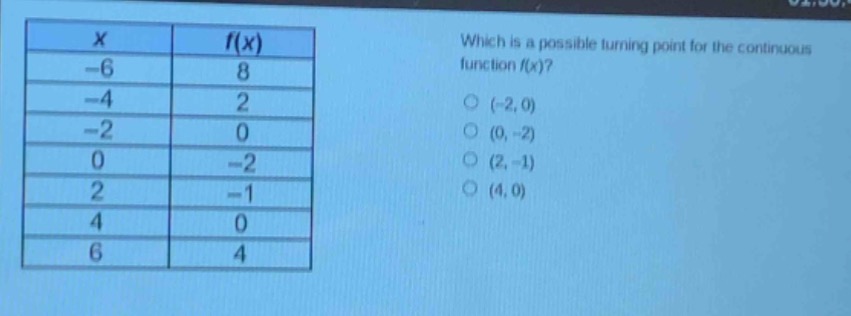
which is a possible turning point for the continuous function f(x)?\n(-2,0)\n(0, -2)\n(2, -1)\n(4,0)\n\nx\tf(x)\n-6\t8\n-4\t2\n-2\t0\n0\t-2\n2\t-1\n4\t0\n6\t4
Answer
Explanation:
Step1: Recall turning - point definition
A turning point of a continuous function is a point where the function changes from increasing to decreasing or vice - versa. This means the derivative of the function is zero or undefined at that point. For a discrete set of data points like this, we look for a change in the trend of the function values.
Step2: Analyze the trend of (f(x)) values
As (x) goes from (-6) to (-4), (f(x)) decreases from (8) to (2). As (x) goes from (-4) to (-2), (f(x)) decreases from (2) to (0). As (x) goes from (-2) to (0), (f(x)) decreases from (0) to (-2). As (x) goes from (0) to (2), (f(x)) increases from (-2) to (-1). As (x) goes from (2) to (4), (f(x)) increases from (-1) to (0). As (x) goes from (4) to (6), (f(x)) increases from (0) to (4). The function changes from decreasing to increasing between (x = 0) and (x = 2).
Step3: Identify the turning - point candidate
The point ((0,-2)) is a candidate for the turning point as the function changes its decreasing trend to an increasing trend around this (x) - value.
Answer:
((0, - 2))