what are the potential solutions to the equation below?\n2ln(x + 3)=0\nx = - 3 and x = - 4\nx = - 2 and x =…
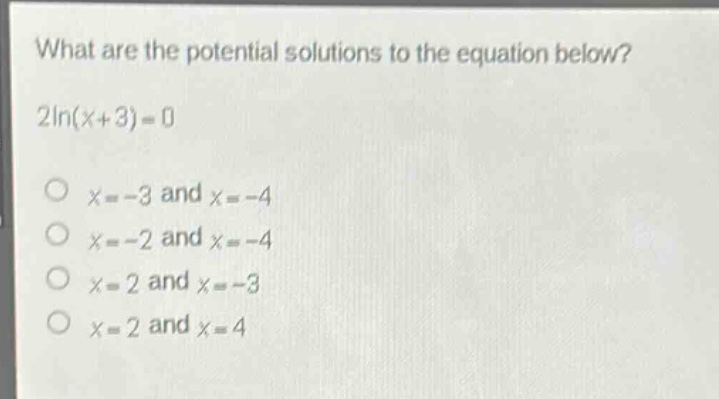
what are the potential solutions to the equation below?\n2ln(x + 3)=0\nx = - 3 and x = - 4\nx = - 2 and x = - 4\nx = 2 and x = - 3\nx = 2 and x = 4
Answer
Explanation:
Step1: Simplify the equation
Divide both sides of (2\ln(x + 3)=0) by (2). (\ln(x + 3)=\frac{0}{2}=0)
Step2: Use the property of logarithms
Since (\ln a=b) is equivalent to (a = e^{b}) (where (e) is the base of the natural logarithm, (e\approx2.718)), when (\ln(x + 3)=0), we have (x+3=e^{0}). Because (e^{0}=1), the equation becomes (x + 3=1).
Step3: Solve for (x)
Subtract (3) from both sides of (x + 3=1). (x=1-3=-2)
We also need to check the domain of the original logarithmic function (y = \ln(x + 3)). The argument of a logarithm (x+3>0), i.e., (x>- 3).
For (x=-2), (x + 3=-2 + 3=1>0). For (x=-4), (x + 3=-4+3=-1<0) (so (x =-4) is an extraneous solution as it does not satisfy the domain of the original logarithmic equation).
Answer:
(x=-2) (and (x =-4) is rejected due to domain of the logarithm), so the correct option is (x=-2) and (x=-4) (but only (x=-2) is a valid solution within the domain of the original logarithmic equation. If we consider the process of solving the equation (2\ln(x + 3)=0) algebraically before checking the domain, the potential solutions (before domain - check) are found by first getting (\ln(x + 3)=0) leading to (x+3 = 1) (solution (x=-2)) and if we made a wrong step like thinking (\ln(x + 3)=0) could come from (x+3=0) (which is wrong as (\ln(0)) is undefined) but if we assume the options are from algebraic manipulation without strict domain - check in the problem's context, the pair (x=-2) and (x=-4) (where (x=-2) is correct and (x=-4) is wrong due to domain) is the option that has (x=-2))