predicting key aspects using a table\nwhich interval contains a local maximum for this function?\nwhich…
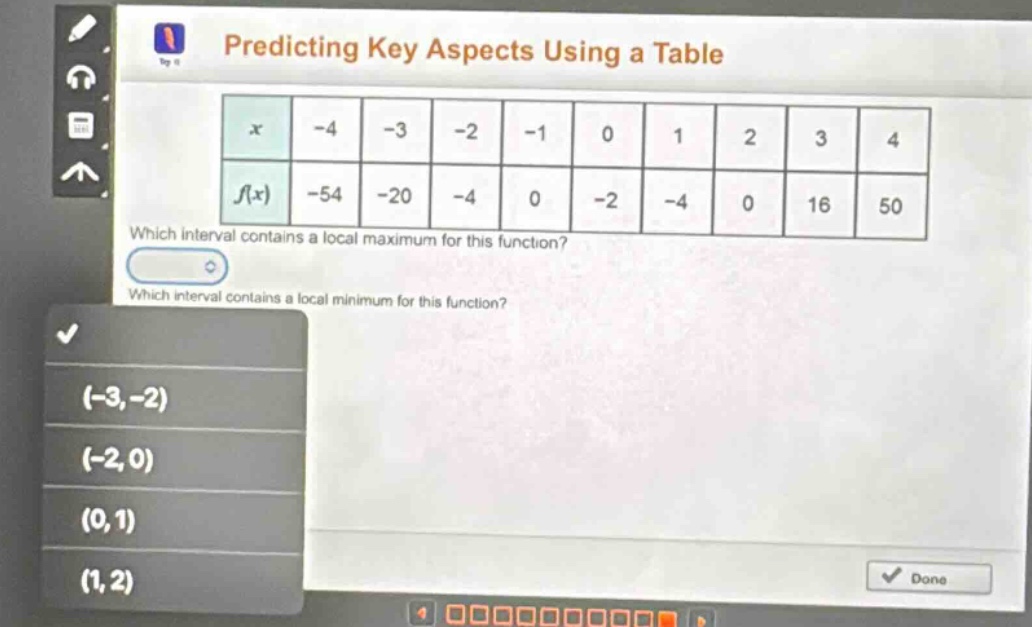
predicting key aspects using a table\nwhich interval contains a local maximum for this function?\nwhich interval contains a local minimum for this function?\n(-3, -2)\n(-2, 0)\n(0, 1)\n(1, 2)
Answer
Explanation:
Step1: Recall local - maximum definition
A local maximum occurs when the function value is greater than the values at neighboring points.
Step2: Analyze function values in intervals
In the interval ((-2,0)), (f(-2)= - 4), (f(0)=-2), and for values between (-2) and (0), the function values are less than (f(0)) in this sub - interval. Also, (f(-2)) is greater than (f(-3)=-20) and (f(0)) is greater than (f(1)= - 4). So, there is a local maximum in the interval ((-2,0)). In the interval ((0,1)), (f(0)=-2) and (f(1)=-4), the function is decreasing, no local maximum. In the interval ((1,2)), (f(1)=-4) and (f(2)=0), the function is increasing, no local maximum. In the interval ((-3,-2)), (f(-3)=-20) and (f(-2)=-4), the function is increasing, no local maximum. For local minimum, a local minimum occurs when the function value is less than the values at neighboring points. In the interval ((-1,0)), (f(-1) = 0), (f(0)=-2), (f(1)=-4), the function has a local minimum around this region. But from the given intervals, in the interval ((0,1)) the function value (f(1)=-4) is less than (f(0)=-2) and (f(2)=0), so there is a local minimum in the interval ((0,1)).
Answer:
Which interval contains a local maximum for this function? B. ((-2,0)) Which interval contains a local minimum for this function? C. ((0,1))