previous problem problem list next problem the figure above shows the graph of f(x) = x^5/5 - x^4/2 - x^3/3…
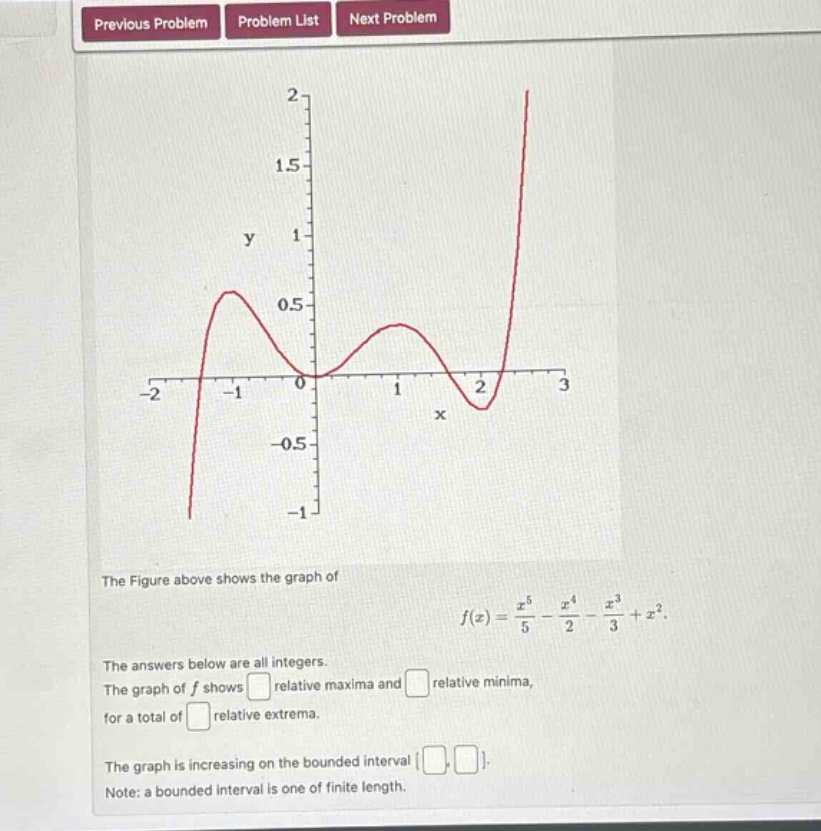
previous problem problem list next problem the figure above shows the graph of f(x) = x^5/5 - x^4/2 - x^3/3 + x^2. the answers below are all integers. the graph of f shows relative maxima and relative minima, for a total of relative extrema. the graph is increasing on the bounded interval . note: a bounded interval is one of finite length.
Answer
Explanation:
Step1: Find the derivative of $f(x)$
First, find $f'(x)$ using power - rule. Given $f(x)=\frac{x^{5}}{5}-\frac{x^{4}}{2}-\frac{x^{3}}{3}+x^{2}$, then $f'(x)=x^{4}-2x^{3}-x^{2} + 2x=x(x^{3}-2x^{2}-x + 2)=x(x - 1)(x + 1)(x - 2)$.
Step2: Find critical points
Set $f'(x)=0$. The critical points are $x=-1,0,1,2$ since $x(x - 1)(x + 1)(x - 2)=0$ when $x=-1,0,1,2$.
Step3: Use the first - derivative test
Test the intervals $(-\infty,-1),(-1,0),(0,1),(1,2),(2,\infty)$ with test points.
- For $x=-2$ (in $(-\infty,-1)$), $f'(-2)=(-2)(-3)(-1)(-4)=24>0$, so $f(x)$ is increasing on $(-\infty,-1)$.
- For $x =-\frac{1}{2}$ (in $(-1,0)$), $f'(-\frac{1}{2})=(-\frac{1}{2})(-\frac{3}{2})(\frac{1}{2})(-\frac{5}{2})=-\frac{15}{16}<0$, so $f(x)$ is decreasing on $(-1,0)$.
- For $x=\frac{1}{2}$ (in $(0,1)$), $f'(\frac{1}{2})=(\frac{1}{2})(-\frac{1}{2})(\frac{3}{2})(-\frac{3}{2})=\frac{9}{16}>0$, so $f(x)$ is increasing on $(0,1)$.
- For $x=\frac{3}{2}$ (in $(1,2)$), $f'(\frac{3}{2})=(\frac{3}{2})(\frac{1}{2})(\frac{5}{2})(-\frac{1}{2})=-\frac{15}{16}<0$, so $f(x)$ is decreasing on $(1,2)$.
- For $x = 3$ (in $(2,\infty)$), $f'(3)=(3)(2)(4)(1)=24>0$, so $f(x)$ is increasing on $(2,\infty)$.
- Relative maxima occur where $f(x)$ changes from increasing to decreasing. So, $x=-1$ and $x = 1$ are relative maxima.
- Relative minima occur where $f(x)$ changes from decreasing to increasing. So, $x = 0$ and $x = 2$ are relative minima.
- The number of relative maxima is 2, the number of relative minima is 2, and the total number of relative extrema is $2 + 2=4$.
- The function is increasing on the bounded intervals $(-\infty,-1)$ and $(0,1)$ and $(2,\infty)$. The bounded interval among them is $(0,1)$.
Answer:
Relative maxima: 2 Relative minima: 2 Total relative extrema: 4 Increasing bounded interval: 0, 1