problem 5. 2pts. this is a bonus question, which is why there are so few points attached to it. recall the…
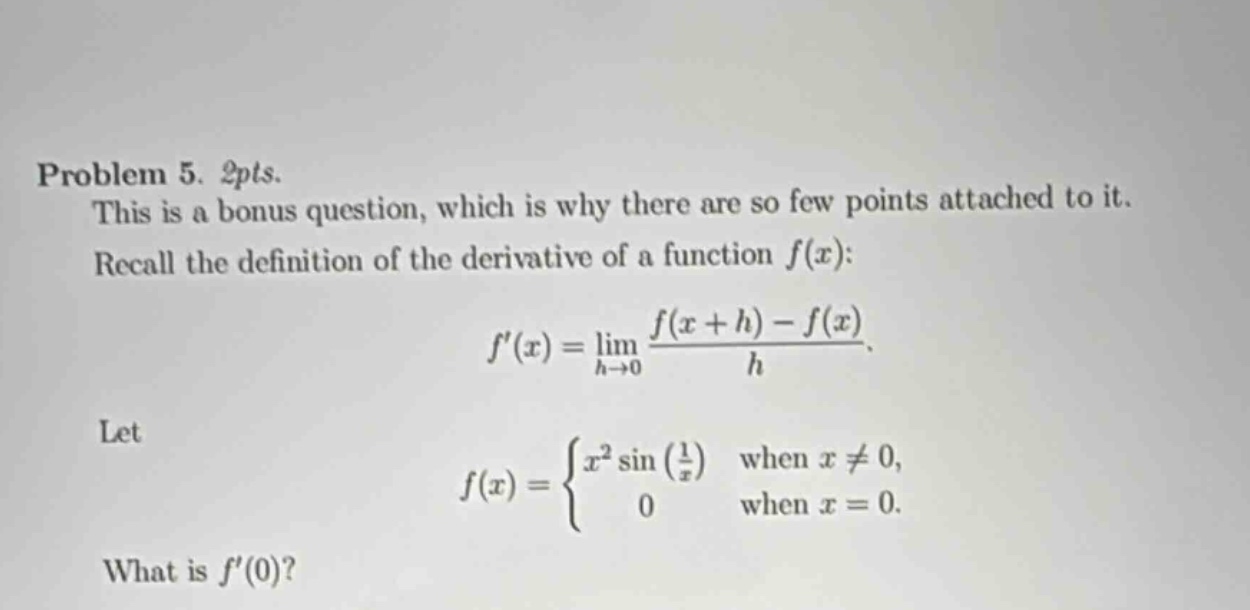
problem 5. 2pts. this is a bonus question, which is why there are so few points attached to it. recall the definition of the derivative of a function f(x): f(x)=lim h→0 (f(x + h)-f(x))/h. let f(x)={x²sin(1/x) when x≠0, 0 when x = 0. what is f(0)?
Answer
Explanation:
Step1: Apply derivative - definition formula
We want to find (f^{\prime}(0)), so we use (f^{\prime}(0)=\lim_{h\rightarrow0}\frac{f(0 + h)-f(0)}{h}). Since (f(0) = 0) and (f(h)=h^{2}\sin(\frac{1}{h})) for (h\neq0), then (f^{\prime}(0)=\lim_{h\rightarrow0}\frac{h^{2}\sin(\frac{1}{h})-0}{h}).
Step2: Simplify the limit - expression
Simplify (\lim_{h\rightarrow0}\frac{h^{2}\sin(\frac{1}{h})}{h}) to (\lim_{h\rightarrow0}h\sin(\frac{1}{h})).
Step3: Use the - squeeze theorem
We know that (- 1\leqslant\sin(\frac{1}{h})\leqslant1) for (h\neq0). Then (-h\leqslant h\sin(\frac{1}{h})\leqslant h). As (\lim_{h\rightarrow0}(-h)=0) and (\lim_{h\rightarrow0}h = 0), by the squeeze - theorem (\lim_{h\rightarrow0}h\sin(\frac{1}{h}) = 0).
Answer:
(0)