problem 3. consider the curve described by the equation (x² + y²)² = 4(x² - y²). (a) 6pts. use the method of…
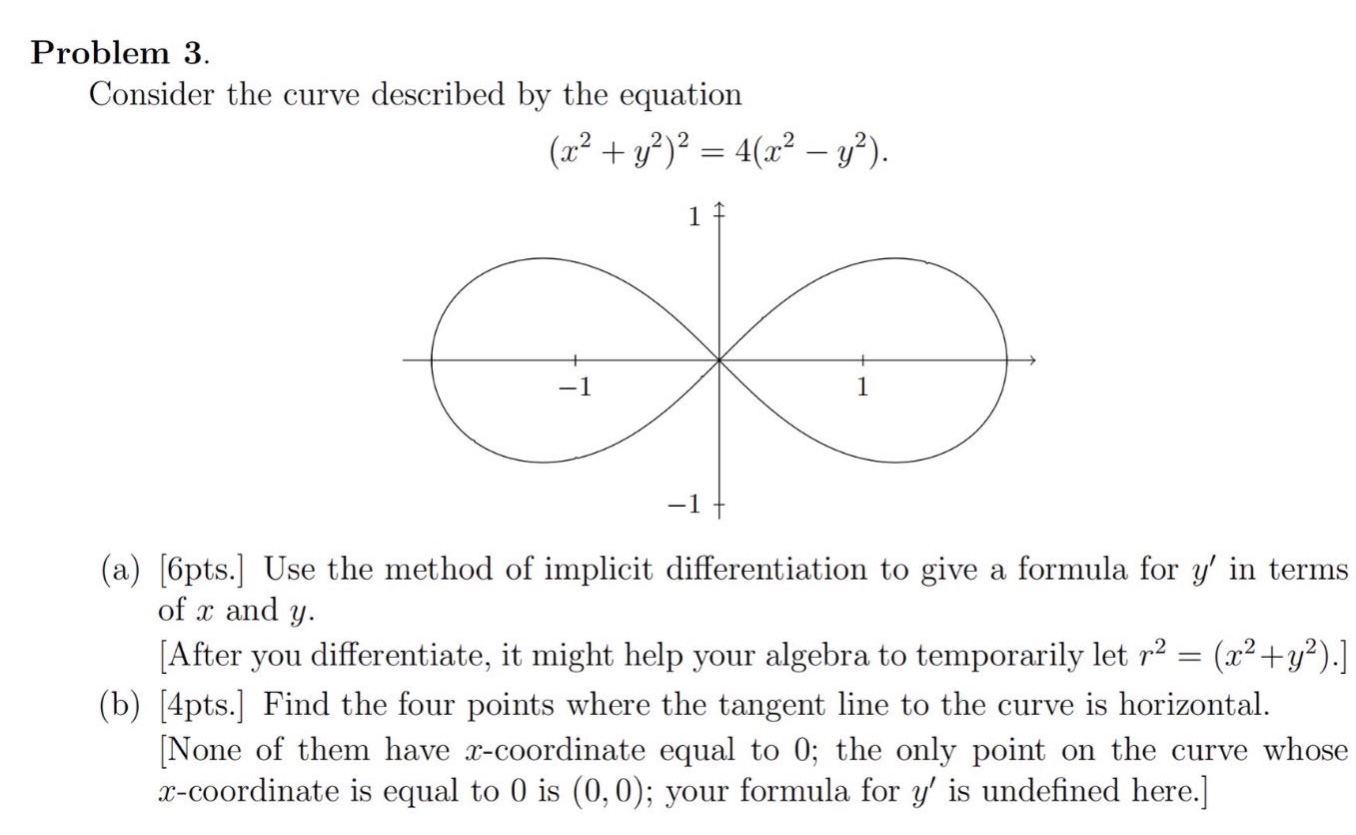
problem 3. consider the curve described by the equation (x² + y²)² = 4(x² - y²). (a) 6pts. use the method of implicit differentiation to give a formula for y in terms of x and y. after you differentiate, it might help your algebra to temporarily let r² = (x²+y²). (b) 4pts. find the four points where the tangent line to the curve is horizontal. none of them have x - coordinate equal to 0; the only point on the curve whose x - coordinate is equal to 0 is (0,0); your formula for y is undefined here.
Answer
Explanation:
Step1: Differentiate the left - hand side
Differentiate $(x^{2}+y^{2})^{2}$ with respect to $x$ using the chain rule. Let $u = x^{2}+y^{2}$, so $(x^{2}+y^{2})^{2}=u^{2}$. Then $\frac{d}{dx}(u^{2}) = 2u\frac{du}{dx}$, and $\frac{du}{dx}=2x + 2y y'$. So $\frac{d}{dx}(x^{2}+y^{2})^{2}=2(x^{2}+y^{2})(2x + 2y y')$.
Step2: Differentiate the right - hand side
Differentiate $4(x^{2}-y^{2})$ with respect to $x$. Using the sum - difference rule and the chain rule, we get $\frac{d}{dx}(4(x^{2}-y^{2}))=4(2x-2y y')$.
Step3: Set the two derivatives equal
$2(x^{2}+y^{2})(2x + 2y y')=4(2x-2y y')$. Expand the left - hand side: $4x(x^{2}+y^{2})+4y(x^{2}+y^{2})y'=8x - 8y y'$. Move all terms with $y'$ to one side: $4y(x^{2}+y^{2})y'+8y y'=8x - 4x(x^{2}+y^{2})$. Factor out $y'$: $y'(4y(x^{2}+y^{2}) + 8y)=8x - 4x(x^{2}+y^{2})$. Solve for $y'$: $y'=\frac{8x - 4x(x^{2}+y^{2})}{4y(x^{2}+y^{2})+8y}=\frac{2x - x(x^{2}+y^{2})}{y(x^{2}+y^{2})+2y}$.
Step4: Find points with horizontal tangent
A horizontal tangent occurs when $y' = 0$. So $2x - x(x^{2}+y^{2})=0$ and $y(x^{2}+y^{2})+2y\neq0$. Factor out $x$ from $2x - x(x^{2}+y^{2})=0$: $x(2-(x^{2}+y^{2})) = 0$. Since $x\neq0$ (given in the problem), then $x^{2}+y^{2}=2$. Substitute $x^{2}+y^{2}=2$ into the original equation $(x^{2}+y^{2})^{2}=4(x^{2}-y^{2})$. We get $4 = 4(x^{2}-y^{2})$, so $x^{2}-y^{2}=1$. Solve the system of equations $\begin{cases}x^{2}+y^{2}=2\x^{2}-y^{2}=1\end{cases}$ Add the two equations: $2x^{2}=3$, so $x=\pm\frac{\sqrt{6}}{2}$. Substitute $x^{2}=\frac{3}{2}$ into $x^{2}+y^{2}=2$, we get $y^{2}=2 - \frac{3}{2}=\frac{1}{2}$, so $y=\pm\frac{\sqrt{2}}{2}$.
Answer:
(a) $y'=\frac{2x - x(x^{2}+y^{2})}{y(x^{2}+y^{2})+2y}$ (b) $(\frac{\sqrt{6}}{2},\frac{\sqrt{2}}{2}),(\frac{\sqrt{6}}{2},-\frac{\sqrt{2}}{2}),(-\frac{\sqrt{6}}{2},\frac{\sqrt{2}}{2}),(-\frac{\sqrt{6}}{2},-\frac{\sqrt{2}}{2})$