problem 1. differentiate the following functions. (a) 4pts. $f(x)=\frac{x^{2}sin(x)}{1 + x^{2}}$ (b) 4pts…
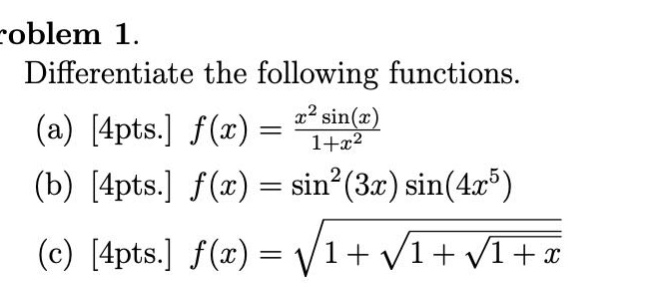
problem 1. differentiate the following functions. (a) 4pts. $f(x)=\frac{x^{2}sin(x)}{1 + x^{2}}$ (b) 4pts. $f(x)=sin^{2}(3x)sin(4x^{5})$ (c) 4pts. $f(x)=sqrt{1+sqrt{1+sqrt{1 + x}}}$
Answer
Explanation:
Step1: Use quotient - rule for (a)
The quotient - rule states that if $y=\frac{u}{v}$, then $y^\prime=\frac{u^\prime v - uv^\prime}{v^{2}}$. Here, $u = x^{2}\sin(x)$, $u^\prime=2x\sin(x)+x^{2}\cos(x)$ (using product - rule $(uv)^\prime = u^\prime v+uv^\prime$ where $u = x^{2}$ and $v=\sin(x)$), and $v = 1 + x^{2}$, $v^\prime = 2x$. Then $f^\prime(x)=\frac{(2x\sin(x)+x^{2}\cos(x))(1 + x^{2})-x^{2}\sin(x)\cdot2x}{(1 + x^{2})^{2}}=\frac{2x\sin(x)+2x^{3}\sin(x)+x^{2}\cos(x)+x^{4}\cos(x)-2x^{3}\sin(x)}{(1 + x^{2})^{2}}=\frac{2x\sin(x)+x^{2}\cos(x)+x^{4}\cos(x)}{(1 + x^{2})^{2}}$.
Step2: Use product - rule and chain - rule for (b)
The product - rule: if $y = u\cdot v$, then $y^\prime=u^\prime v+uv^\prime$. Let $u=\sin^{2}(3x)$ and $v = \sin(4x^{5})$. First, find $u^\prime$: Let $t=\sin(3x)$, then $u = t^{2}$, by the chain - rule $\frac{du}{dx}=\frac{du}{dt}\cdot\frac{dt}{dx}$. $\frac{du}{dt}=2t$ and $\frac{dt}{dx}=3\cos(3x)$, so $u^\prime = 2\sin(3x)\cdot3\cos(3x)=3\sin(6x)$ (using double - angle formula $\sin(2\alpha)=2\sin\alpha\cos\alpha$). And $v^\prime=\cos(4x^{5})\cdot20x^{4}$. Then $f^\prime(x)=3\sin(6x)\sin(4x^{5})+20x^{4}\cos(4x^{5})\sin^{2}(3x)$.
Step3: Use chain - rule for (c)
Let $y = f(x)=\sqrt{1+\sqrt{1+\sqrt{1 + x}}}$, let $u = 1+\sqrt{1+\sqrt{1 + x}}$, then $y=\sqrt{u}=u^{\frac{1}{2}}$, $\frac{dy}{du}=\frac{1}{2}u^{-\frac{1}{2}}$. Let $v = 1+\sqrt{1 + x}$, then $u = 1 + v^{\frac{1}{2}}$, $\frac{du}{dv}=\frac{1}{2}v^{-\frac{1}{2}}$. Let $w=1 + x$, then $v = 1+w^{\frac{1}{2}}$, $\frac{dv}{dw}=\frac{1}{2}w^{-\frac{1}{2}}$. And $\frac{dw}{dx}=1$. By the chain - rule $\frac{dy}{dx}=\frac{dy}{du}\cdot\frac{du}{dv}\cdot\frac{dv}{dw}\cdot\frac{dw}{dx}=\frac{1}{2}(1+\sqrt{1+\sqrt{1 + x}})^{-\frac{1}{2}}\cdot\frac{1}{2}(1+\sqrt{1 + x})^{-\frac{1}{2}}\cdot\frac{1}{2}(1 + x)^{-\frac{1}{2}}$.
Answer:
(a) $f^\prime(x)=\frac{2x\sin(x)+x^{2}\cos(x)+x^{4}\cos(x)}{(1 + x^{2})^{2}}$ (b) $f^\prime(x)=3\sin(6x)\sin(4x^{5})+20x^{4}\cos(4x^{5})\sin^{2}(3x)$ (c) $f^\prime(x)=\frac{1}{8(1+\sqrt{1+\sqrt{1 + x}})^{\frac{1}{2}}(1+\sqrt{1 + x})^{\frac{1}{2}}(1 + x)^{\frac{1}{2}}}$