problem 1.\ndifferentiate the following functions.\n(a) 4pts. ( f(x)=\frac{x^{2} sin (x)}{1+x^{2}} )\n(b)…
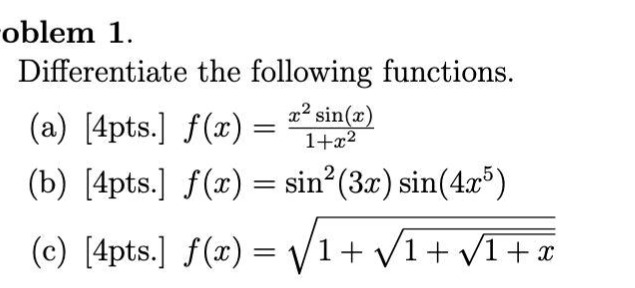
problem 1.\ndifferentiate the following functions.\n(a) 4pts. ( f(x)=\frac{x^{2} sin (x)}{1+x^{2}} )\n(b) 4pts. ( f(x)=sin ^{2}(3 x) sin left(4 x^{5}\right) )\n(c) 4pts. ( f(x)=sqrt{1+sqrt{1+sqrt{1+x}}} )
Answer
Explanation:
(a)
Step1: Use the quotient rule
The quotient rule is ((\frac{u}{v})^\prime=\frac{u^\prime v - uv^\prime}{v^2}), where (u = x^{2}\sin(x)), (v=1 + x^{2}). First, find (u^\prime) using the product rule ((uv)^\prime = u^\prime v+uv^\prime) (here (u = x^{2}), (v=\sin(x))), so (u^\prime=2x\sin(x)+x^{2}\cos(x)), and (v^\prime = 2x). Then [f^\prime(x)=\frac{(2x\sin(x)+x^{2}\cos(x))(1 + x^{2})-x^{2}\sin(x)\cdot2x}{(1 + x^{2})^{2}}] [=\frac{2x\sin(x)+2x^{3}\sin(x)+x^{2}\cos(x)+x^{4}\cos(x)-2x^{3}\sin(x)}{(1 + x^{2})^{2}}] [=\frac{2x\sin(x)+x^{2}\cos(x)+x^{4}\cos(x)}{(1 + x^{2})^{2}}] [=\frac{x\sin(x)(2 + x^{2})+x^{2}\cos(x)(1 + x^{2})}{(1 + x^{2})^{2}}] [=\frac{x\sin(x)}{1 + x^{2}}+\frac{x^{2}\cos(x)}{1 + x^{2}}]
(b)
Step1: Use the product rule
The product rule ((uv)^\prime=u^\prime v + uv^\prime), where (u=\sin^{2}(3x)), (v = \sin(4x^{5})). First, find (u^\prime) using the chain rule. Let (t=\sin(3x)), then (u = t^{2}), (u^\prime=2t\cdot t^\prime), and (t^\prime = 3\cos(3x)), so (u^\prime=6\sin(3x)\cos(3x)). Second, find (v^\prime) using the chain rule. Let (s = 4x^{5}), then (v=\sin(s)), (v^\prime=\cos(s)\cdot s^\prime), and (s^\prime=20x^{4}), so (v^\prime=20x^{4}\cos(4x^{5})). Then (f^\prime(x)=6\sin(3x)\cos(3x)\sin(4x^{5})+20x^{4}\cos(4x^{5})\sin^{2}(3x))
(c)
Step1: Use the chain rule repeatedly
Let (y = f(x)=\sqrt{1+\sqrt{1+\sqrt{1 + x}}}), let (u = 1+\sqrt{1+\sqrt{1 + x}}), then (y=\sqrt{u}), (y^\prime=\frac{1}{2\sqrt{u}}\cdot u^\prime). Let (v=\sqrt{1+\sqrt{1 + x}}), then (u = 1 + v), (u^\prime=v^\prime). Let (w=\sqrt{1 + x}), then (v=\sqrt{1 + w}), (v^\prime=\frac{1}{2\sqrt{1 + w}}\cdot w^\prime). And (w^\prime=\frac{1}{2\sqrt{1 + x}}) So (v^\prime=\frac{1}{2\sqrt{1+\sqrt{1 + x}}}\cdot\frac{1}{2\sqrt{1 + x}}) (u^\prime=\frac{1}{4\sqrt{1 + x}\sqrt{1+\sqrt{1 + x}}}) (y^\prime=\frac{1}{8\sqrt{1 + x}\sqrt{1+\sqrt{1 + x}}\sqrt{1+\sqrt{1+\sqrt{1 + x}}}})
Answer:
(a) (f^\prime(x)=\frac{x\sin(x)}{1 + x^{2}}+\frac{x^{2}\cos(x)}{1 + x^{2}}) (b) (f^\prime(x)=6\sin(3x)\cos(3x)\sin(4x^{5})+20x^{4}\cos(4x^{5})\sin^{2}(3x)) (c) (f^\prime(x)=\frac{1}{8\sqrt{1 + x}\sqrt{1+\sqrt{1 + x}}\sqrt{1+\sqrt{1+\sqrt{1 + x}}}})