problem 1. differentiate the following functions. (a) f(x)=(6x^4 - 3x^2 + 1)√x. (b) f(x)=x^4 sin x / x^2 + x…
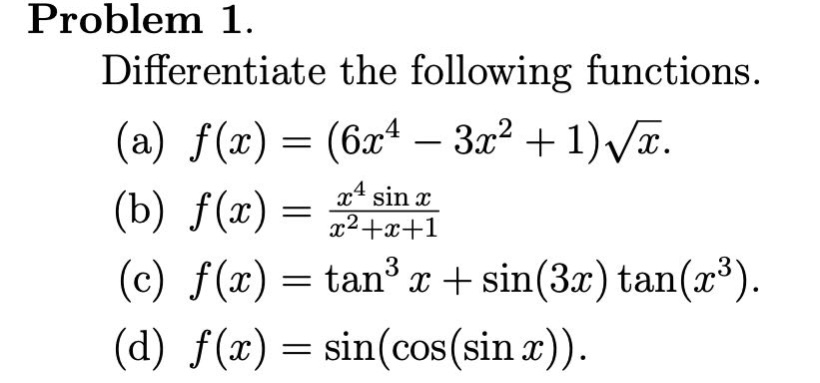
problem 1. differentiate the following functions. (a) f(x)=(6x^4 - 3x^2 + 1)√x. (b) f(x)=x^4 sin x / x^2 + x + 1 (c) f(x)=tan^3 x+sin(3x)tan(x^3). (d) f(x)=sin(cos(sin x)).
Answer
Explanation:
Step1: Rewrite the function for (a)
Rewrite $f(x)=(6x^{4}-3x^{2}+1)\sqrt{x}=(6x^{4}-3x^{2}+1)x^{\frac{1}{2}} = 6x^{\frac{9}{2}}-3x^{\frac{5}{2}}+x^{\frac{1}{2}}$. Then use the power - rule $\frac{d}{dx}(x^{n})=nx^{n - 1}$. $f^\prime(x)=6\times\frac{9}{2}x^{\frac{9}{2}-1}-3\times\frac{5}{2}x^{\frac{5}{2}-1}+\frac{1}{2}x^{\frac{1}{2}-1}=27x^{\frac{7}{2}}-\frac{15}{2}x^{\frac{3}{2}}+\frac{1}{2}x^{-\frac{1}{2}}$.
Step2: Use the quotient - rule for (b)
The quotient - rule is $\left(\frac{u}{v}\right)^\prime=\frac{u^\prime v - uv^\prime}{v^{2}}$, where $u = x^{4}\sin x$ and $v=x^{2}+x + 1$. First, find $u^\prime$ using the product - rule $(uv)^\prime=u^\prime v+uv^\prime$. If $u = x^{4}$ and $v=\sin x$, then $u^\prime = 4x^{3}\sin x+x^{4}\cos x$. And $v^\prime=2x + 1$. $f^\prime(x)=\frac{(4x^{3}\sin x+x^{4}\cos x)(x^{2}+x + 1)-(x^{4}\sin x)(2x + 1)}{(x^{2}+x + 1)^{2}}$.
Step3: Use the chain - rule and sum - rule for (c)
The sum - rule is $(u + v)^\prime=u^\prime+v^\prime$. For $y_1=\tan^{3}x$, let $u = \tan x$, then $y_1 = u^{3}$ and $y_1^\prime=3\tan^{2}x\sec^{2}x$ by the chain - rule. For $y_2=\sin(3x)\tan(x^{3})$, use the product - rule $(uv)^\prime=u^\prime v+uv^\prime$ where $u=\sin(3x)$ and $v = \tan(x^{3})$. $u^\prime=3\cos(3x)$ and $v^\prime = 3x^{2}\sec^{2}(x^{3})$. So $y_2^\prime=3\cos(3x)\tan(x^{3})+3x^{2}\sec^{2}(x^{3})\sin(3x)$. Then $f^\prime(x)=3\tan^{2}x\sec^{2}x+3\cos(3x)\tan(x^{3})+3x^{2}\sec^{2}(x^{3})\sin(3x)$.
Step4: Use the chain - rule for (d)
Let $u=\cos(\sin x)$, then $f(x)=\sin(u)$. The derivative of $\sin(u)$ with respect to $u$ is $\cos(u)$. Now find the derivative of $u=\cos(\sin x)$ with respect to $x$. Let $t=\sin x$, then $u=\cos(t)$. The derivative of $\cos(t)$ with respect to $t$ is $-\sin(t)$ and the derivative of $t=\sin x$ with respect to $x$ is $\cos x$. So $u^\prime=-\sin(\sin x)\cos x$. Then $f^\prime(x)=\cos(\cos(\sin x))\times(-\sin(\sin x)\cos x)=-\cos x\sin(\sin x)\cos(\cos(\sin x))$.
Answer:
(a) $f^\prime(x)=27x^{\frac{7}{2}}-\frac{15}{2}x^{\frac{3}{2}}+\frac{1}{2}x^{-\frac{1}{2}}$ (b) $f^\prime(x)=\frac{(4x^{3}\sin x+x^{4}\cos x)(x^{2}+x + 1)-(x^{4}\sin x)(2x + 1)}{(x^{2}+x + 1)^{2}}$ (c) $f^\prime(x)=3\tan^{2}x\sec^{2}x+3\cos(3x)\tan(x^{3})+3x^{2}\sec^{2}(x^{3})\sin(3x)$ (d) $f^\prime(x)=-\cos x\sin(\sin x)\cos(\cos(\sin x))$