for each problem, find the area of the region enclosed by the curves. you may use the provided graph to…
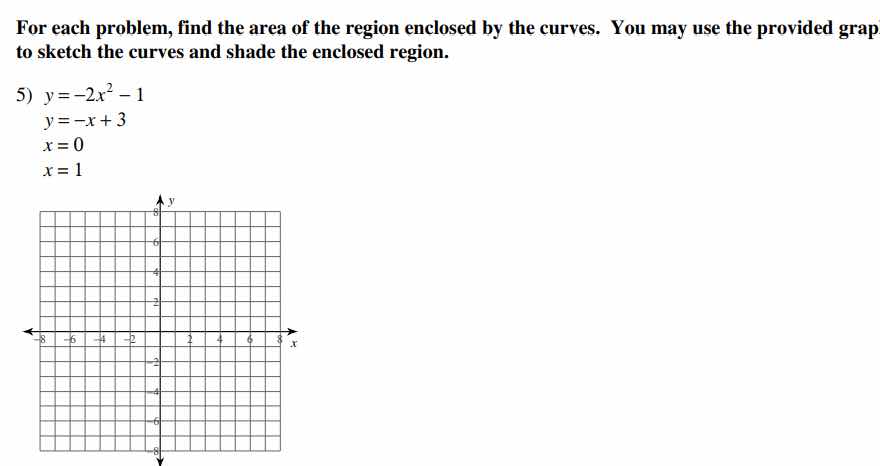
for each problem, find the area of the region enclosed by the curves. you may use the provided graph to sketch the curves and shade the enclosed region.\n\n5) $y = -2x^2 - 1$\n$y = -x + 3$\n$x = 0$\n$x = 1$
Answer
Explanation:
Step1: Identify the upper and lower functions
On the interval $[0, 1]$, $y = -x + 3$ is greater than $y = -2x^2 - 1$. $$f(x) = -x + 3, \quad g(x) = -2x^2 - 1$$
Step2: Set up the definite integral for area
The area $A$ is the integral of the upper minus lower function. $$A = \int_{0}^{1} [(-x + 3) - (-2x^2 - 1)] , dx$$
Step3: Simplify the integrand
Combine like terms within the integral. $$A = \int_{0}^{1} (2x^2 - x + 4) , dx$$
Step4: Find the antiderivative
Apply the power rule for integration. $$\int (2x^2 - x + 4) , dx = \frac{2}{3}x^3 - \frac{1}{2}x^2 + 4x$$
Step5: Evaluate at the boundaries
Substitute the limits $x=1$ and $x=0$ into the antiderivative. $$A = \left[ \frac{2}{3}(1)^3 - \frac{1}{2}(1)^2 + 4(1) \right] - [0]$$
Step6: Calculate the final value
Find a common denominator to sum the fractions. $$A = \frac{2}{3} - \frac{1}{2} + 4 = \frac{4 - 3 + 24}{6} = \frac{25}{6}$$
Answer:
$\frac{25}{6}$