for each problem, find the: x and y intercepts, asymptotes, x - coordinates of the critical points, open…
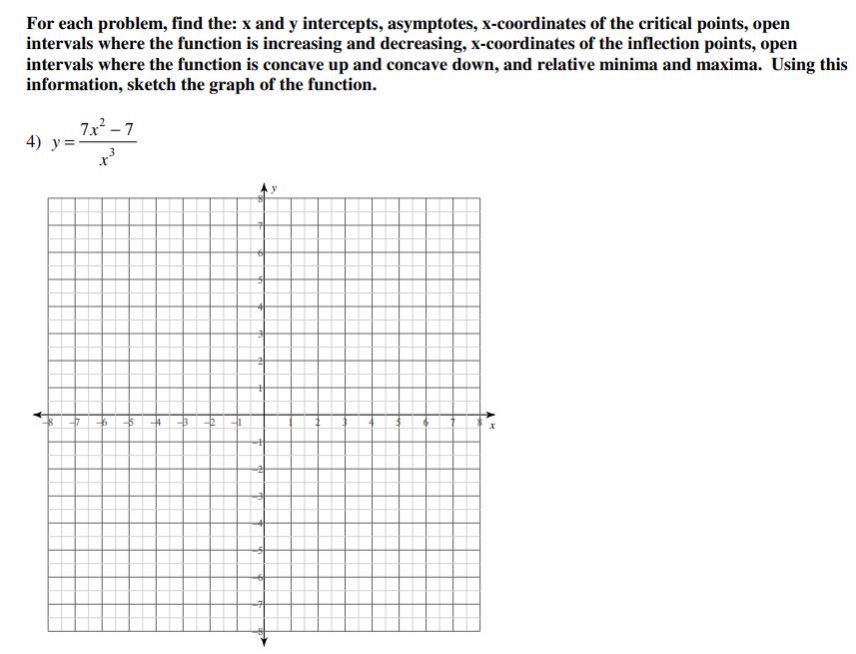
for each problem, find the: x and y intercepts, asymptotes, x - coordinates of the critical points, open intervals where the function is increasing and decreasing, x - coordinates of the inflection points, open intervals where the function is concave up and concave down, and relative minima and maxima. using this information, sketch the graph of the function.\n4) $y = \\frac{7x^{2}-7}{x^{3}}$
Answer
Explanation:
Step1: Find x - intercept
Set $y = 0$, then $\frac{7x^{2}-7}{x^{3}}=0$, which means $7x^{2}-7 = 0$ and $x\neq0$. Solving $7x^{2}-7 = 0$, we get $x^{2}=1$, so $x=\pm1$.
Step2: Find y - intercept
The function $y=\frac{7x^{2}-7}{x^{3}}$ is undefined at $x = 0$, so there is no y - intercept.
Step3: Find asymptotes
Vertical asymptote: Set the denominator equal to zero. Since $x^{3}=0$ when $x = 0$, $x = 0$ is a vertical asymptote. Horizontal asymptote: $\lim_{x\rightarrow\pm\infty}\frac{7x^{2}-7}{x^{3}}=\lim_{x\rightarrow\pm\infty}(\frac{7}{x}-\frac{7}{x^{3}})=0$, so $y = 0$ is a horizontal asymptote.
Step4: Find the first - derivative
Use the quotient rule. If $y=\frac{u}{v}$ where $u = 7x^{2}-7$ and $v=x^{3}$, then $u'=14x$ and $v' = 3x^{2}$. $y'=\frac{u'v - uv'}{v^{2}}=\frac{14x\cdot x^{3}-(7x^{2}-7)\cdot3x^{2}}{x^{6}}=\frac{14x^{4}-21x^{4}+21x^{2}}{x^{6}}=\frac{-7x^{4}+21x^{2}}{x^{6}}=\frac{-7x^{2}(x^{2}-3)}{x^{6}}=\frac{-7(x^{2}-3)}{x^{4}}(x\neq0)$. Set $y' = 0$, then $-7(x^{2}-3)=0$, so $x=\pm\sqrt{3}$.
Step5: Determine intervals of increase and decrease
Test intervals: For $x<-\sqrt{3}$, let $x=-2$, $y'=\frac{-7(4 - 3)}{16}<0$, the function is decreasing. For $-\sqrt{3}<x<0$, let $x=-1$, $y'=\frac{-7(1 - 3)}{1}>0$, the function is increasing. For $0<x<\sqrt{3}$, let $x = 1$, $y'=\frac{-7(1 - 3)}{1}>0$, the function is increasing. For $x>\sqrt{3}$, let $x = 2$, $y'=\frac{-7(4 - 3)}{16}<0$, the function is decreasing.
Step6: Find the second - derivative
$y'=\frac{-7x^{4}+21x^{2}}{x^{6}}$, using the quotient rule again. Let $u=-7x^{4}+21x^{2}$, $u'=-28x^{3}+42x$, $v = x^{6}$, $v'=6x^{5}$. $y''=\frac{(-28x^{3}+42x)\cdot x^{6}-(-7x^{4}+21x^{2})\cdot6x^{5}}{x^{12}}=\frac{-28x^{9}+42x^{7}+42x^{9}-126x^{7}}{x^{12}}=\frac{14x^{9}-84x^{7}}{x^{12}}=\frac{14x^{7}(x^{2}-6)}{x^{12}}=\frac{14(x^{2}-6)}{x^{5}}(x\neq0)$. Set $y'' = 0$, then $14(x^{2}-6)=0$, so $x=\pm\sqrt{6}$.
Step7: Determine concavity
For $x<-\sqrt{6}$, let $x=-3$, $y''=\frac{14(9 - 6)}{-243}<0$, concave down. For $-\sqrt{6}<x<0$, let $x=-1$, $y''=\frac{14(1 - 6)}{-1}>0$, concave up. For $0<x<\sqrt{6}$, let $x = 1$, $y''=\frac{14(1 - 6)}{1}<0$, concave down. For $x>\sqrt{6}$, let $x = 3$, $y''=\frac{14(9 - 6)}{243}>0$, concave up.
Step8: Find relative extrema
Since the function changes from decreasing to increasing at $x=-\sqrt{3}$, $y(-\sqrt{3})=\frac{7\times3 - 7}{-3\sqrt{3}}=-\frac{14}{3\sqrt{3}}$ is a relative minimum. Since the function changes from increasing to decreasing at $x=\sqrt{3}$, $y(\sqrt{3})=\frac{7\times3 - 7}{3\sqrt{3}}=\frac{14}{3\sqrt{3}}$ is a relative maximum.
Answer:
- x - intercepts: $x = 1,x=-1$
- y - intercept: None
- Vertical asymptote: $x = 0$
- Horizontal asymptote: $y = 0$
- x - coordinates of critical points: $x=-\sqrt{3},x=\sqrt{3}$
- Intervals of increase: $(-\sqrt{3},0),(0,\sqrt{3})$
- Intervals of decrease: $(-\infty,-\sqrt{3}),(\sqrt{3},\infty)$
- x - coordinates of inflection points: $x =-\sqrt{6},x=\sqrt{6}$
- Intervals of concave up: $(-\sqrt{6},0),(\sqrt{6},\infty)$
- Intervals of concave down: $(-\infty,-\sqrt{6}),(0,\sqrt{6})$
- Relative minimum: $y(-\sqrt{3})=-\frac{14}{3\sqrt{3}}$
- Relative maximum: $y(\sqrt{3})=\frac{14}{3\sqrt{3}}$