for each problem, find the: x and y intercepts, x - coordinates of the critical points, open intervals where…
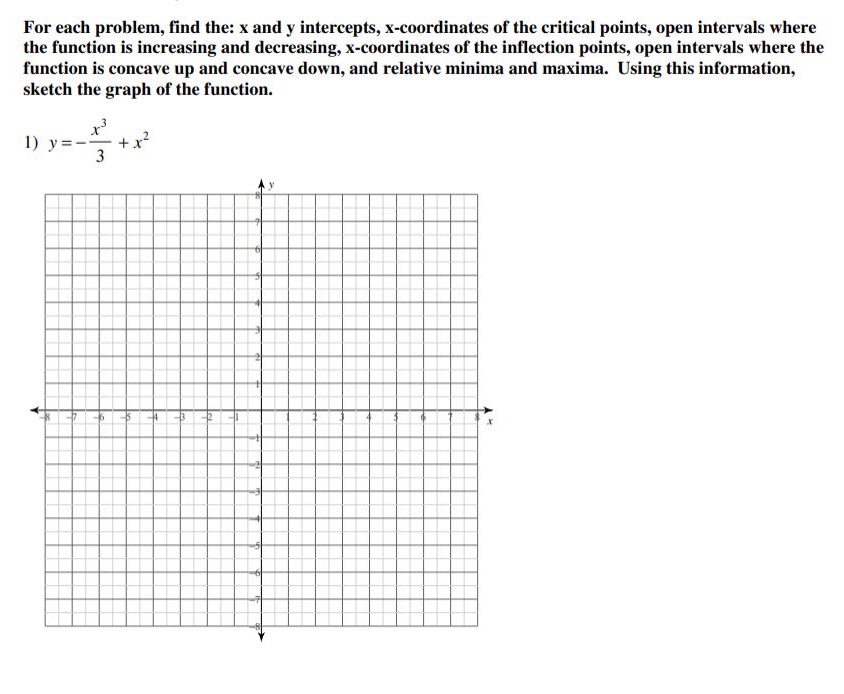
for each problem, find the: x and y intercepts, x - coordinates of the critical points, open intervals where the function is increasing and decreasing, x - coordinates of the inflection points, open intervals where the function is concave up and concave down, and relative minima and maxima. using this information, sketch the graph of the function.\n1) $y =-\frac{x^{3}}{3}+x^{2}$
Answer
Explanation:
Step1: 求x - 截距
令$y = 0$,即$-\frac{x^{3}}{3}+x^{2}=0$,提取公因式$x^{2}$得$x^{2}(1 - \frac{x}{3})=0$,解得$x = 0$或$x = 3$。
Step2: 求y - 截距
令$x = 0$,则$y=0$。
Step3: 求一阶导数
对$y =-\frac{x^{3}}{3}+x^{2}$求导,$y^\prime=-x^{2}+2x$。
Step4: 求临界值
令$y^\prime = 0$,即$-x^{2}+2x = 0$,提取公因式$x$得$x(2 - x)=0$,解得$x = 0$或$x = 2$。
Step5: 确定单调区间
当$y^\prime>0$时,函数递增,$-x^{2}+2x>0$,即$x(2 - x)>0$,解得$0<x<2$,递增区间为$(0,2)$;当$y^\prime<0$时,函数递减,解得$x<0$或$x>2$,递减区间为$(-\infty,0)\cup(2,+\infty)$。
Step6: 求二阶导数
对$y^\prime=-x^{2}+2x$求导,$y^{\prime\prime}=-2x + 2$。
Step7: 求拐点
令$y^{\prime\prime}=0$,即$-2x + 2=0$,解得$x = 1$。
Step8: 确定凹凸区间
当$y^{\prime\prime}>0$时,函数上凹,$-2x + 2>0$,解得$x<1$,上凹区间为$(-\infty,1)$;当$y^{\prime\prime}<0$时,函数下凹,解得$x>1$,下凹区间为$(1,+\infty)$。
Step9: 求极值
因为$y^\prime$在$x = 0$左侧小于0,右侧大于0,所以$x = 0$处为极小值点,$y(0)=0$;$y^\prime$在$x = 2$左侧大于0,右侧小于0,所以$x = 2$处为极大值点,$y(2)=-\frac{8}{3}+4=\frac{4}{3}$。
Answer:
x - 截距:$x = 0,x = 3$;y - 截距:$y = 0$; 临界值:$x = 0,x = 2$; 递增区间:$(0,2)$;递减区间:$(-\infty,0)\cup(2,+\infty)$; 拐点:$x = 1$; 上凹区间:$(-\infty,1)$;下凹区间:$(1,+\infty)$; 极小值:$y(0)=0$;极大值:$y(2)=\frac{4}{3}$ 。