for each problem, find the: x and y intercepts, x-coordinates of the critical points, open intervals where…
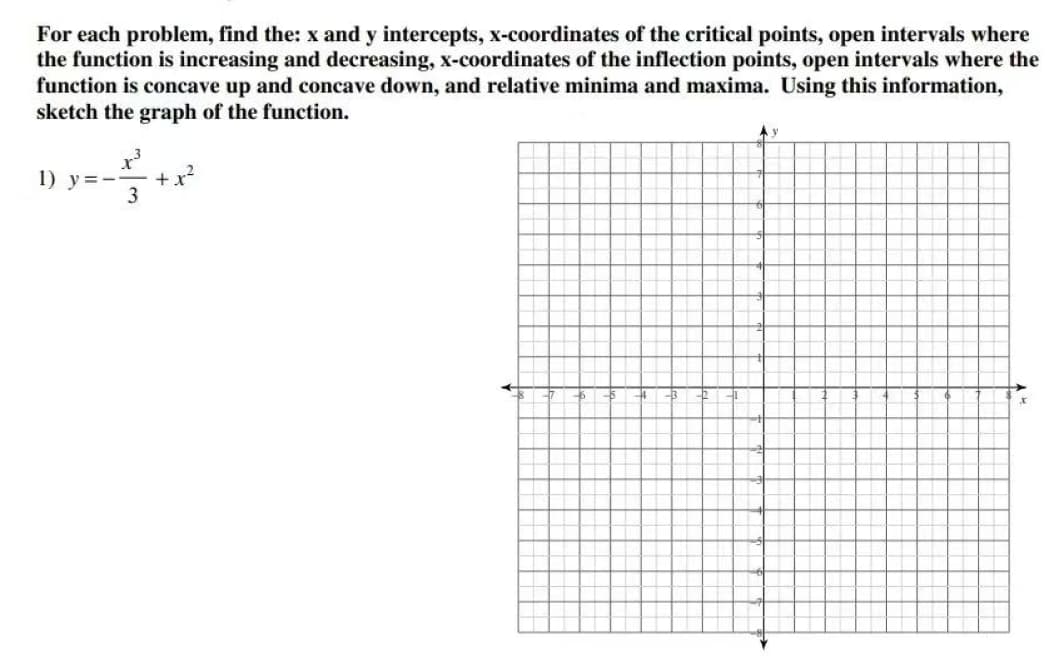
for each problem, find the: x and y intercepts, x-coordinates of the critical points, open intervals where the function is increasing and decreasing, x-coordinates of the inflection points, open intervals where the function is concave up and concave down, and relative minima and maxima. using this information, sketch the graph of the function.\n1) $y=\\frac{x^3}{3}+x^2$
Answer
Explanation:
Step1: Find x-intercepts (set $y=0$)
$$-\frac{x^3}{3}+x^2=0$$ $$x^2\left(-\frac{x}{3}+1\right)=0$$ $$x^2=0 \text{ or } -\frac{x}{3}+1=0$$ $$x=0, x=3$$
Step2: Find y-intercept (set $x=0$)
$$y=-\frac{0^3}{3}+0^2=0$$
Step3: Find critical points (solve $y'=0$)
First compute derivative: $$y' = -x^2 + 2x$$ Set $y'=0$: $$-x^2+2x=0$$ $$x(-x+2)=0$$ $$x=0, x=2$$
Step4: Test increasing/decreasing intervals
Use test points for $(-\infty,0)$, $(0,2)$, $(2,\infty)$:
- For $x=-1$: $y'=-(-1)^2+2(-1)=-3<0$ (decreasing)
- For $x=1$: $y'=-(1)^2+2(1)=1>0$ (increasing)
- For $x=3$: $y'=-(3)^2+2(3)=-3<0$ (decreasing)
Step5: Find relative min/max
- At $x=0$: function changes from decreasing to increasing? No, decreasing then increasing: relative minimum at $x=0$, $y=0$
- At $x=2$: function changes from increasing to decreasing: relative maximum at $x=2$, $y=-\frac{8}{3}+4=\frac{4}{3}$
Step6: Find inflection points (solve $y''=0$)
Compute second derivative: $$y''=-2x+2$$ Set $y''=0$: $$-2x+2=0$$ $$x=1$$
Step7: Test concavity intervals
Use test points for $(-\infty,1)$, $(1,\infty)$:
- For $x=0$: $y''=-2(0)+2=2>0$ (concave up)
- For $x=2$: $y''=-2(2)+2=-2<0$ (concave down)
Answer:
- Intercepts:
- x-intercepts: $(0,0)$ and $(3,0)$
- y-intercept: $(0,0)$
- Critical points (x-coordinates): $x=0$, $x=2$
- Increasing/Decreasing Intervals:
- Decreasing: $(-\infty, 0) \cup (2, \infty)$
- Increasing: $(0, 2)$
- Relative Extrema:
- Relative minimum: $(0, 0)$
- Relative maximum: $\left(2, \frac{4}{3}\right)$
- Inflection point (x-coordinate): $x=1$ (point: $\left(1, \frac{2}{3}\right)$)
- Concavity Intervals:
- Concave up: $(-\infty, 1)$
- Concave down: $(1, \infty)$
(Graph sketch guidance): Plot intercepts, extrema, inflection point; draw decreasing curve from left to $(0,0)$, increasing to $\left(2, \frac{4}{3}\right)$, then decreasing; curve is concave up until $x=1$, then concave down.