for each problem, find the: x and y - intercepts, x - coordinates of the critical points, open intervals…
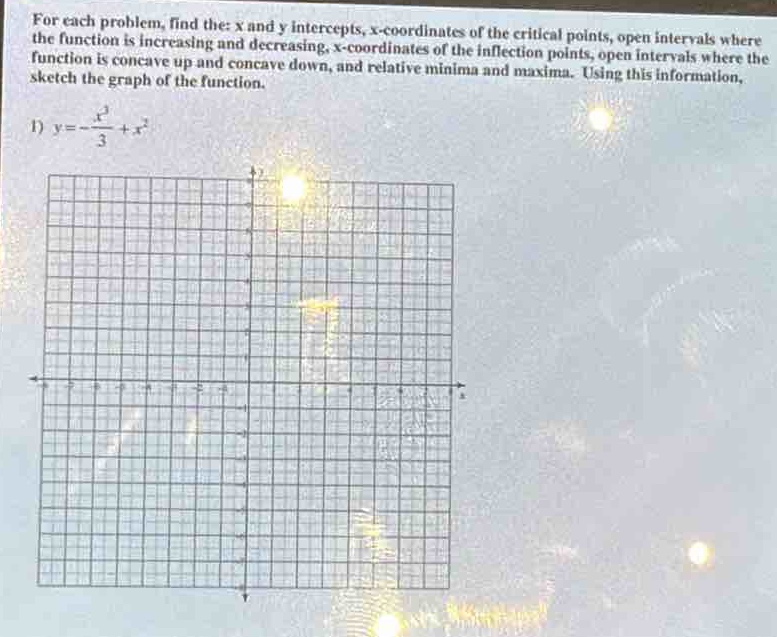
for each problem, find the: x and y - intercepts, x - coordinates of the critical points, open intervals where the function is increasing and decreasing, x - coordinates of the inflection points, open intervals where the function is concave up and concave down, and relative minima and maxima. using this information, sketch the graph of the function.\n1) $y = -\\frac{x^{3}}{3}+x^{2}$
Answer
Explanation:
Step1: Find x - intercepts
Set $y = 0$. So, $-\frac{x^{3}}{3}+x^{2}=0$. Factor out $x^{2}$: $x^{2}(1 - \frac{x}{3})=0$. Then $x = 0$ or $x = 3$.
Step2: Find y - intercepts
Set $x = 0$. Then $y=-\frac{0^{3}}{3}+0^{2}=0$.
Step3: Find the first - derivative
Differentiate $y =-\frac{x^{3}}{3}+x^{2}$ with respect to $x$. Using the power rule $\frac{d}{dx}(x^{n})=nx^{n - 1}$, we get $y'=-x^{2}+2x=-x(x - 2)$.
Step4: Find critical points
Set $y' = 0$. So, $-x(x - 2)=0$. The critical points are $x = 0$ and $x = 2$.
Step5: Determine intervals of increase and decrease
Test intervals:
- For $x\lt0$, let $x=-1$. Then $y'=-(-1)(-1 - 2)=-3\lt0$, so the function is decreasing on $(-\infty,0)$.
- For $0\lt x\lt2$, let $x = 1$. Then $y'=-1(1 - 2)=1\gt0$, so the function is increasing on $(0,2)$.
- For $x\gt2$, let $x = 3$. Then $y'=-3(3 - 2)=-3\lt0$, so the function is decreasing on $(2,\infty)$.
Step6: Find the second - derivative
Differentiate $y'=-x^{2}+2x$ with respect to $x$. We get $y''=-2x + 2$.
Step7: Find inflection points
Set $y'' = 0$. So, $-2x + 2=0$, which gives $x = 1$.
Step8: Determine concavity
Test intervals:
- For $x\lt1$, let $x = 0$. Then $y''=-2(0)+2 = 2\gt0$, so the function is concave up on $(-\infty,1)$.
- For $x\gt1$, let $x = 2$. Then $y''=-2(2)+2=-2\lt0$, so the function is concave down on $(1,\infty)$.
Step9: Find relative extrema
- At $x = 0$, since the function changes from decreasing ($x\lt0$) to increasing ($0\lt x\lt2$), $y(0)=0$ is a relative minimum.
- At $x = 2$, since the function changes from increasing ($0\lt x\lt2$) to decreasing ($x\gt2$), $y(2)=-\frac{2^{3}}{3}+2^{2}=-\frac{8}{3}+4=\frac{4}{3}$ is a relative maximum.
Answer:
- x - intercepts: $x = 0,3$
- y - intercept: $y = 0$
- Critical points: $x = 0,2$
- Intervals of increase: $(0,2)$
- Intervals of decrease: $(-\infty,0)\cup(2,\infty)$
- Inflection point: $x = 1$
- Intervals of concavity up: $(-\infty,1)$
- Intervals of concavity down: $(1,\infty)$
- Relative minimum: $(0,0)$
- Relative maximum: $(2,\frac{4}{3})$