problem\n8. a fireman has to reach a burning building. determine the length of the shortest ladder that will…
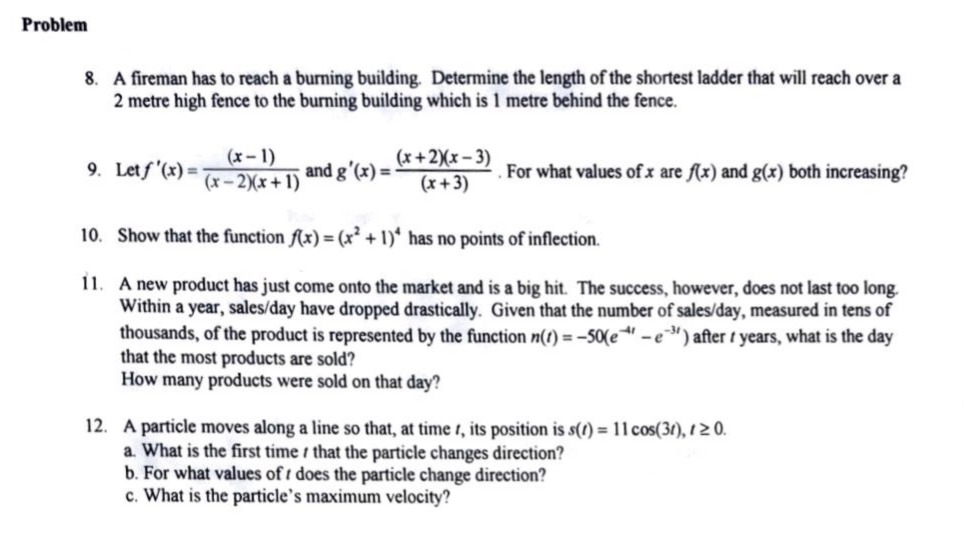
problem\n8. a fireman has to reach a burning building. determine the length of the shortest ladder that will reach over a 2 - metre high fence to the burning building which is 1 metre behind the fence.\n9. let $f(x)=\\frac{(x - 1)}{(x - 2)(x + 1)}$ and $g(x)=\\frac{(x + 2)(x - 3)}{(x + 3)}$. for what values of $x$ are $f(x)$ and $g(x)$ both increasing?\n10. show that the function $f(x)=(x^{2}+1)^{4}$ has no points of inflection.\n11. a new product has just come onto the market and is a big hit. the success, however, does not last too long. within a year, sales/day have dropped drastically. given that the number of sales/day, measured in tens of thousands, of the product is represented by the function $n(t)=-50(e^{-4t}-e^{-3t})$ after $t$ years, what is the day that the most products are sold? how many products were sold on that day?\n12. a particle moves along a line so that, at time $t$, its position is $s(t)=11\\cos(3t),t\\geq0$.\n a. what is the first time $t$ that the particle changes direction?\n b. for what values of $t$ does the particle change direction?\n c. what is the particles maximum velocity?
Answer
8.
Explanation:
Step1: Set up the geometric - trigonometric model
Let the angle that the ladder makes with the ground be $\theta$. The horizontal distance from the base of the ladder to the fence is $x$ and the height of the fence is $h = 2$m and the distance from the fence to the building is $d=1$m. The length of the ladder $L$ can be expressed as $L=\frac{2}{\sin\theta}+\frac{1}{\cos\theta}$.
Step2: Differentiate the function of $L$ with respect to $\theta$
We know that if $L(\theta)=\frac{2}{\sin\theta}+\frac{1}{\cos\theta}=2\csc\theta+\sec\theta$. Then $L'(\theta)=- 2\csc\theta\cot\theta+\sec\theta\tan\theta$. Set $L'(\theta) = 0$, so $-2\frac{\cos\theta}{\sin^{2}\theta}+\frac{\sin\theta}{\cos^{2}\theta}=0$. Cross - multiply to get $-2\cos^{3}\theta+\sin^{3}\theta = 0$, or $\tan^{3}\theta = 2$, so $\tan\theta=\sqrt[3]{2}$.
Step3: Calculate the length of the ladder
$\sin\theta=\frac{\sqrt[3]{2}}{\sqrt{1 + 2^{\frac{2}{3}}}}$ and $\cos\theta=\frac{1}{\sqrt{1 + 2^{\frac{2}{3}}}}$. $L=\frac{2}{\frac{\sqrt[3]{2}}{\sqrt{1 + 2^{\frac{2}{3}}}}}+\frac{1}{\frac{1}{\sqrt{1 + 2^{\frac{2}{3}}}}}=2\cdot2^{-\frac{1}{3}}\sqrt{1 + 2^{\frac{2}{3}}}+\sqrt{1 + 2^{\frac{2}{3}}}=\sqrt{1 + 2^{\frac{2}{3}}}(2^{\frac{2}{3}} + 1)=(2^{\frac{2}{3}}+1)^{\frac{3}{2}}\approx5.04$m.
Answer:
$(2^{\frac{2}{3}} + 1)^{\frac{3}{2}}$m
9.
Explanation:
Step1: Find where $f(x)$ is increasing
A function $y = f(x)$ is increasing when $f'(x)>0$. For $f'(x)=\frac{x - 1}{(x - 2)(x + 1)}$, we find the critical points by setting the numerator and denominator equal to zero. The critical points are $x=1,x = 2,x=-1$. Using a sign - chart, we test the intervals $(-\infty,-1),(-1,1),(1,2),(2,\infty)$. $f'(x)>0$ on the intervals $(-\infty,-1)$ and $(1,2)$.
Step2: Find where $g(x)$ is increasing
For $g'(x)=\frac{(x + 2)(x - 3)}{x+3}$, the critical points are $x=-2,x = 3,x=-3$. Using a sign - chart, we test the intervals $(-\infty,-3),(-3,-2),(-2,3),(3,\infty)$. $g'(x)>0$ on the intervals $(-3,-2)$ and $(3,\infty)$.
Step3: Find the intersection of the increasing intervals
The intersection of the intervals where $f(x)$ and $g(x)$ are increasing is the empty set $\varnothing$.
Answer:
$\varnothing$
10.
Explanation:
Step1: Find the first - derivative of $f(x)$
Using the chain rule, if $f(x)=(x^{2}+1)^{4}$, then $f'(x)=4(x^{2}+1)^{3}\cdot2x = 8x(x^{2}+1)^{3}$.
Step2: Find the second - derivative of $f(x)$
Using the product rule $(uv)'=u'v + uv'$ where $u = 8x$ and $v=(x^{2}+1)^{3}$. $u'=8$ and $v'=3(x^{2}+1)^{2}\cdot2x=6x(x^{2}+1)^{2}$. $f''(x)=8(x^{2}+1)^{3}+8x\cdot6x(x^{2}+1)^{2}=8(x^{2}+1)^{2}(x^{2}+1 + 6x^{2})=8(x^{2}+1)^{2}(7x^{2}+1)$.
Step3: Determine the inflection points
Set $f''(x)=0$. Since $(x^{2}+1)^{2}>0$ and $7x^{2}+1>0$ for all real $x$, there are no real solutions for $f''(x)=0$. So the function $f(x)$ has no points of inflection.
Answer:
The function $f(x)=(x^{2}+1)^{4}$ has no points of inflection.
11.
Explanation:
Step1: Find the derivative of $n(t)$
Given $n(t)=-50(e^{-4t}-e^{-3t})$, then $n'(t)=-50(-4e^{-4t}+3e^{-3t})=50e^{-4t}(4 - 3e^{t})$.
Step2: Set the derivative equal to zero to find the critical points
Set $n'(t)=0$. Since $e^{-4t}>0$ for all $t\geq0$, we solve $4 - 3e^{t}=0$. So $e^{t}=\frac{4}{3}$, and $t=\ln(\frac{4}{3})$.
Step3: Find the number of products sold at the critical point
Substitute $t = \ln(\frac{4}{3})$ into $n(t)$: $n(\ln(\frac{4}{3}))=-50(e^{-4\ln(\frac{4}{3})}-e^{-3\ln(\frac{4}{3})})=-50((\frac{4}{3})^{-4}-(\frac{4}{3})^{-3})=-50\cdot\frac{3^{4}-3^{3}\cdot4}{4^{4}}=\frac{50\cdot3^{3}}{4^{4}}=\frac{1350}{256}\approx5.27$ (in tens of thousands).
Answer:
The day when the most products are sold is $t=\ln(\frac{4}{3})$ years. The number of products sold is $\frac{1350}{256}\times10000\approx52734$
12.
Explanation:
a.
Step1: Find the velocity function
The velocity function $v(t)=s'(t)$. Given $s(t)=11\cos(3t)$, then $v(t)=-33\sin(3t)$.
Step2: Find when the velocity changes sign
The particle changes direction when $v(t)$ changes sign, i.e., $v(t) = 0$. So $-33\sin(3t)=0$, which gives $3t = k\pi$, $t=\frac{k\pi}{3}$, $k\in\mathbb{Z}$. Since $t\geq0$, the first non - zero value of $t$ for which the particle changes direction is $t=\frac{\pi}{3}$.
b.
Step1: Determine the general solution for when the velocity is zero
We know that $v(t)=-33\sin(3t)=0$. So $3t = k\pi$, $t=\frac{k\pi}{3}$, $k\in\mathbb{N}\cup{0}$.
c.
Step1: Find the acceleration function
The acceleration function $a(t)=v'(t)=-99\cos(3t)$. The maximum value of $|v(t)|$ occurs when $|\sin(3t)| = 1$. The maximum value of $v(t)$ is $|v(t)|_{max}=33$.
Answer:
a. $t=\frac{\pi}{3}$ b. $t=\frac{k\pi}{3},k\in\mathbb{N}\cup{0}$ c. $33$