problem 2. let f ∈ c¹(ℝ), f(x + 1) = f(x), for all x, then we have ||f||∞ ≤ ∫₀¹ |f(t)|dt + ∫₀¹ |f(t)|dt…
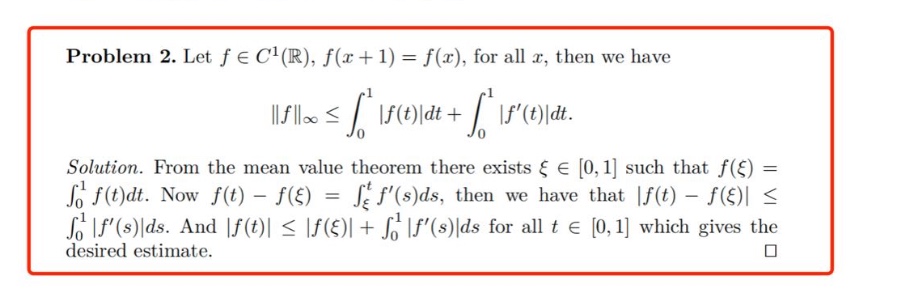
problem 2. let f ∈ c¹(ℝ), f(x + 1) = f(x), for all x, then we have ||f||∞ ≤ ∫₀¹ |f(t)|dt + ∫₀¹ |f(t)|dt. solution. from the mean - value theorem there exists ξ ∈ 0,1 such that f(ξ) = ∫₀¹ f(t)dt. now f(t) - f(ξ) = ∫_ξ^t f(s)ds, then we have that |f(t) - f(ξ)| ≤ ∫₀¹ |f(s)|ds. and |f(t)| ≤ |f(ξ)| + ∫₀¹ |f(s)|ds for all t ∈ 0,1 which gives the desired estimate.
Answer
Explanation:
Step1: Apply mean - value theorem
By the mean - value theorem for integrals, since (f\in C^{1}(\mathbb{R})) and (f(x + 1)=f(x)) for all (x), there exists (\xi\in[0,1]) such that (f(\xi)=\int_{0}^{1}f(t)dt).
Step2: Use fundamental theorem of calculus
We know that (f(t)-f(\xi)=\int_{\xi}^{t}f^{\prime}(s)ds). Then, by the property of absolute - value of integrals, (|f(t)-f(\xi)|\leq\int_{0}^{1}|f^{\prime}(s)|ds).
Step3: Manipulate the absolute - value inequality
From (|f(t)-f(\xi)|\leq\int_{0}^{1}|f^{\prime}(s)|ds), we can rewrite it as (|f(t)|\leq|f(\xi)|+\int_{0}^{1}|f^{\prime}(s)|ds). Since (|f(\xi)|=\left|\int_{0}^{1}f(t)dt\right|\leq\int_{0}^{1}|f(t)|dt), we get (|f|{\infty}\leq\int{0}^{1}|f(t)|dt+\int_{0}^{1}|f^{\prime}(t)|dt).
Answer:
The proof shows that (|f|{\infty}\leq\int{0}^{1}|f(t)|dt+\int_{0}^{1}|f^{\prime}(t)|dt) for (f\in C^{1}(\mathbb{R})) with (f(x + 1)=f(x)) for all (x).