problem set for integration by parts\ni. determine the integrals\n1. $int 2x^{2}ln x dx$\n2. $int 2e^{5x}cos…
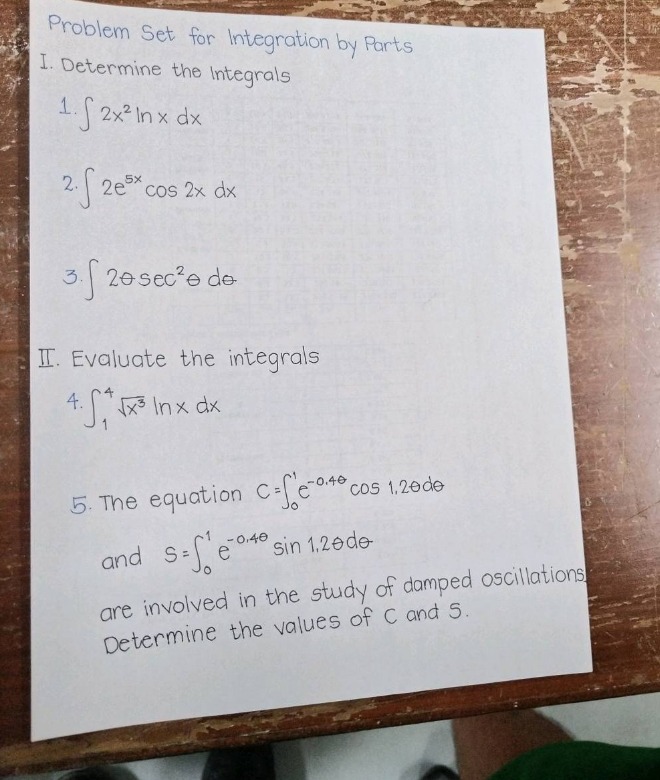
problem set for integration by parts\ni. determine the integrals\n1. $int 2x^{2}ln x dx$\n2. $int 2e^{5x}cos 2x dx$\n3. $int 2\thetasec^{2}\theta d\theta$\nii. evaluate the integrals\n4. $int_{1}^{4}sqrt{x^{3}}ln x dx$\n5. the equation $c = int_{0}^{1}e^{- 0.4\theta}cos1.2\theta d\theta$\nand $s=int_{0}^{1}e^{-0.4\theta}sin1.2\theta d\theta$\nare involved in the study of damped oscillations. determine the values of c and s.
Answer
1. $\int 2x^{2}\ln xdx$
Explanation:
Step1: Apply integration - by - parts formula $\int u dv=uv-\int v du$
Let $u = \ln x$, $dv=2x^{2}dx$. Then $du=\frac{1}{x}dx$, $v=\frac{2}{3}x^{3}$.
Step2: Substitute into the formula
$\int 2x^{2}\ln xdx=\frac{2}{3}x^{3}\ln x-\int\frac{2}{3}x^{3}\cdot\frac{1}{x}dx$ $=\frac{2}{3}x^{3}\ln x-\frac{2}{3}\int x^{2}dx$
Step3: Integrate $x^{2}$
$=\frac{2}{3}x^{3}\ln x-\frac{2}{3}\cdot\frac{1}{3}x^{3}+C=\frac{2}{3}x^{3}\ln x-\frac{2}{9}x^{3}+C$
Answer:
$\frac{2}{3}x^{3}\ln x-\frac{2}{9}x^{3}+C$
2. $\int 2e^{5x}\cos(2x)dx$
Explanation:
Step1: Apply integration - by - parts twice
Let $u = \cos(2x)$, $dv = 2e^{5x}dx$, then $du=- 2\sin(2x)dx$, $v=\frac{2}{5}e^{5x}$. $\int 2e^{5x}\cos(2x)dx=\frac{2}{5}e^{5x}\cos(2x)+\frac{4}{5}\int e^{5x}\sin(2x)dx$ For $\int e^{5x}\sin(2x)dx$, let $u=\sin(2x)$, $dv = e^{5x}dx$, then $du = 2\cos(2x)dx$, $v=\frac{1}{5}e^{5x}$ $\int e^{5x}\sin(2x)dx=\frac{1}{5}e^{5x}\sin(2x)-\frac{2}{5}\int e^{5x}\cos(2x)dx$
Step2: Substitute the second - integration - by - parts result into the first
$\int 2e^{5x}\cos(2x)dx=\frac{2}{5}e^{5x}\cos(2x)+\frac{4}{5}(\frac{1}{5}e^{5x}\sin(2x)-\frac{2}{5}\int e^{5x}\cos(2x)dx)$ $\int 2e^{5x}\cos(2x)dx=\frac{2}{5}e^{5x}\cos(2x)+\frac{4}{25}e^{5x}\sin(2x)-\frac{8}{25}\int e^{5x}\cos(2x)dx$ $\int 2e^{5x}\cos(2x)dx+\frac{8}{25}\int e^{5x}\cos(2x)dx=\frac{2}{5}e^{5x}\cos(2x)+\frac{4}{25}e^{5x}\sin(2x)$ $\frac{50 + 8}{25}\int e^{5x}\cos(2x)dx=\frac{2}{5}e^{5x}\cos(2x)+\frac{4}{25}e^{5x}\sin(2x)$ $\int 2e^{5x}\cos(2x)dx=\frac{10}{29}e^{5x}\cos(2x)+\frac{4}{29}e^{5x}\sin(2x)+C$
Answer:
$\frac{10}{29}e^{5x}\cos(2x)+\frac{4}{29}e^{5x}\sin(2x)+C$
3. $\int 2\theta\sec^{2}\theta d\theta$
Explanation:
Step1: Apply integration - by - parts
Let $u = 2\theta$, $dv=\sec^{2}\theta d\theta$. Then $du = 2d\theta$, $v=\tan\theta$.
Step2: Substitute into the formula
$\int 2\theta\sec^{2}\theta d\theta=2\theta\tan\theta-\int 2\tan\theta d\theta$
Step3: Integrate $\tan\theta$
$=2\theta\tan\theta + 2\ln|\cos\theta|+C$
Answer:
$2\theta\tan\theta + 2\ln|\cos\theta|+C$
4. $\int_{1}^{4}\sqrt{x^{3}}\ln xdx$
Explanation:
Step1: Apply integration - by - parts
Let $u=\ln x$, $dv = x^{\frac{3}{2}}dx$. Then $du=\frac{1}{x}dx$, $v=\frac{2}{5}x^{\frac{5}{2}}$. $\int x^{\frac{3}{2}}\ln xdx=\frac{2}{5}x^{\frac{5}{2}}\ln x-\int\frac{2}{5}x^{\frac{5}{2}}\cdot\frac{1}{x}dx=\frac{2}{5}x^{\frac{5}{2}}\ln x-\frac{2}{5}\int x^{\frac{3}{2}}dx$ $=\frac{2}{5}x^{\frac{5}{2}}\ln x-\frac{2}{5}\cdot\frac{2}{5}x^{\frac{5}{2}}+C=\frac{2}{5}x^{\frac{5}{2}}\ln x-\frac{4}{25}x^{\frac{5}{2}}+C$
Step2: Evaluate the definite integral
$\int_{1}^{4}\sqrt{x^{3}}\ln xdx=\left[\frac{2}{5}x^{\frac{5}{2}}\ln x-\frac{4}{25}x^{\frac{5}{2}}\right]_{1}^{4}$ $=\left(\frac{2}{5}\times4^{\frac{5}{2}}\ln 4-\frac{4}{25}\times4^{\frac{5}{2}}\right)-\left(\frac{2}{5}\times1^{\frac{5}{2}}\ln 1-\frac{4}{25}\times1^{\frac{5}{2}}\right)$ $=\left(\frac{2}{5}\times32\ln 4-\frac{4}{25}\times32\right)-\left(0 - \frac{4}{25}\right)$ $=\frac{64}{5}\ln 4-\frac{128}{25}+\frac{4}{25}=\frac{64}{5}\ln 4-\frac{124}{25}$
Answer:
$\frac{64}{5}\ln 4-\frac{124}{25}$
5.
For $C=\int_{0}^{1}e^{- 0.4\theta}\cos(1.2\theta)d\theta$ and $S=\int_{0}^{1}e^{-0.4\theta}\sin(1.2\theta)d\theta$
Explanation:
Step1: Apply integration - by - parts for $C$
Let $u=\cos(1.2\theta)$, $dv = e^{-0.4\theta}d\theta$, then $du=-1.2\sin(1.2\theta)d\theta$, $v=- 2.5e^{-0.4\theta}$ $C=-2.5e^{-0.4\theta}\cos(1.2\theta)-3\int e^{-0.4\theta}\sin(1.2\theta)d\theta=-2.5e^{-0.4\theta}\cos(1.2\theta)-3S$ For $S$, let $u=\sin(1.2\theta)$, $dv = e^{-0.4\theta}d\theta$, then $du = 1.2\cos(1.2\theta)d\theta$, $v=-2.5e^{-0.4\theta}$ $S=-2.5e^{-0.4\theta}\sin(1.2\theta)+3\int e^{-0.4\theta}\cos(1.2\theta)d\theta=-2.5e^{-0.4\theta}\sin(1.2\theta)+3C$
Step2: Evaluate the definite - integrals
When $\theta = 1$: $C=-2.5e^{-0.4}\cos(1.2)-3S$ and $S=-2.5e^{-0.4}\sin(1.2)+3C$ When $\theta = 0$: For $C$, $C|{\theta = 0}=-2.5\cos(0)-3S|{\theta = 0}=-2.5$ For $S$, $S|{\theta = 0}=-2.5\sin(0)+3C|{\theta = 0}=0$ We have the system of equations: $\begin{cases}C=-2.5e^{-0.4}\cos(1.2)-3S\S=-2.5e^{-0.4}\sin(1.2)+3C\end{cases}$ Solve the system: $C + 3S=-2.5e^{-0.4}\cos(1.2)$ and $-3C+S=-2.5e^{-0.4}\sin(1.2)$ Multiply the first equation by 3 and add it to the second equation: $3C + 9S-3C+S=-7.5e^{-0.4}\cos(1.2)-2.5e^{-0.4}\sin(1.2)$ $10S=-2.5e^{-0.4}(3\cos(1.2)+\sin(1.2))$ $S=-\frac{1}{4}e^{-0.4}(3\cos(1.2)+\sin(1.2))$ Substitute $S$ into $C + 3S=-2.5e^{-0.4}\cos(1.2)$ $C=-2.5e^{-0.4}\cos(1.2)-3\left(-\frac{1}{4}e^{-0.4}(3\cos(1.2)+\sin(1.2))\right)$ $C=e^{-0.4}\left(-\frac{5}{2}\cos(1.2)+\frac{9}{4}\cos(1.2)+\frac{3}{4}\sin(1.2)\right)$ $C=e^{-0.4}\left(-\frac{10 - 9}{4}\cos(1.2)+\frac{3}{4}\sin(1.2)\right)=e^{-0.4}\left(-\frac{1}{4}\cos(1.2)+\frac{3}{4}\sin(1.2)\right)$
Answer:
$C = e^{-0.4}\left(-\frac{1}{4}\cos(1.2)+\frac{3}{4}\sin(1.2)\right)$, $S=-\frac{1}{4}e^{-0.4}(3\cos(1.2)+\sin(1.2))$