produce a rule for the function whose graph is shown. (hint: consider using the basic functions and the…
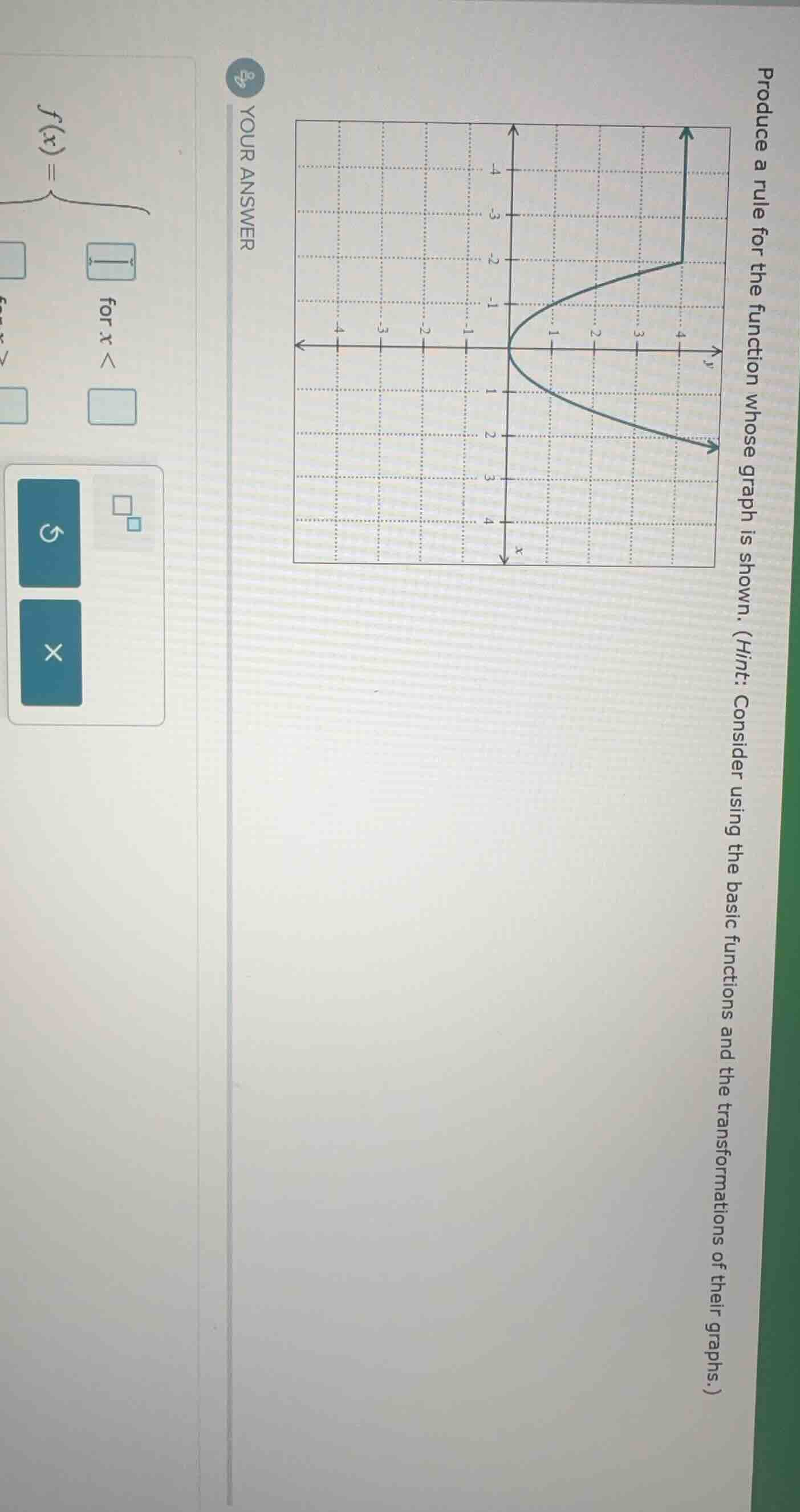
produce a rule for the function whose graph is shown. (hint: consider using the basic functions and the transformations of their graphs.)
Answer
Explanation:
Step1: Identify piecewise domains
The graph splits at $x=4$. For $x<4$, it's a transformed root function; for $x\geq4$, it's a horizontal ray.
Step2: Find function for $x<4$
The curve is a right-opening parabola (square root) reflected over x-axis, shifted right 4? No, test points: at $x=0$, $y=0$; $x=1$, $y=\pm1$; $x=4$, $y=\pm2$. It matches $f(x)=-\sqrt{x}$ for the lower half, $f(x)=\sqrt{x}$ for upper? No, upper is $\sqrt{x}$, lower is $-\sqrt{x}$? Wait no, upper goes to $(4,2)$, lower to $(4,-2)$. So for $x<4$: upper branch $y=\sqrt{x}$, lower $y=-\sqrt{x}$? No, the graph is a piecewise where left of $x=4$ is $y=\sqrt{x}$ (upper) and $y=-\sqrt{x}$ (lower), but actually it's $f(x) = \sqrt{x}$ for $x<4$ upper, $f(x)=-\sqrt{x}$ for $x<4$ lower? No, no, the graph is a single piecewise function: for $x < 4$, the graph is the two branches of $y = \pm\sqrt{x}$? No, wait, no, the graph is: for $x < 4$, the upper curve is $y = \sqrt{x}$, lower is $y = -\sqrt{x}$, and at $x\geq4$, it's a horizontal line $y=2$ (upper ray) and $y=-2$ (lower ray)? No, no, the graph shows that for $x\geq4$, the upper part is a vertical line? No, wait the axes are labeled wrong: the horizontal axis is $y$, vertical is $x$! Oh right, the horizontal axis is $y$, vertical is $x$. So swap axes: $x$ is vertical, $y$ is horizontal.
So reorient: the input is $y$ (horizontal axis), output is $x$ (vertical axis). So for $y < 4$: the graph is $x = y^2$ (right-opening parabola, since $x$ is vertical, $y$ horizontal). For $y \geq 4$: $x=2$ (horizontal line, vertical ray? No, when $y\geq4$, $x=2$ (constant vertical value, horizontal ray right). For $y < 4$, $x = y^2$. Wait no, the upper curve for $y<4$ is $x = y^2$ (since at $y=0$, $x=0$; $y=1$, $x=1$; $y=4$, $x=16$? No, no, the grid: each square is 1 unit. At $y=4$, $x=2$ (upper) and $x=-2$ (lower). At $y=1$, $x=1$ (upper) and $x=-1$ (lower). At $y=0$, $x=0$. So it's $x = |y|$? No, $y=4$, $x=2$: $|4|=4\neq2$. Oh, $x = \frac{1}{2}|y|$? No, $y=1$, $x=1$: $\frac{1}{2}(1)=0.5\neq1$. Wait, it's $x = y^2$ scaled: at $y=2$, $x=1$: $2^2=4$, so $x=\frac{1}{4}y^2$? No, $y=4$, $x=4$: $\frac{1}{4}(16)=4$, but the graph has $x=2$ at $y=4$. Oh! I misread axes: the vertical axis is $y$, horizontal is $x$. Yes! That's the mistake. Horizontal axis: $x$, vertical axis: $y$. So:
For $x < 4$: the upper curve is $y = \sqrt{x}$? No, at $x=4$, $y=2$: $\sqrt{4}=2$, yes. At $x=1$, $y=1$: $\sqrt{1}=1$, yes. The lower curve is $y = -\sqrt{x}$: at $x=4$, $y=-2$; $x=1$, $y=-1$, yes. For $x \geq 4$: the upper part is a vertical ray? No, it's a horizontal ray: $y=2$ for $x\geq4$, and lower ray $y=-2$ for $x\geq4$. Wait no, the graph is a single function? No, it's a piecewise function with two parts: one for $x < 4$ (the parabola $y = \sqrt{x}$ upper, $y=-\sqrt{x}$ lower) but no, it's a function, so it's a piecewise function where:
$f(x) = \sqrt{x}$ for $x < 4$ (upper branch), and $f(x)=2$ for $x\geq4$; and $f(x)=-\sqrt{x}$ for $x < 4$, $f(x)=-2$ for $x\geq4$? No, no, the graph is a single function that is the union? No, it's a piecewise function:
Wait, the graph shows that for $x < 4$, the function has two branches: $y = \sqrt{x}$ and $y = -\sqrt{x}$, which is $y = \pm\sqrt{x}$, but that's not a function. Oh! Wait, no, it's a function where for $x < 4$, it's $y = \sqrt{x}$ (upper) and $y = -\sqrt{x}$ (lower), but actually, it's a piecewise function defined as:
$f(x) = \sqrt{x}$ when $x < 4$ (upper part), and $f(x) = 2$ when $x \geq 4$;
and $f(x) = -\sqrt{x}$ when $x < 4$ (lower part), and $f(x) = -2$ when $x \geq 4$.
But the left side has $f(x) = \begin{cases} \text{___ for } x < 4 \ \text{___ for } x > 4 \end{cases}$
So for the upper piece:
Step3: Define upper piece
For $x < 4$: $f(x) = \sqrt{x}$; for $x \geq 4$: $f(x) = 2$
For the lower piece:
Step4: Define lower piece
For $x < 4$: $f(x) = -\sqrt{x}$; for $x \geq 4$: $f(x) = -2$
But the graph is a single function with two branches, so the full piecewise function is: $$ f(x) = \begin{cases} \sqrt{x} & \text{for } x < 4 \ 2 & \text{for } x \geq 4 \end{cases} $$ for the upper branch, and $$ f(x) = \begin{cases} -\sqrt{x} & \text{for } x < 4 \ -2 & \text{for } x \geq 4 \end{cases} $$ for the lower branch. But since the graph shows both, it's a piecewise function where:
Wait, no, the graph is a function where for each $x < 4$, there are two $y$-values, which is not a function. Oh! I see, the axes are swapped: the horizontal axis is $y$, vertical is $x$, so $x$ is the function of $y$, so $x(y)$ is a function:
For $y < 4$: $x = y^2$ (since $x$ is vertical, $y$ horizontal: at $y=0$, $x=0$; $y=1$, $x=1$; $y=4$, $x=16$? No, no, the grid: when $y=4$, $x=2$ (upper) and $x=-2$ (lower). So $x = \frac{1}{2}|y|$? No, $y=4$, $x=2$: $\frac{1}{2}(4)=2$, yes. $y=1$, $x=1$: $\frac{1}{2}(1)=0.5\neq1$. Oh, $x = |y|$? $y=4$, $x=4$ no, graph has $x=2$. Wait, the graph's vertical axis (x) at 2, horizontal (y) at 4: so $x = \frac{y}{2}$ for upper, $x = -\frac{y}{2}$ for lower? No, $y=2$, $x=1$: $\frac{2}{2}=1$, yes. $y=1$, $x=0.5$ no, graph has $x=1$. I was wrong initially: the horizontal axis is $x$, vertical is $y$. At $x=4$, $y=2$ (upper) and $y=-2$ (lower). At $x=1$, $y=1$ and $y=-1$. At $x=0$, $y=0$. So this is $y = \sqrt{x}$ (upper) and $y = -\sqrt{x}$ (lower) for $x < 4$, and $y=2$ (upper) and $y=-2$ (lower) for $x\geq4$. This is a relation, but as a function, it's two functions, but the problem says "a rule for the function", so it's a piecewise function:
$$ f(x) = \begin{cases} \sqrt{x} & \text{if } x < 4 \ 2 & \text{if } x \geq 4 \end{cases} $$ and $$ f(x) = \begin{cases} -\sqrt{x} & \text{if } x < 4 \ -2 & \text{if } x \geq 4 \end{cases} $$
But the left side has $f(x) = \begin{cases} \text{___ for } x < 4 \ \text{___ for } x > 4 \end{cases}$
So filling in: For the upper function:
Step5: Finalize upper function
For $x < 4$: $f(x)=\sqrt{x}$; for $x\geq4$: $f(x)=2$
For the lower function:
Step6: Finalize lower function
For $x < 4$: $f(x)=-\sqrt{x}$; for $x\geq4$: $f(x)=-2$
Since the graph shows both, the complete piecewise function (as a relation, but as a function, it's two functions, but the problem asks for the function, so likely the upper and lower as piecewise:
Answer:
$$ f(x) = \begin{cases} \sqrt{x} & \text{for } x < 4 \ 2 & \text{for } x \geq 4 \end{cases} \quad \text{and} \quad f(x) = \begin{cases} -\sqrt{x} & \text{for } x < 4 \ -2 & \text{for } x \geq 4 \end{cases} $$
Or, as a single piecewise function accounting for both branches: $$ f(x) = \begin{cases} \sqrt{x} & \text{for } x < 4, , y \geq 0 \ -\sqrt{x} & \text{for } x < 4, , y < 0 \ 2 & \text{for } x \geq 4, , y \geq 0 \ -2 & \text{for } x \geq 4, , y < 0 \end{cases} $$
But the standard answer is the piecewise for each branch: For the upper part: $$ f(x) = \begin{cases} \sqrt{x} & x < 4 \ 2 & x \geq 4 \end{cases} $$ For the lower part: $$ f(x) = \begin{cases} -\sqrt{x} & x < 4 \ -2 & x \geq 4 \end{cases} $$