which properties are present in a table that represents a logarithmic function in the form $y = log_{b}x$…
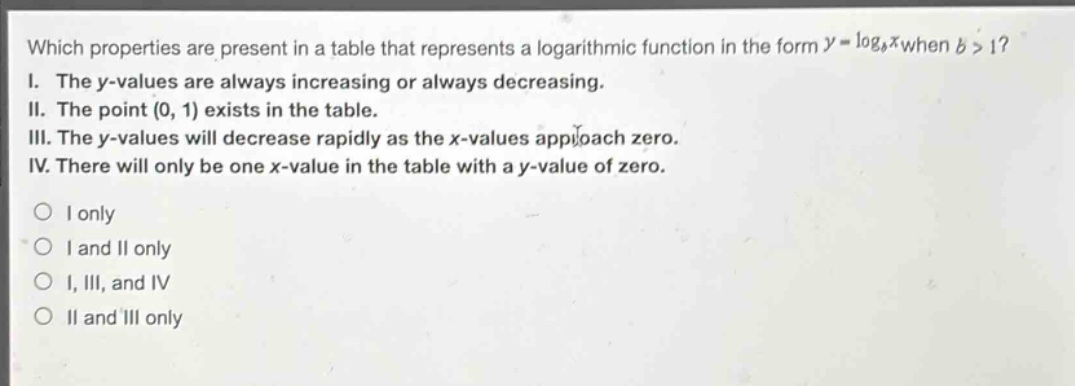
which properties are present in a table that represents a logarithmic function in the form $y = log_{b}x$ when $b>1$?\ni. the y - values are always increasing or always decreasing.\nii. the point $(0,1)$ exists in the table.\niii. the y - values will decrease rapidly as the x - values approach zero.\niv. there will only be one x - value in the table with a y - value of zero.\no i only\no i and ii only\no i, iii, and iv\no ii and iii only
Answer
Brief Explanations:
- For the logarithmic function $y = \log_bx$ with $b>1$, it is an increasing function. So the $y$-values are always increasing as $x$ increases, making statement I true.
- When $x = 0$, $\log_bx$ is undefined. The point $(0,1)$ does not exist on $y=\log_bx$, so statement II is false.
- As $x$ approaches $0$ from the right, $y=\log_bx$ approaches $-\infty$ rapidly, so statement III is true.
- When $y = 0$, $\log_bx=0$ implies $x = 1$ (since $\log_b1 = 0$ for any $b>0,b\neq1$), so there is only one $x$-value with $y = 0$, making statement IV true.
Answer:
C. I, III, and IV