prove the identity. \n\frac{cos ^{2}x}{1 - sin x}=1+sin x\nnote that each statement must be based on a rule…
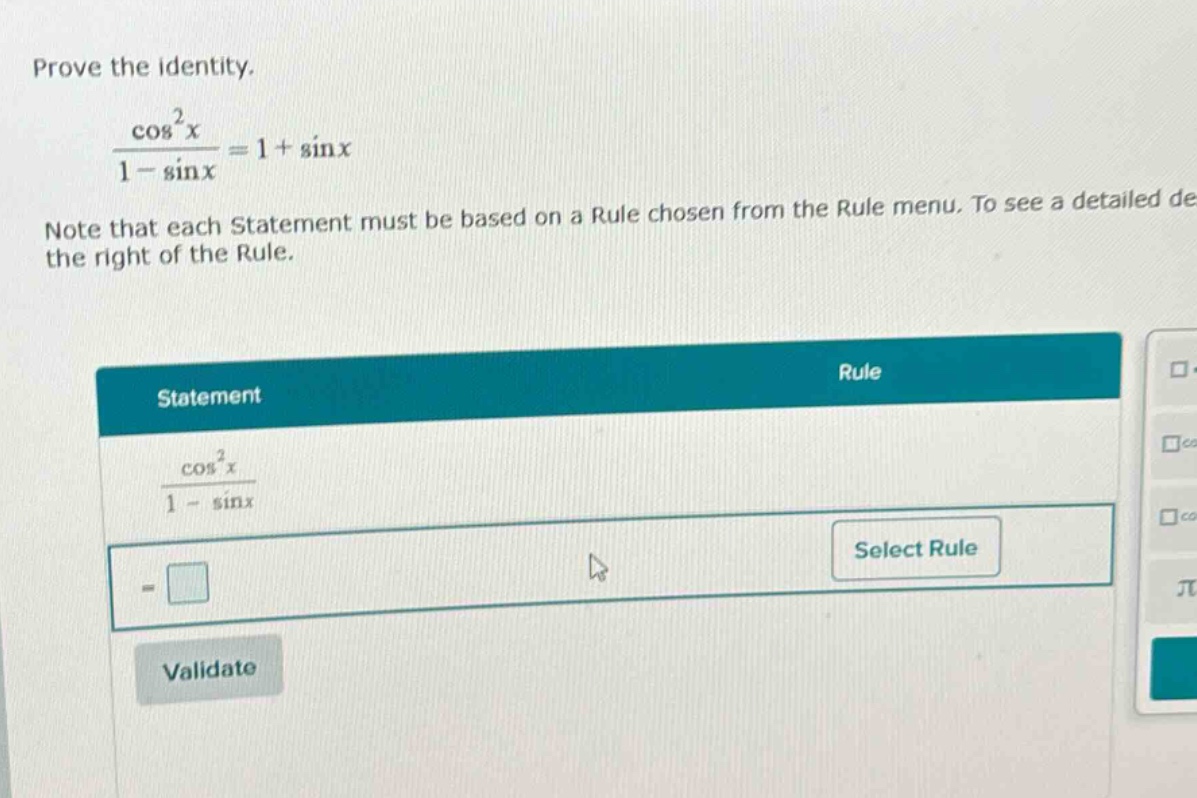
prove the identity. \n\frac{cos ^{2}x}{1 - sin x}=1+sin x\nnote that each statement must be based on a rule chosen from the rule menu. to see a detailed de the right of the rule.\nstatement\trule\n\frac{cos ^{2}x}{1 - sin x}\tselect rule\n= square\t\nvalidate
Answer
Explanation:
Step1: Use the Pythagorean identity
Recall that $\cos^{2}x=1 - \sin^{2}x$. So, $\frac{\cos^{2}x}{1-\sin x}=\frac{1 - \sin^{2}x}{1-\sin x}$.
Step2: Factor the numerator
Since $a^{2}-b^{2}=(a + b)(a - b)$, then $1-\sin^{2}x=(1+\sin x)(1 - \sin x)$. So, $\frac{1 - \sin^{2}x}{1-\sin x}=\frac{(1+\sin x)(1 - \sin x)}{1-\sin x}$.
Step3: Simplify the fraction
Cancel out the common factor $(1 - \sin x)$ in the numerator and denominator. $\frac{(1+\sin x)(1 - \sin x)}{1-\sin x}=1+\sin x$.
Answer:
The identity $\frac{\cos^{2}x}{1-\sin x}=1+\sin x$ is proved.