1. 5 pts sketch a possible graph of a function that satisfies the given conditions. f(-1)=3 lim x→-1⁻ f(x)=1…
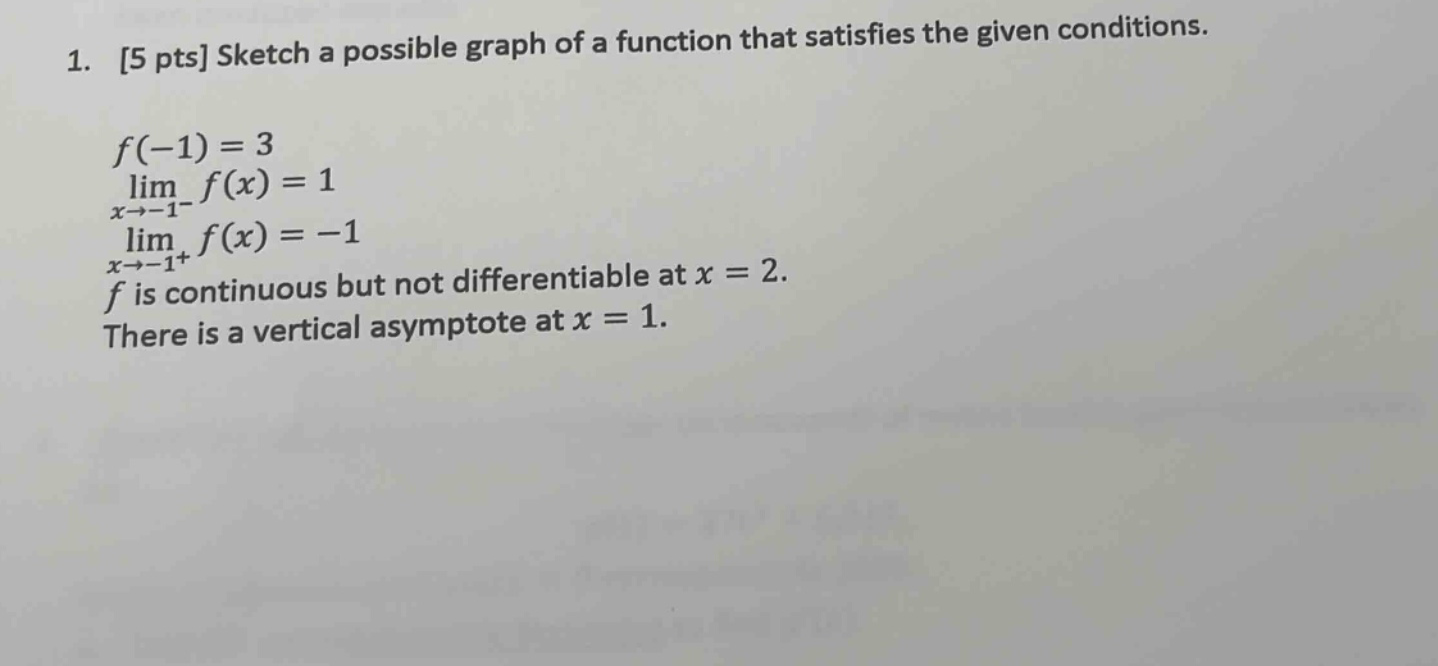
1. 5 pts sketch a possible graph of a function that satisfies the given conditions. f(-1)=3 lim x→-1⁻ f(x)=1 lim x→-1⁺ f(x)= -1 f is continuous but not differentiable at x = 2. there is a vertical asymptote at x = 1.
Answer
Explanation:
Step1: Plot point for $f(-1) = 3$
Plot the point $(-1,3)$ on the graph.
Step2: Indicate one - sided limits at $x=-1$
As $x\to - 1^{-}$, the function approaches $y = 1$, and as $x\to - 1^{+}$, the function approaches $y=-1$. So, draw the function approaching these values from the left and right of $x = - 1$ respectively, creating a jump - like behavior at $x=-1$.
Step3: Consider continuity and non - differentiability at $x = 2$
To be continuous but non - differentiable at $x = 2$, we can draw a sharp corner at $x = 2$. For example, a graph like $y=|x - 2|$ has this property.
Step4: Draw vertical asymptote at $x = 1$
Draw a vertical line $x = 1$ and make the function values go to $\pm\infty$ as $x$ approaches $1$ from either side. Then, connect the parts of the graph in a way that satisfies all the above - mentioned conditions.
Answer:
A hand - drawn graph with a point at $(-1,3)$, one - sided limits at $x=-1$ as described, a sharp corner at $x = 2$ for continuity but non - differentiability, and a vertical asymptote at $x = 1$.