a pure acid measuring x liters is added to 300 liters of a 20% acidic solution. the concentration of acid…
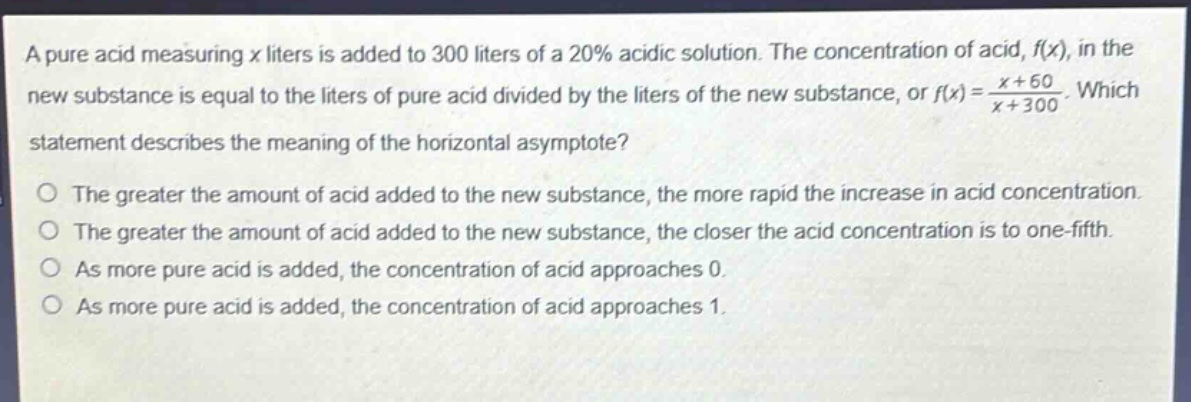
a pure acid measuring x liters is added to 300 liters of a 20% acidic solution. the concentration of acid, f(x), in the new substance is equal to the liters of pure acid divided by the liters of the new substance, or f(x) = \\frac{x + 60}{x + 300}. which statement describes the meaning of the horizontal asymptote?\no the greater the amount of acid added to the new substance, the more rapid the increase in acid concentration.\no the greater the amount of acid added to the new substance, the closer the acid concentration is to one - fifth.\no as more pure acid is added, the concentration of acid approaches 0.\no as more pure acid is added, the concentration of acid approaches 1.
Answer
Answer:
D. As more pure acid is added, the concentration of acid approaches 1.
Explanation:
Step1: Recall horizontal - asymptote concept
For a rational function $y = \frac{f(x)}{g(x)}$ where $f(x)=a_nx^n+\cdots$ and $g(x)=b_mx^m+\cdots$, if $n = m$, the horizontal asymptote is $y=\frac{a_n}{b_m}$.
Step2: Identify $n$ and $m$ for $f(x)=\frac{x + 60}{x+300}$
Here, $n = 1$ (highest - power of $x$ in numerator), $m = 1$ (highest - power of $x$ in denominator), $a_1 = 1$, $b_1 = 1$.
Step3: Calculate the horizontal asymptote
The horizontal asymptote of $y=\frac{x + 60}{x+300}$ is $y=\frac{1}{1}=1$. This means as $x$ (amount of pure acid added) gets very large, the value of $f(x)$ (acid concentration) approaches 1. So, as more pure acid is added, the concentration of acid approaches 1.