pure sounds produce single sine waves on an oscilloscope. find the amplitude and period of the sine - wave…
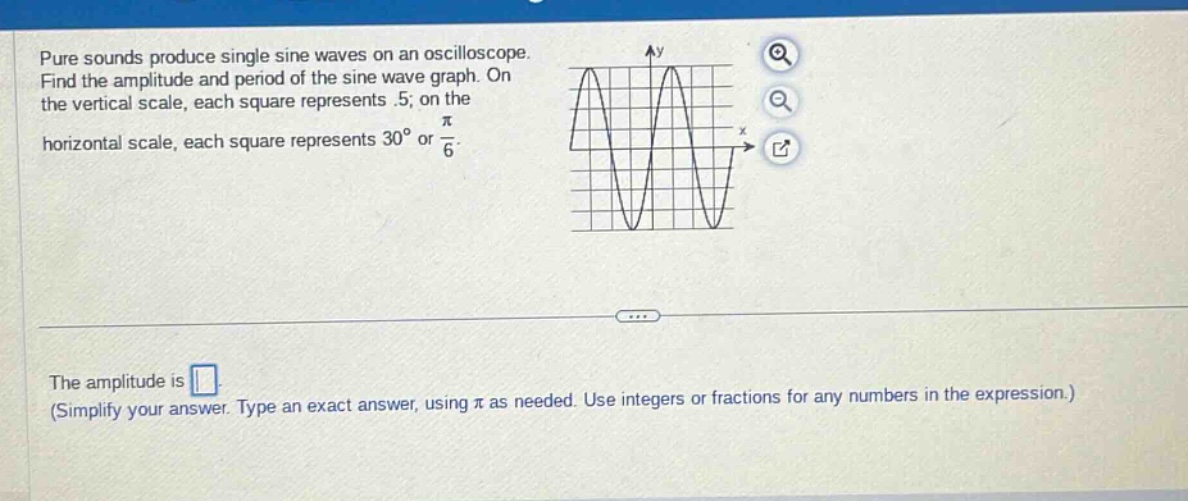
pure sounds produce single sine waves on an oscilloscope. find the amplitude and period of the sine - wave graph. on the vertical scale, each square represents.5; on the horizontal scale, each square represents 30° or $\frac{pi}{6}$. the amplitude is (simplify your answer. type an exact answer, using $pi$ as needed. use integers or fractions for any numbers in the expression.)
Answer
Explanation:
Step1: Recall amplitude definition
Amplitude is half - the vertical distance between max and min.
Step2: Determine vertical distance
On the vertical scale, each square represents $0.5$. The vertical distance from the maximum to the minimum of the sine - wave is 4 squares. So the vertical distance $d = 4\times0.5=2$.
Step3: Calculate amplitude
Amplitude $A=\frac{d}{2}$. Substituting $d = 2$ into the formula, we get $A = 1$.
Answer:
$1$