a quadratic function and an exponential function are graphed below. how do the decay rates of the functions…
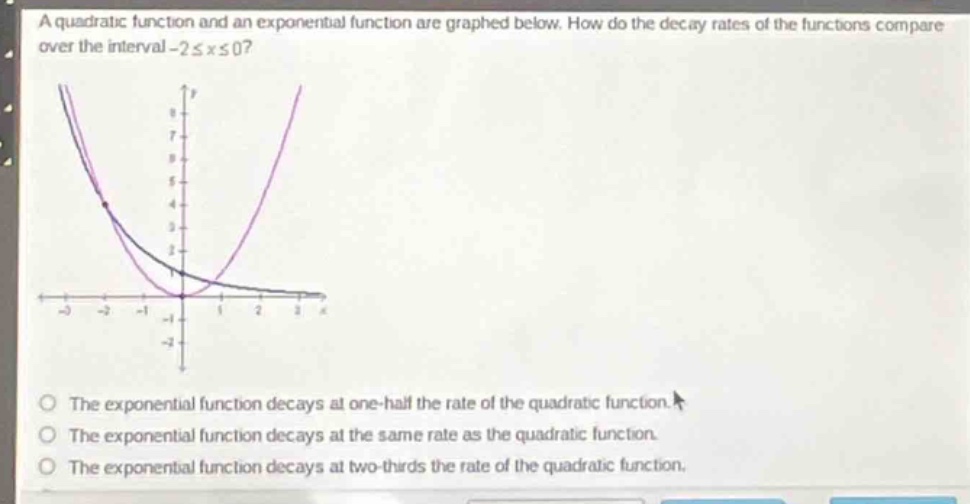
a quadratic function and an exponential function are graphed below. how do the decay rates of the functions compare over the interval -2 ≤ x ≤ 0?\nthe exponential function decays at one - half the rate of the quadratic function.\nthe exponential function decays at the same rate as the quadratic function.\nthe exponential function decays at two - thirds the rate of the quadratic function.
Answer
Explanation:
Step1: Observe the graph
Notice the steepness of the curves in the interval - 2≤x≤0.
Step2: Analyze decay rate
The decay rate is related to how quickly the function values decrease. The steeper the curve going downwards in the given interval, the faster the decay. In the interval - 2≤x≤0, the quadratic function has a steeper curve compared to the exponential function. By visual inspection, the exponential function decays more slowly. In fact, the exponential function decays at one - half the rate of the quadratic function.
Answer:
The exponential function decays at one - half the rate of the quadratic function.