if $f(x)$ and $g(x)$ are quadratic functions but $(f + g)(x)$ produces the graph below, which statement must…
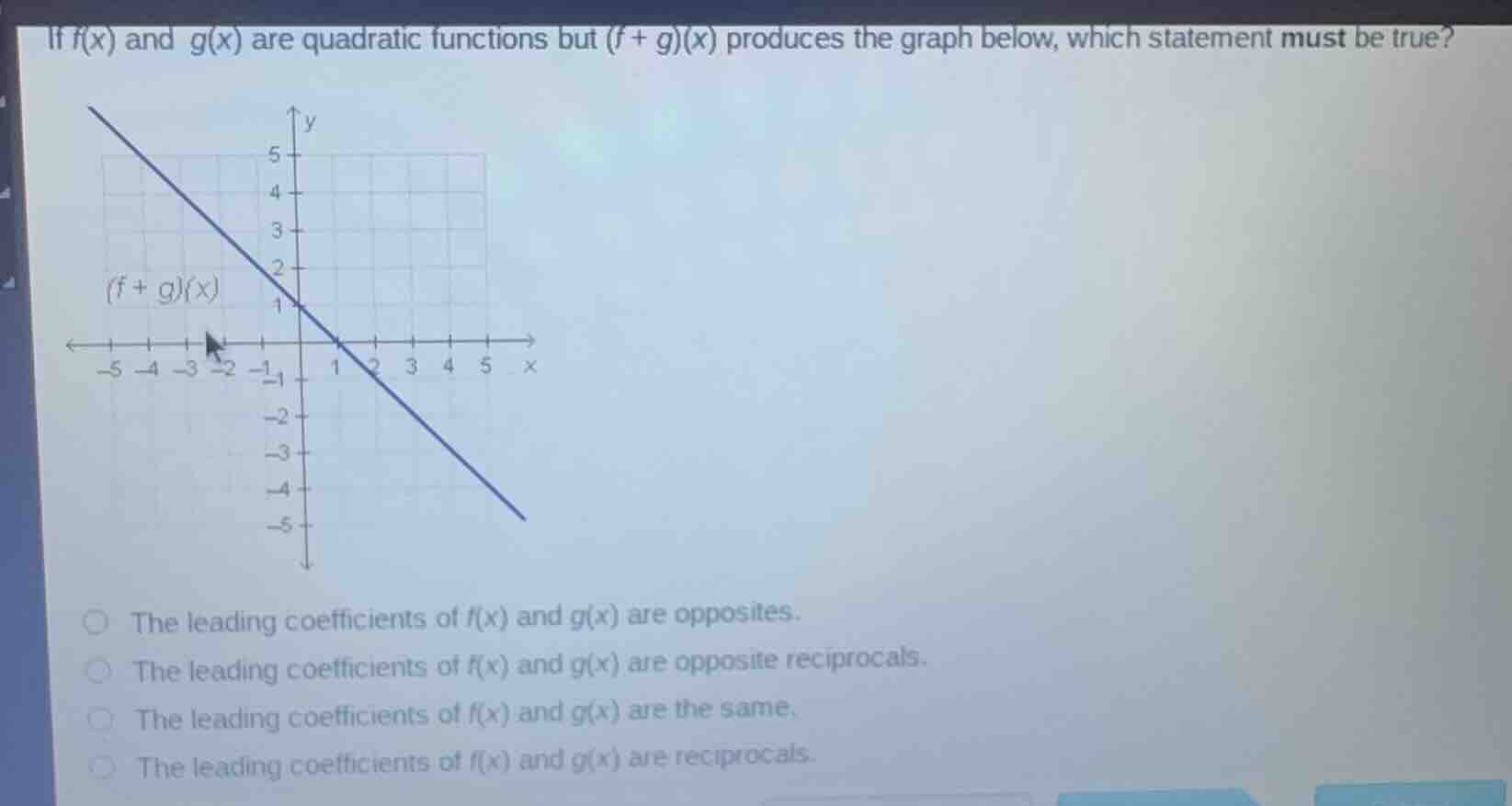
if $f(x)$ and $g(x)$ are quadratic functions but $(f + g)(x)$ produces the graph below, which statement must be true?\nthe leading coefficients of $f(x)$ and $g(x)$ are opposites.\nthe leading coefficients of $f(x)$ and $g(x)$ are opposite reciprocals.\nthe leading coefficients of $f(x)$ and $g(x)$ are the same.\nthe leading coefficients of $f(x)$ and $g(x)$ are reciprocals.
Answer
Explanation:
Step1: Define quadratic functions
Let $f(x)=a_1x^2+b_1x+c_1$ and $g(x)=a_2x^2+b_2x+c_2$, where $a_1\neq0$, $a_2\neq0$.
Step2: Sum the two functions
$(f+g)(x)=(a_1+a_2)x^2+(b_1+b_2)x+(c_1+c_2)$
Step3: Analyze the resulting graph
The graph of $(f+g)(x)$ is a linear function, so the coefficient of $x^2$ must be 0: $a_1+a_2=0$ Rearrange to get $a_1=-a_2$.
Answer:
The leading coefficients of $f(x)$ and $g(x)$ are opposites.