question 10 of 11 > suppose f is a differentiable function and a(x)=∫a^x f(t)dt. match each of the…
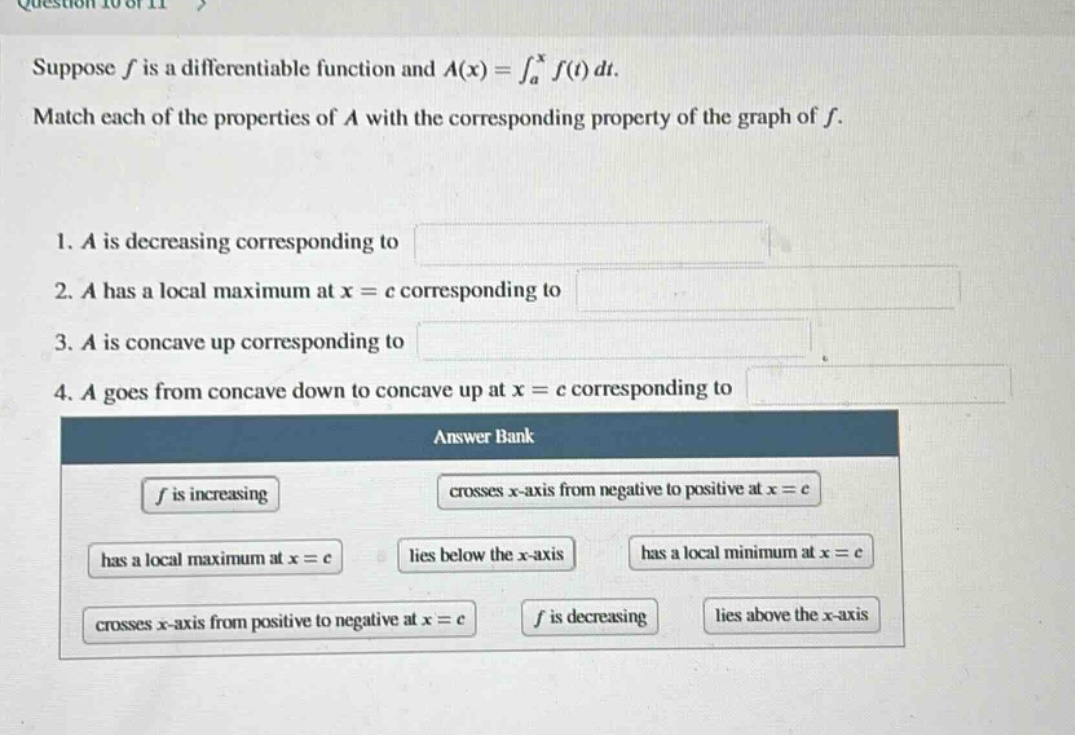
question 10 of 11 > suppose f is a differentiable function and a(x)=∫a^x f(t)dt. match each of the properties of a with the corresponding property of the graph of f. 1. a is decreasing corresponding to 2. a has a local maximum at x = c corresponding to 3. a is concave up corresponding to 4. a goes from concave down to concave up at x = c corresponding to answer bank f is increasing crosses x - axis from negative to positive at x = c has a local maximum at x = c lies below the x - axis has a local minimum at x = c crosses x - axis from positive to negative at x = c f is decreasing lies above the x - axis
Answer
Explanation:
Step1: Recall the fundamental theorem of calculus
By the fundamental - theorem of calculus, $A^\prime(x)=f(x)$ and $A^{\prime\prime}(x)=f^\prime(x)$.
Step2: Analyze when $A$ is decreasing
If $A$ is decreasing, then $A^\prime(x)<0$. Since $A^\prime(x) = f(x)$, this means $f(x)<0$, so $f$ lies below the $x$ - axis.
Step3: Analyze when $A$ has a local maximum
If $A$ has a local maximum at $x = c$, then $A^\prime(c)=0$ and $A^\prime$ changes sign from positive to negative at $x = c$. Since $A^\prime(x)=f(x)$, this means $f(c) = 0$ and $f$ crosses the $x$ - axis from positive to negative at $x = c$.
Step4: Analyze when $A$ is concave up
If $A$ is concave up, then $A^{\prime\prime}(x)>0$. Since $A^{\prime\prime}(x)=f^\prime(x)$, this means $f$ is increasing.
Step5: Analyze when $A$ changes concavity
If $A$ goes from concave down to concave up at $x = c$, then $A^{\prime\prime}(x)$ changes sign from negative to positive at $x = c$. Since $A^{\prime\prime}(x)=f^\prime(x)$, this means $f$ has a local minimum at $x = c$.
Answer:
- lies below the x - axis
- crosses x - axis from positive to negative at $x = c$
- $f$ is increasing
- has a local minimum at $x = c$