question 10, 6.a.77 part 3 of 6\nuse the given function f to answer parts (a) through (f) below.\nf(x)=4 +…
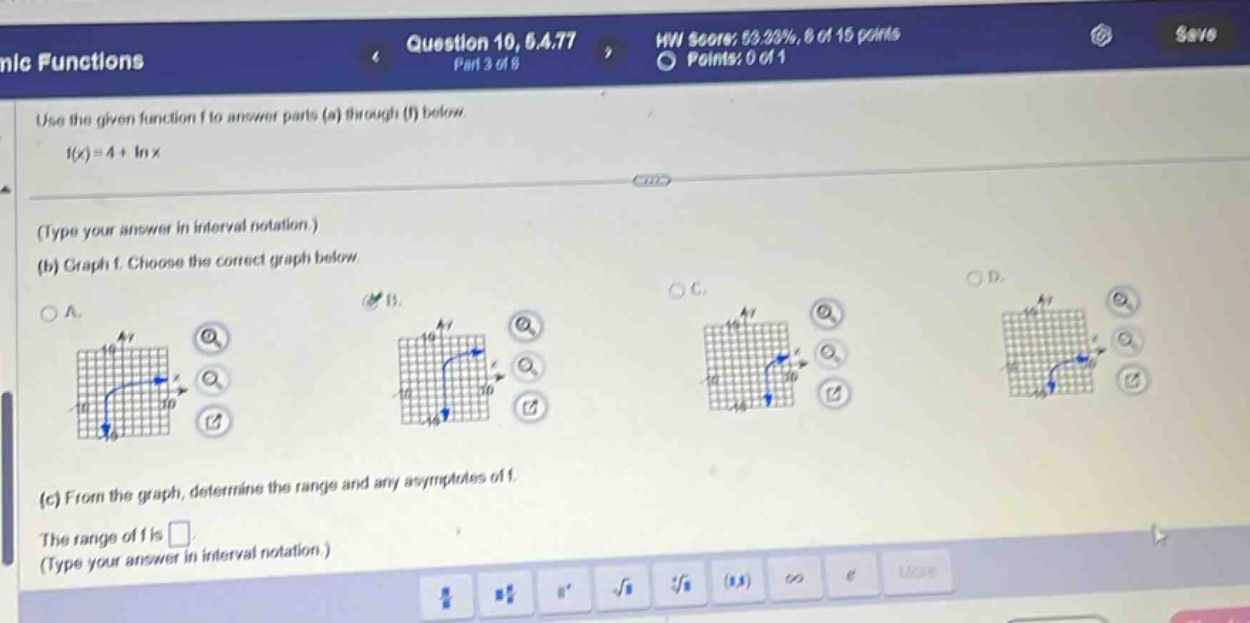
question 10, 6.a.77 part 3 of 6\nuse the given function f to answer parts (a) through (f) below.\nf(x)=4 + ln x\n(type your answer in interval notation.)\n(b) graph f. choose the correct graph below.\n(c) from the graph, determine the range and any asymptotes of f.\nthe range of f is \n(type your answer in interval notation.)
Answer
Explanation:
Step1: Analyze the domain of the function
The natural - logarithm function $\ln x$ is defined for $x>0$. So the domain of $f(x)=4 + \ln x$ is $(0,\infty)$.
Step2: Analyze the graph of $y = \ln x$ and $y=4+\ln x$
The graph of $y = \ln x$ has a vertical asymptote at $x = 0$, passes through the point $(1,0)$. The graph of $y=4+\ln x$ is a vertical shift of the graph of $y = \ln x$ up by 4 units. It still has a vertical asymptote at $x = 0$ and passes through the point $(1,4)$.
Step3: Determine the range
Since the range of $y=\ln x$ is $(-\infty,\infty)$, and $y = 4+\ln x$ is a vertical shift of $y=\ln x$ by 4 units, the range of $y = 4+\ln x$ is also $(-\infty,\infty)$.
Answer:
(b) The graph of $y = 4+\ln x$ has a vertical asymptote at $x = 0$ and passes through the point $(1,4)$. You need to choose the graph that has these characteristics. (c) The range of $f$ is $(-\infty,\infty)$