question 3 of 10 (1 point) | question attempt 1 of unlimited part 1 of 10 (a) as x→−∞,f(x)→2. part 2 of 10…
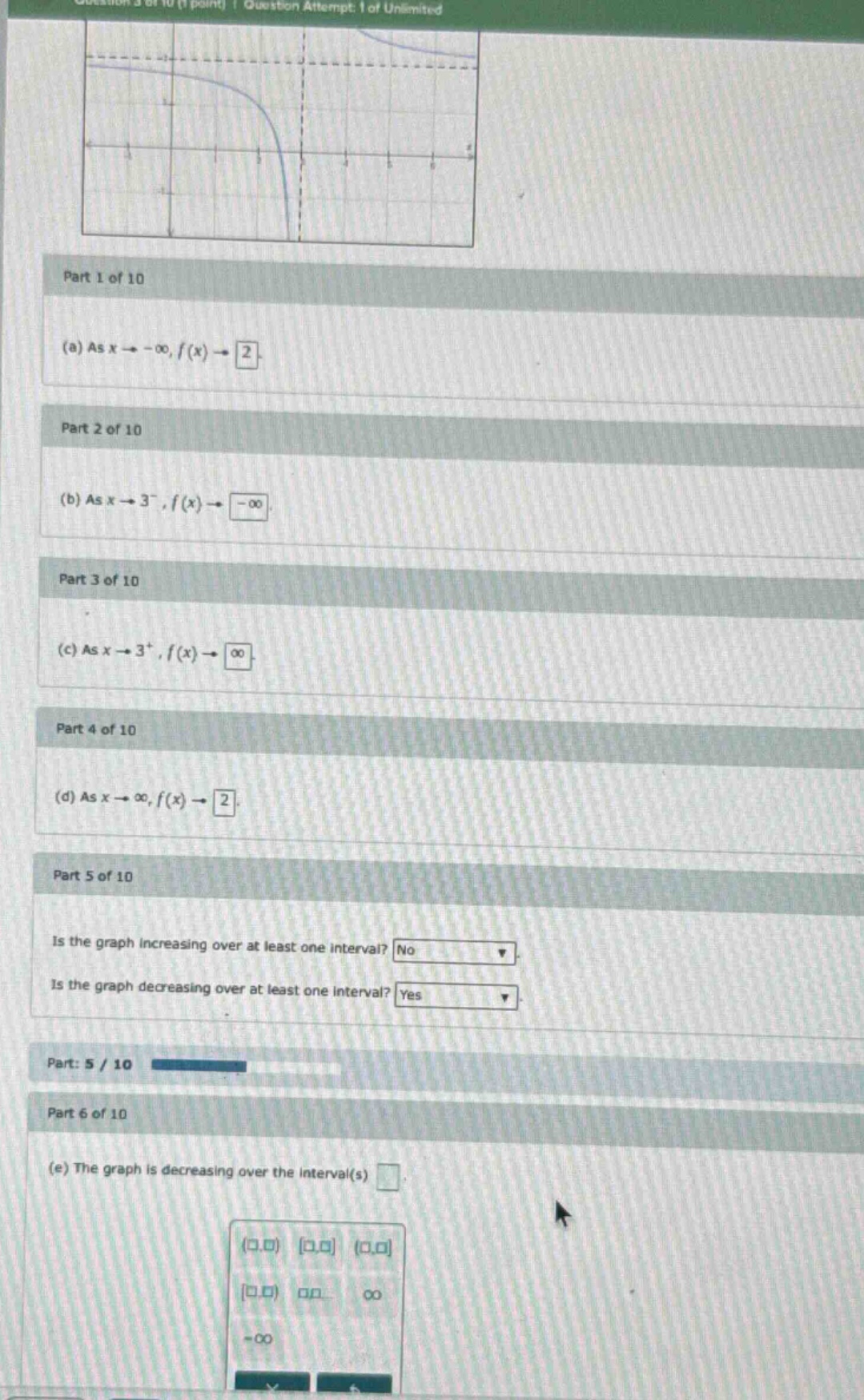
question 3 of 10 (1 point) | question attempt 1 of unlimited part 1 of 10 (a) as x→−∞,f(x)→2. part 2 of 10 (b) as x→3−,f(x)→−∞. part 3 of 10 (c) as x→3+,f(x)→∞. part 4 of 10 (d) as x→∞,f(x)→2. part 5 of 10 is the graph increasing over at least one interval? no is the graph decreasing over at least one interval? yes part: 5 / 10 part 6 of 10 (e) the graph is decreasing over the interval(s)
Answer
Explanation:
Step1: Analyze the graph for decreasing intervals
By observing the graph, we see that the function value $y = f(x)$ is getting smaller as $x$ moves from left - hand side to right - hand side in some parts.
Step2: Determine the decreasing interval
The graph is decreasing for all real $x$ values less than 3. In interval notation, this is $(-\infty,3)$.
Answer:
$(-\infty,3)$