question 1 (10 points). a small - appliance manufacturer finds that it costs $10,000 to produce 1000 toaster…
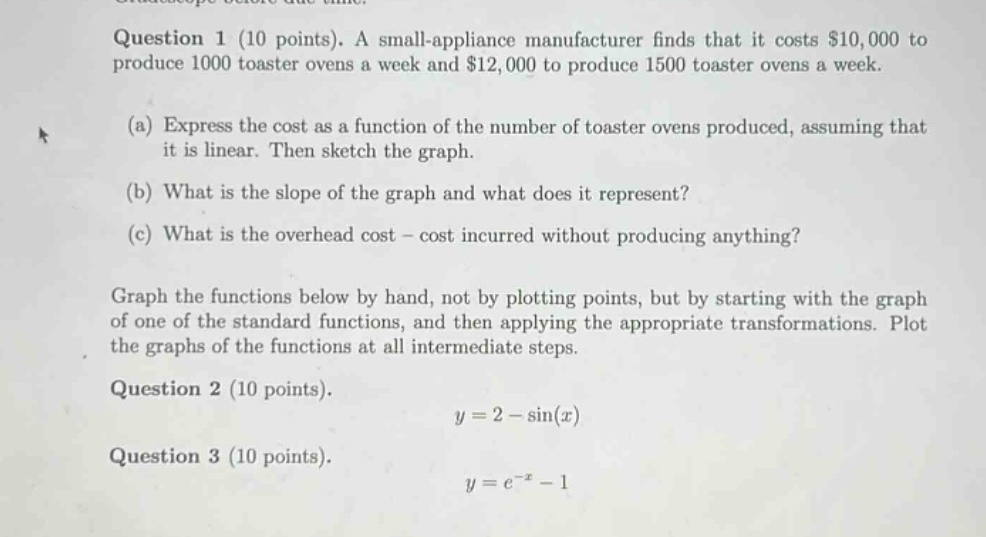
question 1 (10 points). a small - appliance manufacturer finds that it costs $10,000 to produce 1000 toaster ovens a week and $12,000 to produce 1500 toaster ovens a week. (a) express the cost as a function of the number of toaster ovens produced, assuming that it is linear. then sketch the graph. (b) what is the slope of the graph and what does it represent? (c) what is the overhead cost - cost incurred without producing anything? graph the functions below by hand, not by plotting points, but by starting with the graph of one of the standard functions, and then applying the appropriate transformations. plot the graphs of the functions at all intermediate steps. question 2 (10 points). y = 2 - sin(x) question 3 (10 points). y = e^(-x) - 1
Answer
Question 1
Explanation:
Step1: Find the linear - cost function
Let $x$ be the number of toaster ovens produced and $C(x)$ be the cost function. We have two points $(x_1,C_1)=(1000,10000)$ and $(x_2,C_2)=(1500,12000)$. The slope $m$ of the linear function is given by $m=\frac{C_2 - C_1}{x_2 - x_1}=\frac{12000 - 10000}{1500 - 1000}=\frac{2000}{500}=4$. Using the point - slope form $C - C_1=m(x - x_1)$ with $(x_1,C_1)=(1000,10000)$, we get $C(x)-10000 = 4(x - 1000)$. Then $C(x)=4x+6000$.
Step2: Sketch the graph
The $y$ - intercept is $(0,6000)$ and using the slope of 4, we can find another point. For example, when $x = 1000$, $C(1000)=4\times1000 + 6000=10000$. Plot these two points and draw a straight line.
Step3: Find the slope and its meaning
The slope of the graph is $m = 4$. It represents the marginal cost, which is the additional cost of producing one more toaster oven. That is, for each additional toaster oven produced, the cost increases by $4$.
Step4: Find the overhead cost
The overhead cost is the cost when $x = 0$. Substituting $x = 0$ into $C(x)=4x+6000$, we get $C(0)=6000$. So the overhead cost is $6000$.
Answer:
(a) $C(x)=4x + 6000$. To sketch: plot $(0,6000)$ and $(1000,10000)$ and draw a line. (b) Slope is 4. It represents the marginal cost (cost per additional toaster oven). (c) $6000$
Question 2
Explanation:
Step1: Start with the standard function
Start with the graph of $y=\sin(x)$.
Step2: Reflect about the $x$ - axis
The function $y =-\sin(x)$ is the reflection of $y=\sin(x)$ about the $x$ - axis.
Step3: Shift up 2 units
The function $y=2-\sin(x)$ is obtained by shifting the graph of $y =-\sin(x)$ up 2 units.
Answer:
Start with $y = \sin(x)$, reflect it about the $x$ - axis to get $y=-\sin(x)$, then shift it up 2 units to get $y = 2-\sin(x)$.
Question 3
Explanation:
Step1: Start with the standard function
Start with the graph of $y = e^{x}$.
Step2: Reflect about the $y$ - axis
The function $y=e^{-x}$ is the reflection of $y = e^{x}$ about the $y$ - axis.
Step3: Shift down 1 unit
The function $y=e^{-x}-1$ is obtained by shifting the graph of $y = e^{-x}$ down 1 unit.
Answer:
Start with $y = e^{x}$, reflect it about the $y$ - axis to get $y=e^{-x}$, then shift it down 1 unit to get $y=e^{-x}-1$.