question 10 0/1 pt 3 98 details a plane flies at a speed 560 km/hr at a constant height of 14 km. how…
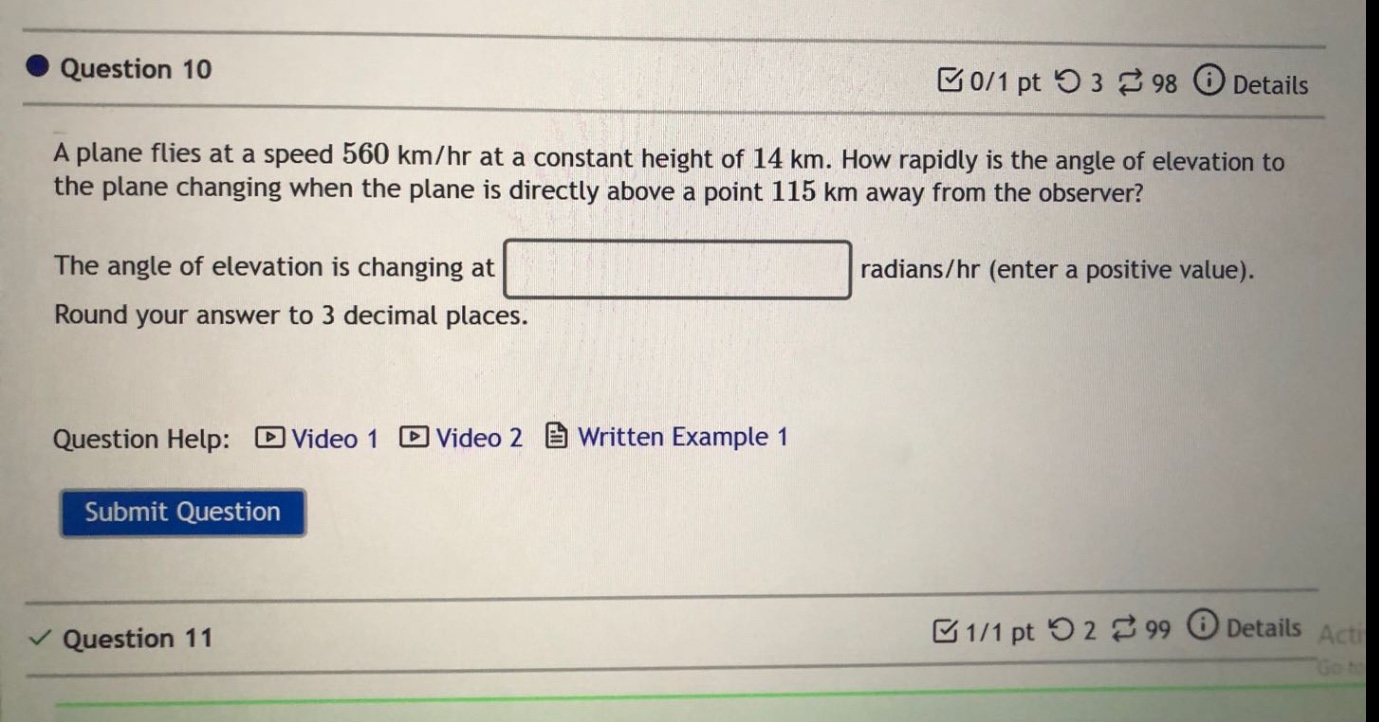
question 10 0/1 pt 3 98 details a plane flies at a speed 560 km/hr at a constant height of 14 km. how rapidly is the angle of elevation to the plane changing when the plane is directly above a point 115 km away from the observer? the angle of elevation is changing at radians/hr (enter a positive value). round your answer to 3 decimal places. question help: video 1 video 2 written example 1 submit question question 11 1/1 pt 2 99 details acti
Answer
Explanation:
Step1: Define variables and relation
Let $x$ be the horizontal - distance of the plane from the point directly above the observer, $h = 14$ km be the height of the plane (constant), and $\theta$ be the angle of elevation. Then $\tan\theta=\frac{h}{x}=\frac{14}{x}$.
Step2: Differentiate both sides with respect to time $t$
Using the chain - rule, $\sec^{2}\theta\frac{d\theta}{dt}=-\frac{14}{x^{2}}\frac{dx}{dt}$. We know that $\frac{dx}{dt}=560$ km/hr. Also, $\sec^{2}\theta = 1+\tan^{2}\theta=1 + (\frac{14}{x})^{2}$.
Step3: Substitute the given values
When $x = 115$ km, $\tan\theta=\frac{14}{115}$, and $\sec^{2}\theta=1+\left(\frac{14}{115}\right)^{2}=1+\frac{196}{13225}=\frac{13225 + 196}{13225}=\frac{13421}{13225}$. Substitute $x = 115$ km and $\frac{dx}{dt}=560$ km/hr into $\sec^{2}\theta\frac{d\theta}{dt}=-\frac{14}{x^{2}}\frac{dx}{dt}$: $\frac{13421}{13225}\frac{d\theta}{dt}=-\frac{14}{115^{2}}\times560$. $\frac{13421}{13225}\frac{d\theta}{dt}=-\frac{14\times560}{13225}$. $\frac{d\theta}{dt}=-\frac{14\times560}{13421}$. Since we want the magnitude (a positive value), $\left|\frac{d\theta}{dt}\right|=\frac{14\times560}{13421}\approx0.589$.
Answer:
$0.589$