question 2 of 10, step 2 of 2\n3/18\ncorrect\nconsider the function:\nf(x) = (81x² + 49)/x\nstep 2 of 2: use…
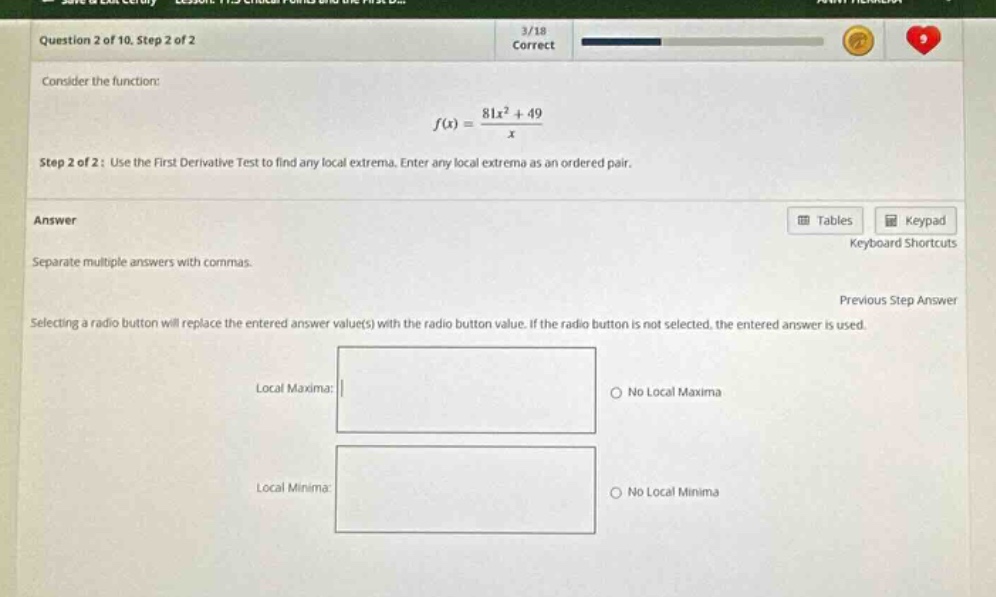
question 2 of 10, step 2 of 2\n3/18\ncorrect\nconsider the function:\nf(x) = (81x² + 49)/x\nstep 2 of 2: use the first - derivative test to find any local extrema. enter any local extrema as an ordered pair.\nanswer\nseparate multiple answers with commas.\ntables\nkeypad\nkeyboard shortcuts\nprevious step answer\nselecting a radio button will replace the entered answer value(s) with the radio button value. if the radio button is not selected, the entered answer is used.\nlocal maxima:\nno local maxima\nlocal minima:\nno local minima
Answer
Explanation:
Step1: Rewrite the function
Rewrite $f(x)=\frac{81x^{2}+49}{x}$ as $f(x)=81x+\frac{49}{x}=81x + 49x^{-1}$.
Step2: Find the first - derivative
Using the power rule $(x^n)'=nx^{n - 1}$, we have $f'(x)=81-49x^{-2}=81-\frac{49}{x^{2}}$.
Step3: Set the first - derivative equal to zero
Set $f'(x) = 0$, so $81-\frac{49}{x^{2}}=0$. Then $\frac{49}{x^{2}}=81$, and $x^{2}=\frac{49}{81}$. Solving for $x$, we get $x=\pm\frac{7}{9}$.
Step4: Analyze the sign of the first - derivative
Choose test points in the intervals $(-\infty,-\frac{7}{9})$, $(-\frac{7}{9},0)$, $(0,\frac{7}{9})$, and $(\frac{7}{9},\infty)$. For $x=-1$ (in $(-\infty,-\frac{7}{9})$), $f'(-1)=81 - 49=32>0$. For $x =-\frac{1}{2}$ (in $(-\frac{7}{9},0)$), $f'(-\frac{1}{2})=81-196=-115<0$. For $x=\frac{1}{2}$ (in $(0,\frac{7}{9})$), $f'(\frac{1}{2})=81 - 196=-115<0$. For $x = 1$ (in $(\frac{7}{9},\infty)$), $f'(1)=81 - 49=32>0$. Since $f'(x)$ changes sign from positive to negative at $x=-\frac{7}{9}$, $f(-\frac{7}{9})=81\times(-\frac{7}{9})+\frac{49}{-\frac{7}{9}}=-63 - 63=-126$ is a local maximum. Since $f'(x)$ changes sign from negative to positive at $x=\frac{7}{9}$, $f(\frac{7}{9})=81\times\frac{7}{9}+\frac{49}{\frac{7}{9}}=63 + 63 = 126$ is a local minimum.
Answer:
Local Maxima: $(-\frac{7}{9},-126)$ Local Minima: $(\frac{7}{9},126)$