question 1 of 10. step 2 of 2 consider the function: f(x)=2x³ - 6x² - 90x + 9 step 2 of 2: use the first…
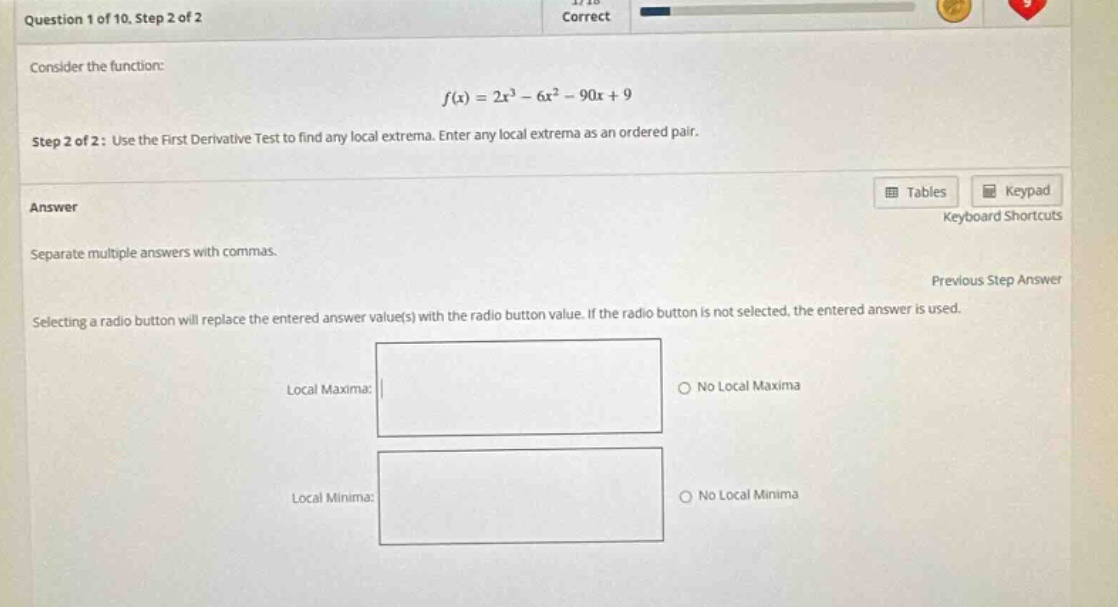
question 1 of 10. step 2 of 2 consider the function: f(x)=2x³ - 6x² - 90x + 9 step 2 of 2: use the first derivative test to find any local extrema. enter any local extrema as an ordered pair. answer separate multiple answers with commas. selecting a radio button will replace the entered answer value(s) with the radio button value. if the radio button is not selected, the entered answer is used. local maxima: no local maxima local minima: no local minima
Answer
Explanation:
Step1: Find the first - derivative
Differentiate $f(x)=2x^{3}-6x^{2}-90x + 9$ using the power rule. The power rule states that if $y = ax^{n}$, then $y^\prime=anx^{n - 1}$. $f^\prime(x)=6x^{2}-12x - 90$
Step2: Set the first - derivative equal to zero
$6x^{2}-12x - 90 = 0$. Divide through by 6: $x^{2}-2x - 15=0$. Factor the quadratic equation: $(x - 5)(x+3)=0$. Solve for $x$: $x = 5$ or $x=-3$.
Step3: Create intervals and test points
The critical points $x=-3$ and $x = 5$ divide the number line into three intervals: $(-\infty,-3)$, $(-3,5)$ and $(5,\infty)$. For the interval $(-\infty,-3)$, choose a test - point, say $x=-4$. Then $f^\prime(-4)=6\times(-4)^{2}-12\times(-4)-90=96 + 48-90=54>0$. For the interval $(-3,5)$, choose $x = 0$. Then $f^\prime(0)=6\times0^{2}-12\times0 - 90=-90<0$. For the interval $(5,\infty)$, choose $x = 6$. Then $f^\prime(6)=6\times6^{2}-12\times6 - 90=216-72 - 90=54>0$.
Step4: Determine local extrema
Since $f(x)$ is increasing on $(-\infty,-3)$ and decreasing on $(-3,5)$, $x=-3$ is a local maximum. $f(-3)=2\times(-3)^{3}-6\times(-3)^{2}-90\times(-3)+9=-54 - 54 + 270+9=171$. Since $f(x)$ is decreasing on $(-3,5)$ and increasing on $(5,\infty)$, $x = 5$ is a local minimum. $f(5)=2\times5^{3}-6\times5^{2}-90\times5+9=250-150 - 450+9=-341$.
Answer:
Local Maxima: $(-3,171)$ Local Minima: $(5,-341)$