question 7 of 10 which of the two functions below has the smallest minimum y - value? f(x)=(x - 13)^4 - 2…
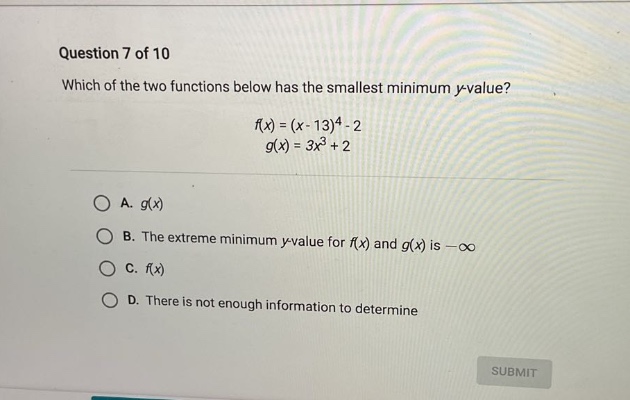
question 7 of 10 which of the two functions below has the smallest minimum y - value? f(x)=(x - 13)^4 - 2 g(x)=3x^3 + 2 a. g(x) b. the extreme minimum y - value for f(x) and g(x) is -∞ c. f(x) d. there is not enough information to determine
Answer
Explanation:
Step1: Analyze (f(x))
Since ((x - 13)^4\geq0) for all real - valued (x) (any real number to the fourth power is non - negative), then (f(x)=(x - 13)^4-2\geq - 2). The minimum value of (f(x)) occurs when ((x - 13)^4 = 0), i.e., when (x = 13), and (f(13)=-2).
Step2: Analyze (g(x))
The function (g(x)=3x^{3}+2) is a cubic function. The derivative of (g(x)) is (g^\prime(x)=9x^{2}). Setting (g^\prime(x)=0), we get (9x^{2}=0), so (x = 0). The second - derivative (g^{\prime\prime}(x)=18x), and (g^{\prime\prime}(0)=0). As (x\to-\infty), (g(x)=3x^{3}+2\to-\infty) because the leading term (3x^{3}) dominates the function's behavior for large (|x|). So, the range of (g(x)) is ((-\infty,\infty)).
Answer:
A. (g(x))