question 11 of 25\nwhich of these could be the graph of (f(x)=ln x + 2)?\na. graph a\nb. graph b\nc. graph…
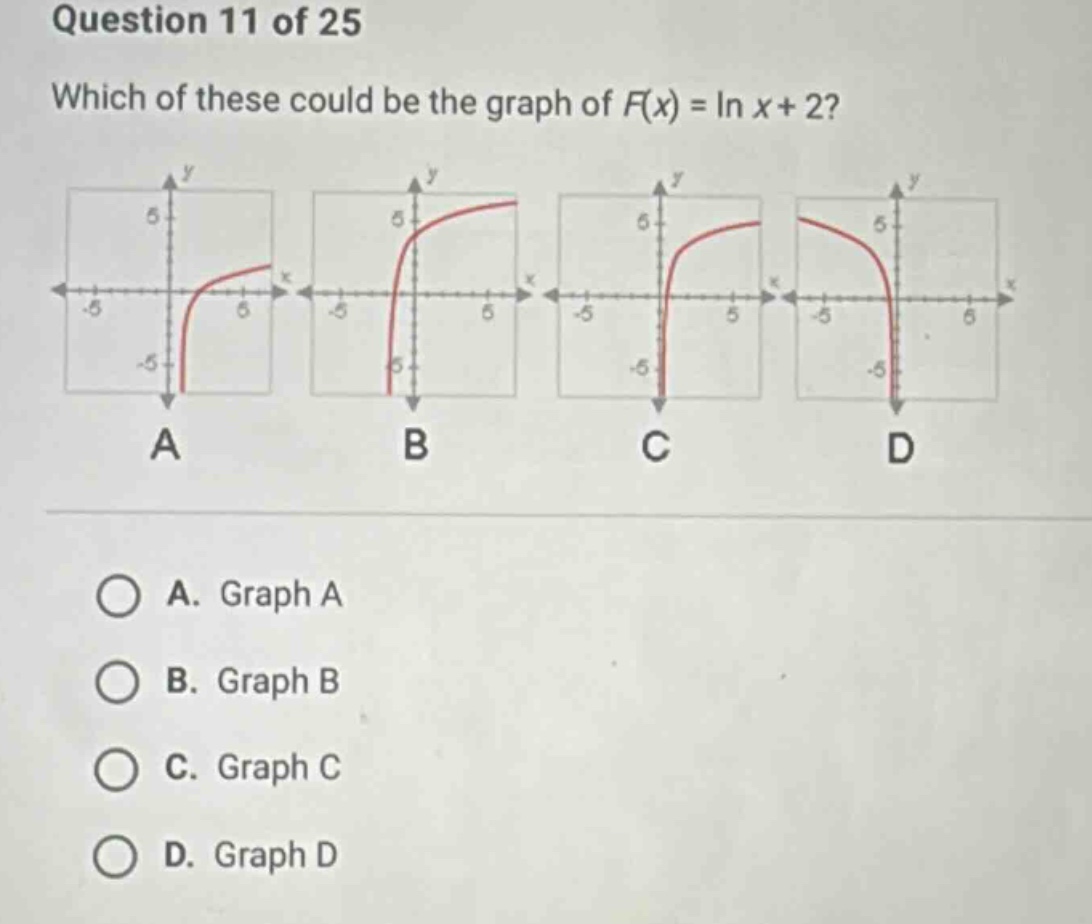
question 11 of 25\nwhich of these could be the graph of (f(x)=ln x + 2)?\na. graph a\nb. graph b\nc. graph c\nd. graph d
Answer
Explanation:
Step1: Recall properties of $y = \ln x$
The domain of $y=\ln x$ is $x>0$, and it passes through the point $(1,0)$ with a vertical - asymptote at $x = 0$. It is an increasing function.
Step2: Analyze $y=\ln x+2$
The graph of $y = f(x)+c$ (where $c = 2$ here) is a vertical shift of the graph of $y = f(x)$ upwards by $c$ units. The domain of $y=\ln x + 2$ is still $x>0$, and it passes through the point $(1,2)$ (since when $x = 1$, $y=\ln(1)+2=0 + 2=2$) and has a vertical asymptote at $x = 0$. It is also an increasing function.
Step3: Check the graphs
Graph A has a $y$-intercept which is not possible for $y=\ln x+2$ as the domain is $x>0$. Graph D is a decreasing function, so it is not the graph of $y=\ln x+2$. Graph B passes through $(0, 2)$ which is wrong as the domain of $y=\ln x+2$ is $x>0$. Graph C has a vertical asymptote at $x = 0$, is an increasing function, and passes through the point $(1,2)$.
Answer:
C. Graph C