question 11 (essay worth 12 points)\n(inverse trigonometric functions | trigonometric equations hc)\npart…
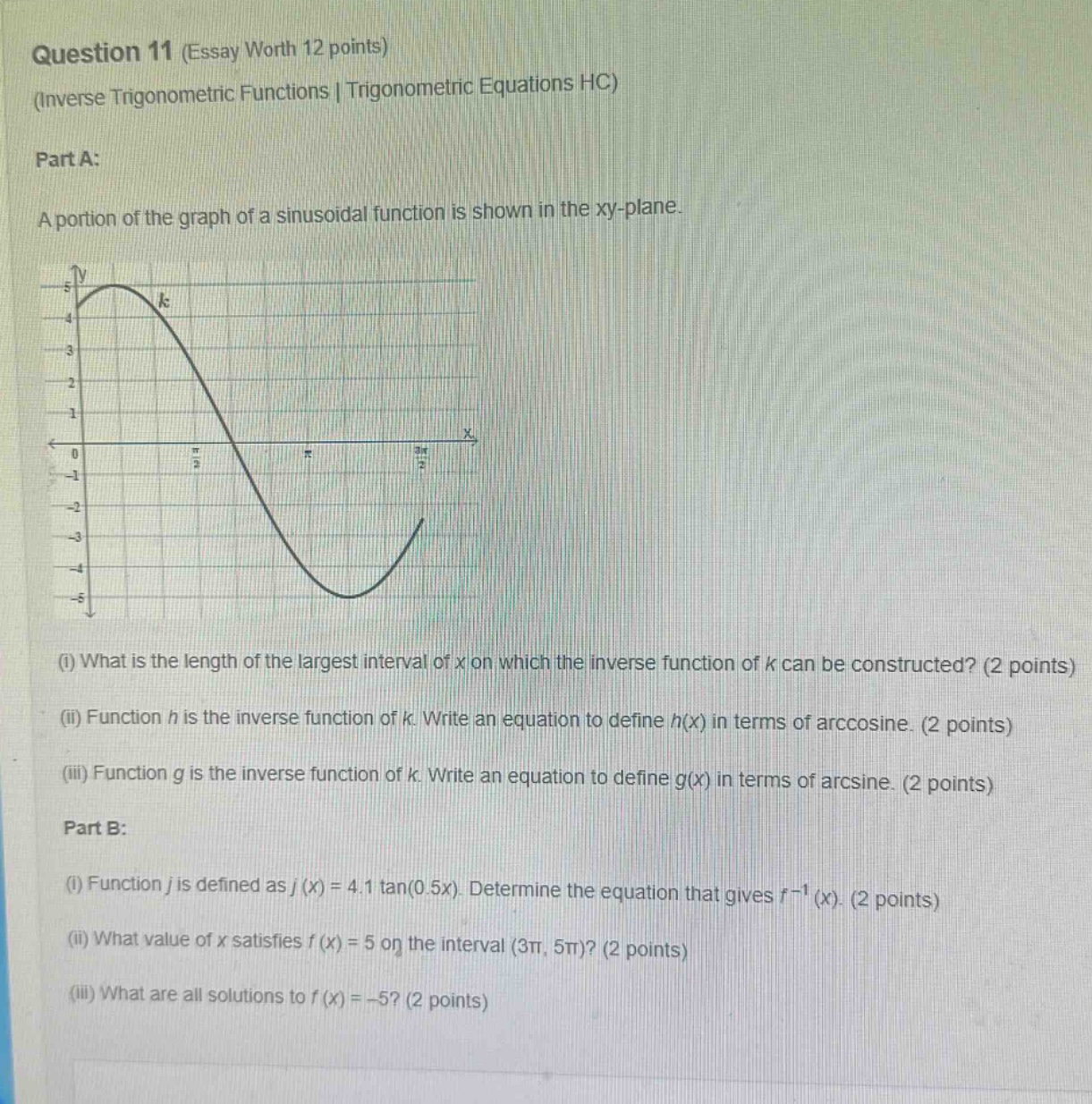
question 11 (essay worth 12 points)\n(inverse trigonometric functions | trigonometric equations hc)\npart a:\na portion of the graph of a sinusoidal function is shown in the xy - plane.\n(i) what is the length of the largest interval of x on which the inverse function of k can be constructed? (2 points)\n(ii) function h is the inverse function of k. write an equation to define h(x) in terms of arccosine. (2 points)\n(iii) function g is the inverse function of k. write an equation to define g(x) in terms of arcsine. (2 points)\npart b:\n(i) function j is defined as j(x)=4.1 tan(0.5x). determine the equation that gives j^(-1)(x). (2 points)\n(ii) what value of x satisfies j(x)=5 on the interval (3π, 5π)? (2 points)\n(iii) what are all solutions to j(x)= - 5? (2 points)
Answer
Explanation:
Part A (i)
Step1: Identify monotonic intervals
The inverse function of $k$ can be constructed on intervals where $k$ is strictly monotonic (either increasing or decreasing). From the graph, $k(x)$ appears to be $k(x) = 5 \cos(x)$. This function is strictly decreasing on $[0, \pi]$ and strictly increasing on $[\pi, 2\pi]$.
Step2: Determine the length of the intervals
The length of the interval $[0, \pi]$ is $\pi - 0 = \pi$. The length of the interval $[\pi, 2\pi]$ is $2\pi - \pi = \pi$.
Step3: Find the maximum length
The largest interval on which the inverse can be constructed corresponds to half the period of the sinusoidal function. The period is $2\pi$, so half the period is $\pi$. The length of the largest interval is $\pi$.
(ii)
Step1: Determine the equation for k(x)
From the graph, the amplitude is $A = 5$, the vertical shift is $D = 0$, the period is $T = 2\pi$, so $B = \frac{2\pi}{T} = 1$. Since the maximum is at $x=0$, the function is $k(x) = 5 \cos(x)$.
Step2: Restrict the domain for arccosine
To define the inverse $h(x)$ using arccosine, we restrict the domain of $k(x)$ to $[0, \pi]$, where $k(x)$ is one-to-one and its range is $[-5, 5]$. The range of $\arccos(u)$ is $[0, \pi]$.
Step3: Derive the inverse function h(x)
Let $y = k(x) = 5 \cos(x)$. Swap $x$ and $y$: $x = 5 \cos(y)$. Solve for $y$: $\cos(y) = \frac{x}{5}$. Apply arccosine: $y = \arccos\left(\frac{x}{5}\right)$. So, $h(x) = \arccos\left(\frac{x}{5}\right)$.
(iii)
Step1: Relate cosine to sine
Use the identity $\cos(y) = \sin\left(\frac{\pi}{2} - y\right)$. We have $k(x) = 5 \cos(x)$. Let $y = k(x)$. We need an inverse $g(x)$ in terms of arcsine.
Step2: Restrict the domain for arcsine
Consider the inverse $g(x)$ such that its range corresponds to the restricted domain of $k(x)$ used in (ii), which is $[0, \pi]$. Let $y = g(x)$. We want $y \in [0, \pi]$. From $x = 5 \cos(y)$, we use $\cos(y) = \sin(\frac{\pi}{2}-y)$. So $x = 5 \sin(\frac{\pi}{2}-y)$.
Step3: Derive the inverse function g(x)
Solve for $y$: $\sin\left(\frac{\pi}{2} - y\right) = \frac{x}{5}$. Apply arcsine: $\frac{\pi}{2} - y = \arcsin\left(\frac{x}{5}\right)$. Note that for $y \in [0, \pi]$, $\frac{\pi}{2}-y \in [-\frac{\pi}{2}, \frac{\pi}{2}]$, which is the range of arcsine. Solve for $y$: $y = \frac{\pi}{2} - \arcsin\left(\frac{x}{5}\right)$. So, $g(x) = \frac{\pi}{2} - \arcsin\left(\frac{x}{5}\right)$.
Part B (i)
Step1: Set up the inverse function derivation
Let $y = f(x) = 4.1 \tan(0.5x)$. To find the inverse $f^{-1}(x)$, swap $x$ and $y$. $x = 4.1 \tan(0.5y)$
Step2: Solve for y
Divide by 4.1: $\tan(0.5y) = \frac{x}{4.1}$. Apply arctangent: $0.5y = \arctan\left(\frac{x}{4.1}\right)$. Multiply by 2: $y = 2 \arctan\left(\frac{x}{4.1}\right)$.
Step3: Write the inverse function
The equation for the inverse function is $f^{-1}(x) = 2 \arctan\left(\frac{x}{4.1}\right)$.
(ii)
Step1: Set up the equation
We need to solve $f(x) = 5$ for $x$ in the interval $(3\pi, 5\pi)$. $4.1 \tan(0.5x) = 5$
Step2: Solve for tan(0.5x)
$\tan(0.5x) = \frac{5}{4.1}$
Step3: Find the general solution for x
$0.5x = \arctan\left(\frac{5}{4.1}\right) + n\pi$, where $n$ is an integer. $x = 2 \arctan\left(\frac{5}{4.1}\right) + 2n\pi$
Step4: Find the solution in the interval (3π, 5π)
Let $\alpha = \arctan\left(\frac{5}{4.1}\right) \approx 0.8834$. So $x \approx 2(0.8834) + 2n\pi = 1.7668 + 2n\pi$. We need $3\pi < x < 5\pi$, which is approximately $9.4248 < x < 15.7080$. For $n=0$, $x \approx 1.7668$. For $n=1$, $x \approx 1.7668 + 2\pi \approx 8.0500$. For $n=2$, $x \approx 1.7668 + 4\pi \approx 14.3332$. This is in the interval. For $n=3$, $x \approx 1.7668 + 6\pi \approx 20.6164$. The value of $x$ is $2 \arctan\left(\frac{5}{4.1}\right) + 4\pi$.
(iii)
Step1: Set up the equation
We need to find all solutions to $f(x) = -5$. $4.1 \tan(0.5x) = -5$
Step2: Solve for tan(0.5x)
$\tan(0.5x) = -\frac{5}{4.1}$
Step3: Find the general solution for x
$0.5x = \arctan\left(-\frac{5}{4.1}\right) + n\pi$, where $n$ is an integer. $x = 2 \arctan\left(-\frac{5}{4.1}\right) + 2n\pi$ Alternatively, since $\arctan(-u) = -\arctan(u)$: $x = -2 \arctan\left(\frac{5}{4.1}\right) + 2n\pi$
Answer:
Part A (i) The length of the largest interval is $\pi$. (ii) $h(x) = \arccos\left(\frac{x}{5}\right)$ (iii) $g(x) = \frac{\pi}{2} - \arcsin\left(\frac{x}{5}\right)$
Part B (i) $f^{-1}(x) = 2 \arctan\left(\frac{x}{4.1}\right)$ (ii) $x = 2 \arctan\left(\frac{5}{4.1}\right) + 4\pi$ (iii) $x = 2 \arctan\left(-\frac{5}{4.1}\right) + 2n\pi$, where $n$ is any integer. (or $x = -2 \arctan\left(\frac{5}{4.1}\right) + 2n\pi$, where $n$ is any integer)