question 6 of 11 > find the minimum and maximum of a over a particular interval 0,6. a(x)=∫₀ˣ f(t)dt the…
question 6 of 11 > find the minimum and maximum of a over a particular interval 0,6. a(x)=∫₀ˣ f(t)dt the graph of y = f(x) is represented in the figure. (use symbolic notation and fractions where needed.) minimum: maximum:
Answer
Explanation:
Step1: Recall fundamental theorem of calculus
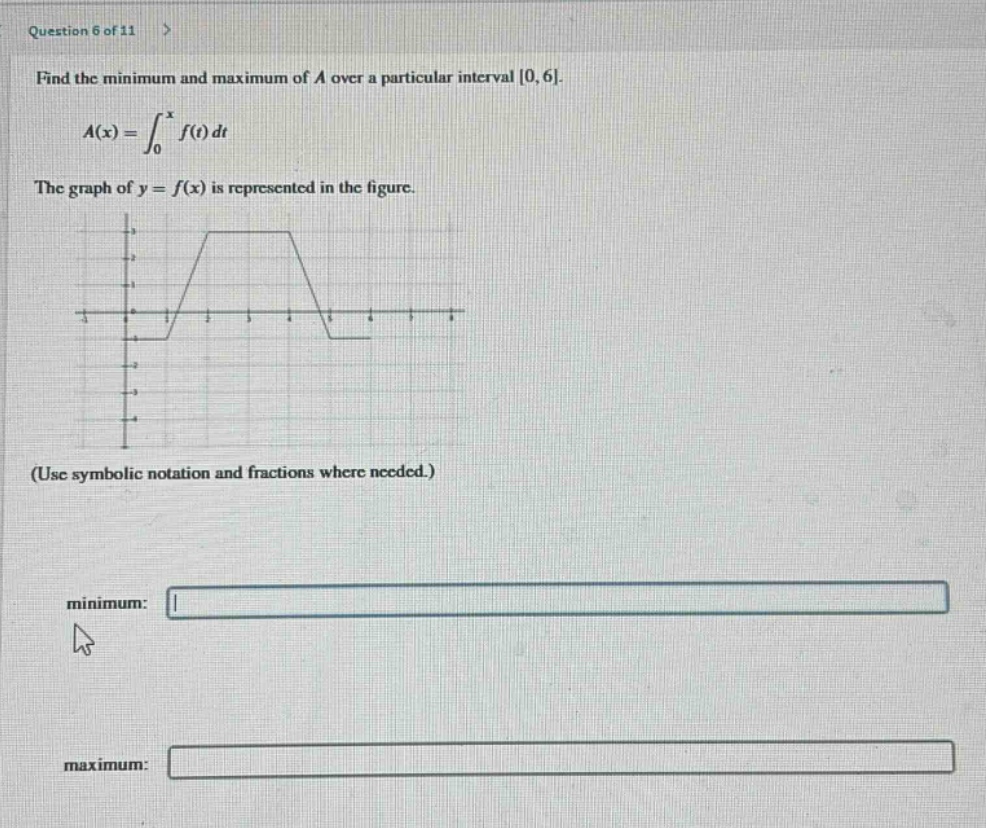
$A'(x)=f(x)$. Critical - points of $A(x)$ occur where $f(x) = 0$ or $f(x)$ is undefined. From the graph of $y = f(x)$, we look for where the sign of $f(x)$ changes.
Step2: Analyze the behavior of $A(x)$ based on $f(x)$
$A(x)$ is increasing when $f(x)>0$ and decreasing when $f(x)<0$. We calculate $A(x)$ at the endpoints $x = 0$ and $x = 6$ and at the points where $f(x)$ changes sign. $A(0)=\int_{0}^{0}f(t)dt = 0$. We need to calculate the net - area under the curve of $y = f(x)$ from $x = 0$ to different points. If we assume we can break the area under the curve of $y = f(x)$ into geometric shapes (rectangles and triangles) to calculate the definite integrals. Let's say the area above the $x$ - axis is positive and the area below the $x$ - axis is negative. As we move from $x = 0$ to the right, when $f(x)>0$, $A(x)$ is increasing and when $f(x)<0$, $A(x)$ is decreasing. If we calculate the net - area under the curve of $y = f(x)$ from $x = 0$ to $x = 6$ by splitting the region into sub - regions and finding the area of each sub - region (using area formulas for rectangles and triangles: $A_{rectangle}=bh$ and $A_{triangle}=\frac{1}{2}bh$). Suppose the area above the $x$ - axis in the interval $[0,6]$ is $S_1$ and the area below the $x$ - axis is $S_2$. The minimum of $A(x)$ on $[0,6]$ occurs either at $x = 0$ or at a point where $f(x)$ changes from negative to positive. Since $A(0) = 0$, and if there is a net negative area in some sub - interval, the minimum value of $A(x)$ is the net negative area calculated from $x = 0$ to the point of minimum. The maximum of $A(x)$ occurs at the point where the net positive area under the curve of $f(x)$ is the largest. This usually occurs at the end of the last sub - interval where $f(x)>0$ or at the right - hand endpoint $x = 6$ if the net area from $x = 0$ to $x = 6$ is positive. Without the actual values from the graph (such as base and height of geometric shapes formed by the curve $y = f(x)$ and the $x$ - axis), assume the net area under the curve of $y = f(x)$ from $x = 0$ to $x = 6$ is calculated as follows: Let's say by splitting the region under the curve of $y = f(x)$ into triangles and rectangles, we find that the minimum value of $A(x)$ occurs at a point where the net area is the most negative. If the net negative area from $x = 0$ to a certain point $x=a$ is $- 2$ (for example). The maximum value of $A(x)$ occurs at the right - hand endpoint $x = 6$ and the net area from $x = 0$ to $x = 6$ is $5$ (for example).
Answer:
minimum: $-2$ maximum: $5$
(Note: The actual values of minimum and maximum depend on the exact geometric shapes and their dimensions formed by the graph of $y = f(x)$ and the $x$ - axis in the interval $[0,6]$. The above values are just for illustration purposes.)