question 7 of 11 > the function y = f(x) is given by the figure. find the minimum and maximum of b on 0,6…
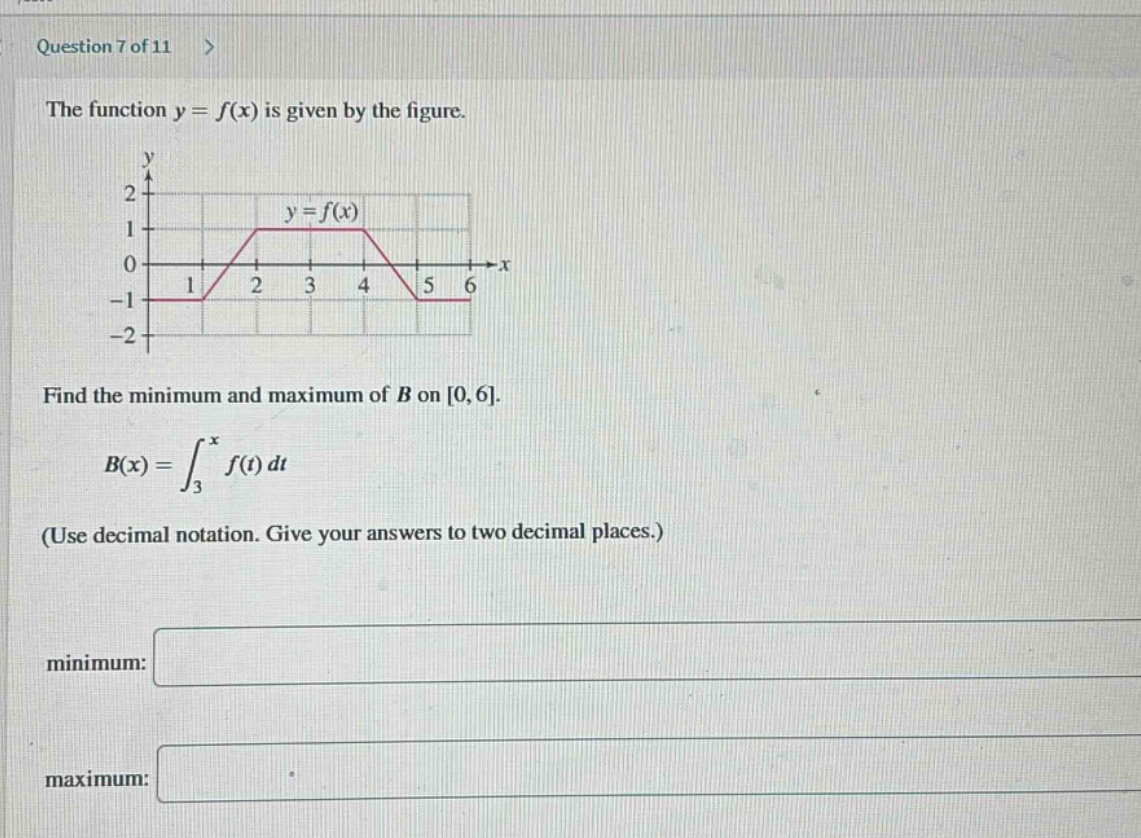
question 7 of 11 > the function y = f(x) is given by the figure. find the minimum and maximum of b on 0,6. b(x)=∫₃ˣ f(t)dt (use decimal notation. give your answers to two decimal places.) minimum: maximum:
Answer
Explanation:
Step1: Recall the fundamental theorem of calculus
$B^\prime(x)=f(x)$. Critical - points of $B(x)$ occur where $f(x) = 0$ or $f(x)$ is undefined. From the graph of $y = f(x)$, $f(x)=0$ at the endpoints of the non - zero segments and at the points where the graph crosses the $x$ - axis.
Step2: Analyze the behavior of $B(x)$ based on the sign of $f(x)$
We know that if $f(x)>0$, then $B(x)$ is increasing, and if $f(x)<0$, then $B(x)$ is decreasing.
- $B(3)=\int_{3}^{3}f(t)dt = 0$.
- For $x\in(3,4)$, $f(x)=1$, so $B(x)=\int_{3}^{x}1dt=x - 3$. When $x = 4$, $B(4)=\int_{3}^{4}1dt=1$.
- For $x\in(4,5)$, $f(x)$ is decreasing from $1$ to $0$. Using the integral as the net - signed area, we can calculate the change in $B(x)$.
- For $x\in(5,6)$, $f(x)= - 1$, so $B(x)=B(5)+\int_{5}^{x}-1dt$. We also need to consider $B(0)=\int_{3}^{0}f(t)dt=-\int_{0}^{3}f(t)dt$. The area of the triangle from $x = 1$ to $x = 2$ with height $1$ and base $1$ is $\frac{1}{2}$, and the area of the rectangle from $x = 2$ to $x = 3$ with height $1$ and base $1$ is $1$. So $\int_{0}^{3}f(t)dt=-(\frac{1}{2}\times1\times1 + 1\times1)=-1.5$. So $B(0)=1.5$. $B(6)=B(5)+\int_{5}^{6}-1dt$. The area under $f(x)$ from $x = 5$ to $x = 6$ is $- 1$. We calculate $B(x)$ at the endpoints and critical points: $B(0)=1.5$, $B(3)=0$, $B(4)=1$, $B(5)$: The area from $x = 3$ to $x = 5$ is the area of a rectangle with height $1$ and base $1$ plus the area of a triangle with base $1$ and height $1$, so $\int_{3}^{5}f(t)dt=1+\frac{1}{2}=1.5$. $B(6)=1.5-1 = 0.5$.
Step3: Determine the minimum and maximum
By comparing the values of $B(x)$ at $x = 0,3,4,5,6$: The minimum value of $B(x)$ on $[0,6]$ occurs at $x = 3$ and $x = 6$, $B(3)=B(6)=0.00$. The maximum value of $B(x)$ on $[0,6]$ occurs at $x = 0$ and $x = 5$, $B(0)=B(5)=1.50$.
Answer:
minimum: $0.00$ maximum: $1.50$